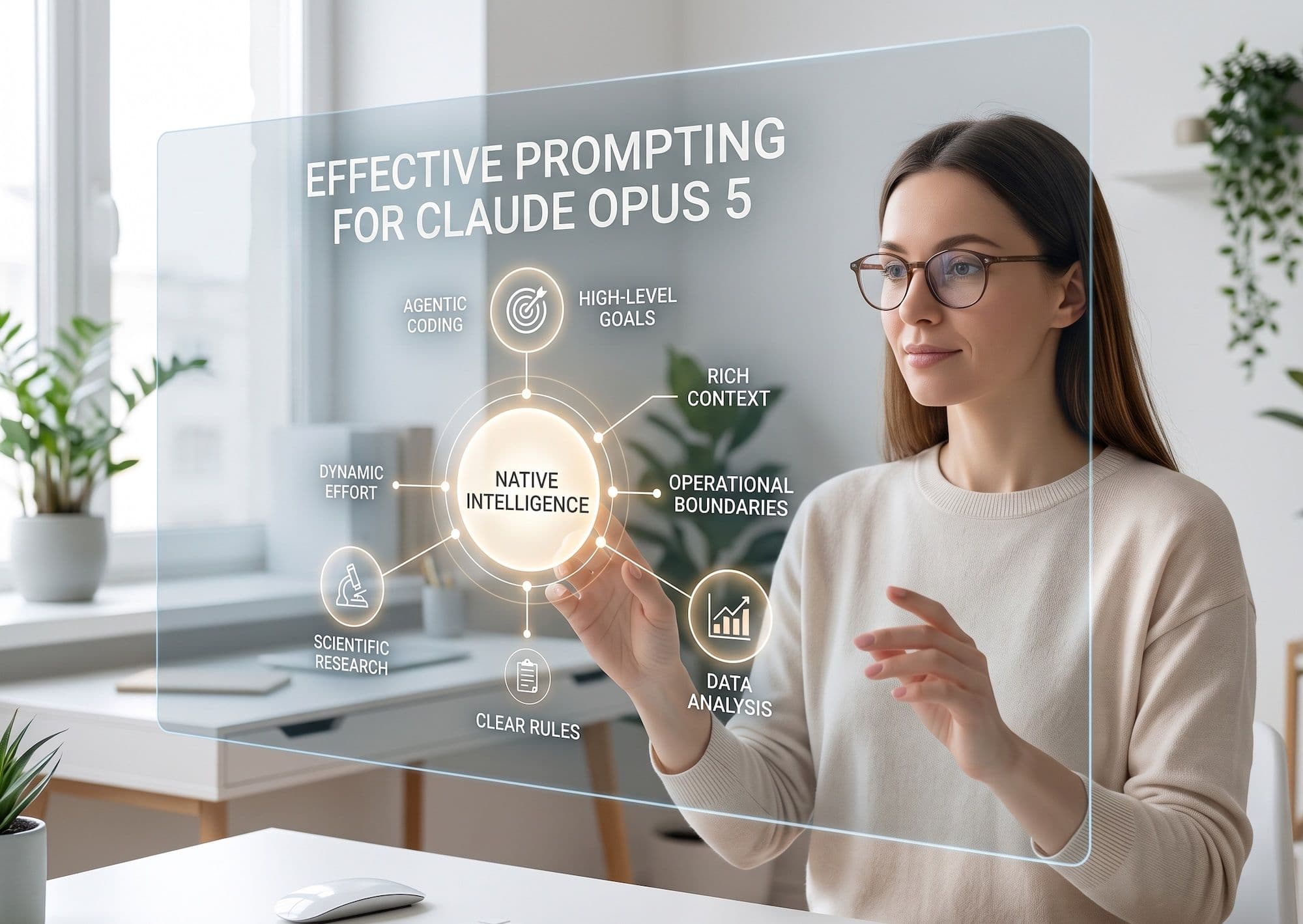
The launch of Claude Opus 5 marks a dramatic shift in how developers, enterprise architects, and AI engineers interact with frontier models. Engineered specifically for complex agentic workflows, long-horizon coding, scientific reasoning, and specialized enterprise intelligence, Opus 5 introduces groundbreaking capabilities—including a native 1-million-token context window, 128k max output tokens, mid-conversation tool modifications, and extended thinking enabled by default.
However, because Claude Opus 5 possesses an unprecedented level of native autonomy, self-correction, and tool delegation, legacy prompt engineering patterns built for earlier models (like Opus 4.8 or 4.6) will actually degrade performance on Opus 5.
If you copy-paste old prompts containing hand-written verification steps, aggressive re-checking prompts, or rigid chain-of-thought rules, you will inadvertently trigger token bloat, over-verification, and unnecessary subagent spawning.
In this comprehensive technical guide, we will unpack the official Anthropic prompt engineering strategies for Claude Opus 5. You will learn how to optimize system prompts, calibrate effort parameters, control agentic narration, manage subagent delegation, and harness the 1M context window for production applications.
1. Understanding the Claude Opus 5 Architecture
To write effective prompts for Claude Opus 5, you must first understand the architectural improvements and default behaviors that separate it from previous generations.
The "Thinking-First" Mindset Shift
On Claude Opus 5, extended thinking is activated by default. Rather than relying on simple pattern-matching, Opus 5 allocates test-time compute to reason through edge cases, review code structures, and evaluate potential errors before generating its visible output.
Because the model reasons natively, prescriptive prompt instructions that dictate step-by-step thinking actually constrain its intelligence. Opus 5 performs best when given a clear end-state goal, strict boundary constraints, and the freedom to organize its internal reasoning process.
2. Rule 1: Prune Verification and Re-Check Prompts
In previous AI models, developers frequently added defensive prompt instructions to prevent hallucinations:
- "Double-check your code for syntax errors before responding."
- "Perform a final verification step for any non-trivial math problem."
- "Re-read the document and confirm your conclusions."
The Problem on Opus 5: Over-Verification
Claude Opus 5 features advanced, native self-correction. When given explicit instructions to "re-verify" or "double-check," these instructions compound with the model's built-in verification loops.
This results in over-verification: Opus 5 will spawn extra internal steps, re-run tests multiple times, and execute unnecessary verification passes. This inflates token usage and increases latency by 30% to 50% with zero gain in accuracy.
The Fix: Let Native Verification Work
When migrating prompts to Claude Opus 5, strip out all manual verification directives.
<!-- ❌ BAD (Legacy Opus 4.8 Prompt) -->
<instructions>
  Analyze the codebase for memory leaks. Once you find a bug, write a fix.
  Before finalizing your output, double-check your code, run a mental static analysis,
  and re-verify that no new edge cases were introduced.
</instructions>

<!-- ✅ GOOD (Claude Opus 5 Optimized Prompt) -->
<instructions>
  Analyze the codebase for memory leaks and implement a permanent fix for any root causes identified.
</instructions>
Key Rule: If Opus 5 makes a minor, non-consequential slip during an intermediate step, it will automatically correct itself and proceed without cluttering the output. Do not prompt it to audit its own thinking.
3. Rule 2: Control Subagent Spawning and Delegation
One of the stand-out features of Claude Opus 5 is its ability to act as an agentic coordinator, delegating sub-tasks to . While subagent delegation pays massive dividends on large, parallelizable projects (like refactoring an entire 50-file repository), Opus 5 will delegate too readily if left unconstrained on minor tasks.
When Opus 5 spawns subagents for trivial scripts, execution times slow down and API costs multiply exponentially.
Prompting Strategy for Subagent Boundaries
To prevent subagent over-spawning, explicitly define the criteria for delegation in your system prompt.
<subagent_delegation_rules>
  - Perform routine tasks, single-file edits, and immediate lookups yourself.
  - Spawn a subagent ONLY for wide, multi-file investigations or independent tasks that can run in parallel.
  - Never spawn a subagent solely to verify, review, or double-check work you have already completed.
  - Limit maximum simultaneous subagent spawns to 2 unless explicitly instructed otherwise.
</subagent_delegation_rules>
4. Rule 3: Calibrate User-Facing Narration and Verbosity
In agentic coding sessions and multi-turn workflows, Claude Opus 5 has a natural tendency to narrate its actions. By default, it will announce what tool it is about to use, explain intermediate findings, and summarize every step taken.
For automated background pipelines or clean conversational UI products, this chatty narration creates visual clutter and wastes output tokens.
Steering Communication Style
To control verbosity, Anthropic recommends using positive framing (telling the model how to communicate) rather than negative prompting ("do not talk").
System Prompt Template for Concise Agentic Narration:
<communication_style>
  - Lead with the final outcome: your first sentence must directly answer "what happened" or "what was found."
  - Before invoking a tool, state your immediate intent in a single, concise sentence.
  - Provide intermediate progress updates ONLY if you discover a critical blocker or change execution direction.
  - Keep disclaimers, caveats, and introductory summaries brief. Omit redundant concluding boilerplate.
</communication_style>
Example Output Comparison:
- Unoptimized Output: "I am now going to examine the
auth.tsfile to see how JWT tokens are validated. Upon opening the file, I noticed that line 42 lacks expiration checking. I will now openconfig.tsto check the secret key... [300 words of filler]... In conclusion, I have successfully updated the files." - Optimized Output (with prompt above): "Fixed JWT token validation in
auth.tsby enforcing strict expiration checks againstconfig.ts."
5. Rule 4: Harnessing the 1M Context Window and Advanced Vision
Claude Opus 5 defaults to a 1-million-token context window. Unlike legacy models that experienced "context fatigue" or lost recall in the middle of long prompts, Opus 5 maintains razor-sharp instruction following, tool calling, and needle-in-a-haystack retrieval across the entire 1M window.
Advanced Vision without Workarounds
Opus 5 sets a new benchmark for visual understanding, excelling at:
- Parsing dense financial charts, scientific diagrams, and organic chemistry spectroscopy.
- Replicating complex UI/UX layouts directly into clean /Tailwind code.
- Extracting geometric metrics from raw engineering schematics.
In earlier models, developers used complex prompt workarounds—such as instructing the model to describe an image in text before writing code, or slicing images into grids manually. On Opus 5, these workarounds are obsolete.
<!-- ✅ Optimal Vision Prompting in Opus 5 -->
<task>
  Examine the attached UI wireframe mockup <image_1>.
  Replicate this interface precisely as a responsive Next.js component using Tailwind CSS.
  Use visual crop tools to inspect typography alignment and icon padding if needed.
</task>
Pro-Tip: Opus 5 performs visual tasks best when given access to visual editing tools (like crop, zoom, and dynamic preview) rather than relying solely on high effort settings. Tool-assisted visual iteration is significantly cheaper and more accurate than raw test-time compute.
6. Rule 5: Calibrating Effort Settings vs. Disabling Thinking
Claude Opus 5 introduces granular effort parameters that allow developers to scale test-time compute up or down depending on task complexity.
// Example API Payload for Claude Opus 5
{
  "model": "claude-opus-5",
  "max_tokens": 8192,
  "effort": "concise", // Options: minimal, concise, standard, comprehensive
  "messages": [
    {"role": "user", "content": "Refactor the database connection pool in db.ts."}
  ]
}
Understanding Effort Levels:
- Minimal: Emits 1–2 sentences. Ideal for quick classification, routing, or simple yes/no checks.
- Concise: A single focused paragraph. Perfect for brief summaries or targeted bug fixes.
- Standard: Balanced reasoning and structured output. The default for general development work.
- Comprehensive / Max: Maximum extended thinking compute. Required for novel architectural design, complex math (ARC-AGI tasks), or multi-repo refactoring.
The Dangers of Disabling Thinking Completely
On Claude Opus 5, extended thinking is on by default. While thinking can be disabled (at effort settings of high or below), Anthropic strongly advises keeping thinking enabled.
When thinking is completely disabled, the model can occasionally emit internal XML tags (such as <thinking> or <search_quality_score>) directly into its visible response. To reduce token usage without risking tag leakage, simply lower the effort setting to minimal or concise rather than disabling thinking entirely.
7. Agentic Coding & Enterprise Document Workflows
Claude Opus 5 represents a monumental leap in automated , scoring state-of-the-art results on benchmarks like Frontier-Bench v0.1 and CursorBench 3.2.
Unlike previous models that generated incomplete code stubs, placeholder comments (// TODO: implement later), or surface-level bug patches, Opus 5 builds end-to-end features, constructs its own unit test harnesses, and addresses deep root causes.
Prompting for Enterprise Software Engineering
When prompting Opus 5 for complex coding tasks, follow these three golden rules:
- Provide the Full Specification Upfront: Give Opus 5 the complete requirements, database schemas, and API contracts at the start. Do not feed instructions piecemeal in a multi-turn chat.
- Encourage Test Harness Construction: Tell the model to build an isolated test suite to validate its own code before reporting completion.
- Avoid Hand-Holding: Do not prescribe specific functions or line-by-line implementations unless strictly required. State the problem and let the model's extended thinking architecture engineer the optimal solution.
System Prompt Template for Production Agentic Coding:
<system_prompt>
  <role>You are a Principal Software Architect specializing in full-stack TypeScript and PostgreSQL systems.</role>

  <execution_guidelines>
    - Analyze the complete specification before writing code.
    - Write clean, production-ready code with zero stubs, placeholders, or missing imports.
    - If a bug is encountered, identify and resolve the underlying architectural cause rather than patching surface symptoms.
    - Construct a lightweight test script to validate your implementation against edge cases.
    - Lead your final response with a 1-sentence summary of the changes made, followed by clean diffs.
  </execution_guidelines>
</system_prompt>
Complex Document & Office Automation (Excel & Slides)
Opus 5 natively generates multi-sheet Excel workbooks with non-trivial formulas (VLOOKUP, INDEX/MATCH, nested financial models) and structured PowerPoint slide decks. When prompting for enterprise deliverables:
- Provide explicit layout templates or style guidelines in XML tags.
- Instruct the model to populate realistic, mathematically accurate data rather than generic placeholder text.
8. Migration Blueprint: Upgrading Prompts from Opus 4.8 to Opus 5
If you are migrating an existing production codebase or API integration from Claude Opus 4.8 to Claude Opus 5, follow this step-by-step checklist:
[ Migration Audit Checklist ]
  │
  ├── 1. Remove Manual Verification Rules
  │    └── Strip "double-check", "verify your logic", and "re-examine" prompts.
  │
  ├── 2. Constrain Subagent Spawning
  │    └── Add explicit boundaries on when subagents may be initialized.
  │
  ├── 3. Enforce Narration Rules
  │    └── Set clear guidelines for progress updates in multi-turn sessions.
  │
  ├── 4. Remove Vision Workarounds
  │    └── Pass raw images directly without text-description pre-processing.
  │
  ├── 5. Tune Effort Settings
  │    └── Use effort: "concise" for simple API endpoints instead of disabling thinking.
  │
  └── 6. Leverage Beta Headers
       └── Add mid-conversation-tool-changes-2026-07-01 to dynamically manage tools.
Frequently Asked Questions (FAQs)
Why is my Claude Opus 5 API response taking longer than Opus 4.8?
Opus 5 has "Extended Thinking" enabled by default. If your prompt is ambiguous or asks broad, unconstrained questions, the model will allocate significant test-time compute to reason through every possible interpretation. To speed up responses, make your prompt direct and specific, or lower the API effort parameter to concise or minimal.
Should I use Chain-of-Thought (CoT) XML tags (<thinking>) in my prompts for Opus 5?
No. Do not manually write <thinking> tags or instruct the model to "use thinking tags." Claude Opus 5 manages its internal thinking blocks automatically. Explicitly referencing internal tag names in your prompt reduces prompting efficacy and can confuse the model's native output parsing.
What is the minimum prompt caching threshold for Claude Opus 5?
Anthropic reduced the minimum cacheable prompt threshold on Claude Opus 5 to 512 tokens (down from 1,024 tokens on Opus 4.8). This means even shorter system prompts, tool definitions, and conversation histories will automatically benefit from prompt caching, drastically reducing cost and latency for API applications.
How does mid-conversation tool changing work in Opus 5?
By passing the mid-conversation-tool-changes-2026-07-01 beta header in your API requests, you can dynamically add or remove tools between turns in a multi-turn conversation without invalidating the existing prompt cache. This allows you to give an agent light lookup tools during an initial search phase, and swap in heavy execution tools only when needed.
Why is Claude Opus 5 spawning too many subagents during my coding workflows?
Opus 5 delegates to subagents aggressively when faced with open-ended tasks. If you do not set explicit boundaries, it may spawn subagents for minor single-file edits or simple checks. To fix this, add clear delegation rules in your system prompt instructing the model to spawn subagents only for large, parallelizable, multi-file tasks.
Summary
Prompting Claude Opus 5 effectively requires stepping back and letting the model's native intelligence work for you. By eliminating redundant verification instructions, setting clear rules for subagent spawning, managing user-facing narration, and leveraging dynamic effort parameters, you can unlock unprecedented accuracy across agentic coding, scientific research, and enterprise data analysis.
Rather than micromanaging the model with step-by-step hand-holding, provide clear end-state goals, rich context within the 1M token window, and the operational boundaries required for clean, cost-effective execution.