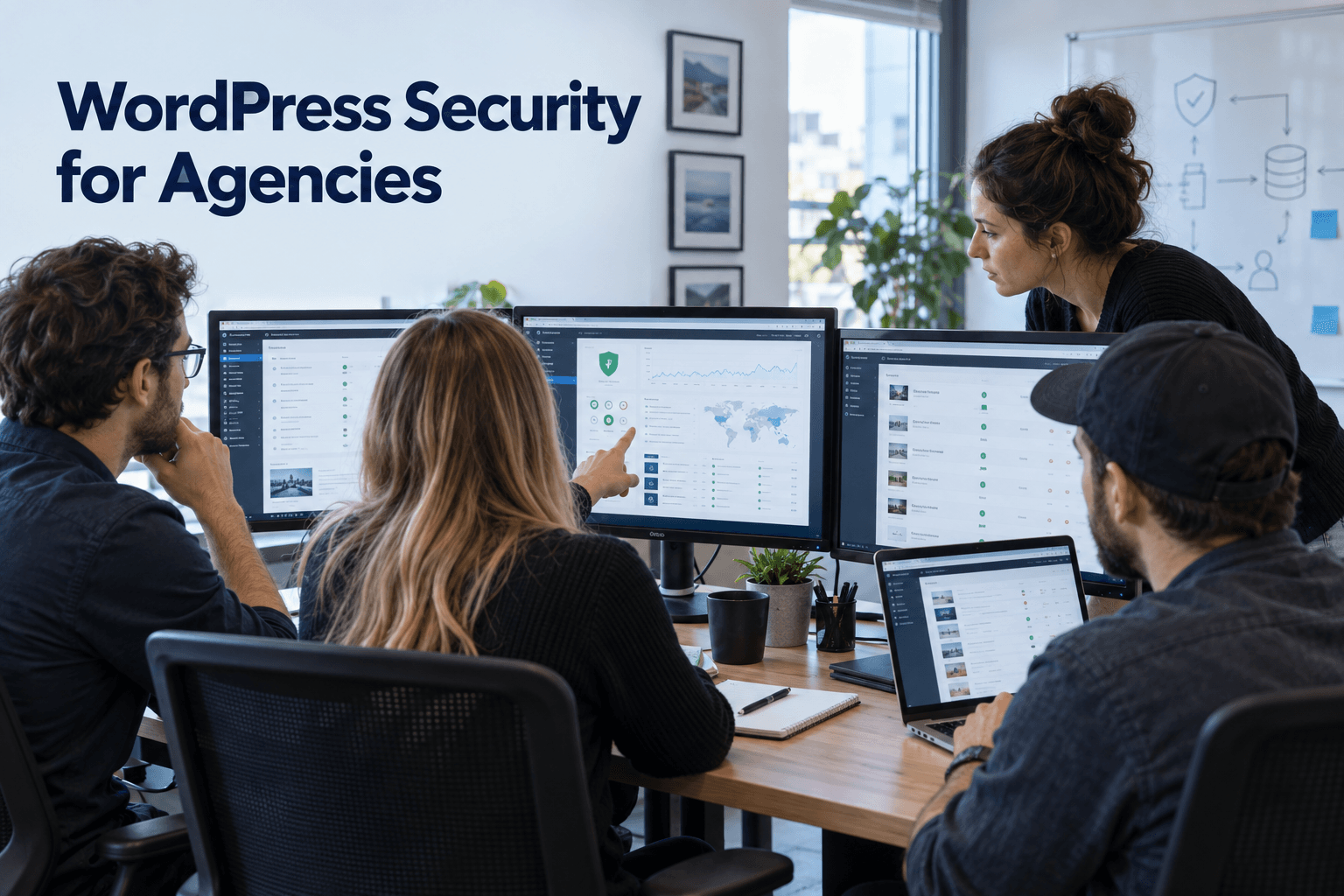
An agency rarely manages one WordPress site in isolation. It manages a portfolio of different hosts, plugins, owners, budgets and risk levels. Without a shared operating model, every urgent update becomes an improvised project and every incident begins with the same question: who has access to what?
A scalable agency security program turns those unknowns into repeatable controls. It standardizes the minimum protection for every client, adds stronger safeguards for high-risk sites and creates evidence that work was completed.
1. Build a living client-site inventory
Record the primary domain, hosting account, DNS provider, WordPress version, key plugins, technical owner, business owner, maintenance tier and recovery contacts. Include renewal dates and note whether the site stores customer, payment, health or membership data. An inventory should make prioritization possible, not merely list URLs.
Map the baseline against a repeatable WordPress security audit checklist and assign every failed control to an owner and due date.
2. Separate agency access from client access
Give each staff member an individual account and grant only the permissions required for their work. Do not reuse one administrator login across every client. Use a password manager, MFA and an offboarding checklist that removes WordPress, hosting, DNS, analytics, email and repository access.
Review privileged accounts using the process in how to find and remove rogue WordPress administrators. Agency turnover and old contractor access are common reasons unnecessary accounts survive.
3. Treat central management as high-value infrastructure
A dashboard that can update dozens of websites is convenient and highly privileged. Protect its administrator accounts with MFA, restrict who can add sites, review activity logs and keep the management platform updated. If an agent plugin is compromised, understand its reach and have a way to disconnect or rotate credentials quickly.
- Use named accounts and least privilege in the management dashboard.
- Segment client sites into groups based on risk and maintenance tier.
- Alert on new site connections, bulk logins and bulk plugin changes.
- Document how to operate if the central dashboard is unavailable.
4. Use staged update rings
Do not treat every site as an identical batch. Start with internal or low-risk sites, observe results, then move through client groups. For important sites, test core, plugin and theme changes on staging with representative forms, logins, checkout and integrations. Emergency security patches may justify faster deployment, but they still need backups and smoke tests.
Adopt the practical checks in our to reduce the tension between patch speed and service reliability.
5. Define a recovery standard
Every maintenance tier should specify backup frequency, retention, storage separation and target recovery time. Confirm that the agency can restore without depending on the compromised site or a single employee’s account. Test representative restores and record the result.
Use the to turn successful backup notifications into verified recovery capability.
6. Centralize monitoring without creating alert noise
Track uptime, malware signals, file changes, vulnerable components, failed backups and privileged logins. Route each alert by severity, client and responsible team. An unowned inbox with thousands of warnings is not monitoring. Define response targets and close alerts with notes that another technician can understand.
Our explains how to choose actionable events and preserve enough context for investigation.
7. Agree on incident roles before an incident
Contracts and onboarding documents should explain who authorizes emergency work, who contacts the host, who communicates with customers and what is included in the maintenance plan. Keep a secure contact path that does not depend on the compromised website or mailbox.
Use a shared and rehearse the first-hour decisions with account managers, developers and leadership.
A minimum agency security standard
- Complete inventory and named owners for every managed site.
- Individual accounts, password manager use and MFA for privileged access.
- Risk-based maintenance tiers and staged updates.
- Off-site backups with recorded restore tests.
- Central alerts with severity, ownership and response targets.
- Written incident authority, communication and evidence procedures.
Final takeaway
Agency security succeeds when safe behavior is the default workflow. A clear inventory, isolated access, controlled updates, tested recovery and owned alerts make protection consistent across dozens of different client environments. Start with the highest-risk sites, then apply the same measurable baseline to the rest of the portfolio.
Frequently asked questions
Should an agency use one administrator account for all staff?
No. Individual named accounts provide accountability and make offboarding safer. Grant temporary elevated access when needed instead of sharing a permanent administrator login.
Is a central WordPress management dashboard safe?
It can be, but it is high-value infrastructure. Protect it with MFA, least privilege, activity logging, prompt updates and a documented method for disconnecting sites or rotating credentials.
How should agencies prioritize WordPress updates?
Prioritize actively exploited or high-severity vulnerabilities, then deploy through risk-based update rings with backups and focused smoke tests for critical workflows.
What should a WordPress maintenance report include?
Include updates applied, security alerts reviewed, backup and restore status, uptime, unresolved risks, actions taken and decisions required from the client.