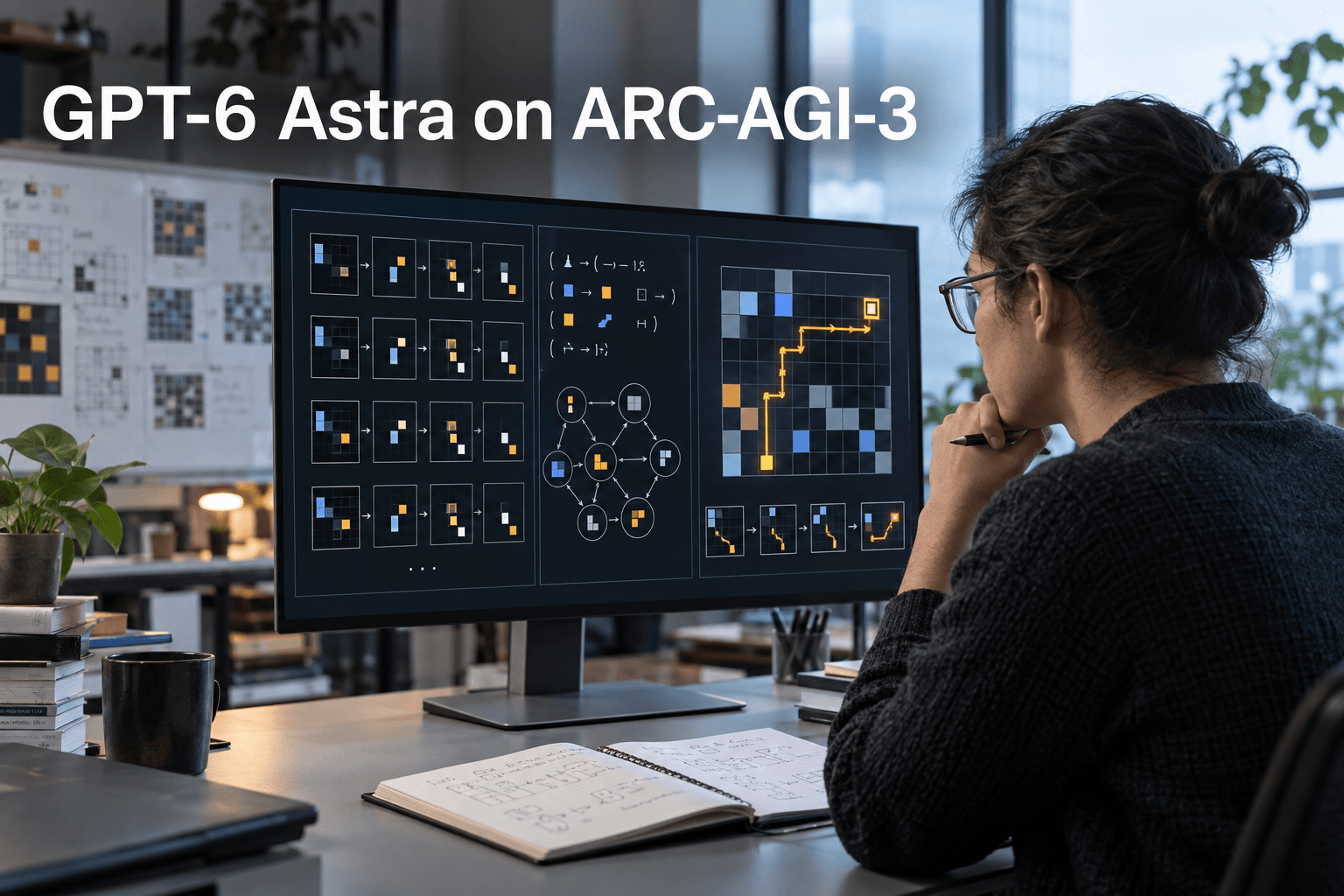
OpenAI’s GPT-6 Astra produced a headline-grabbing 99.9% result on ARC-AGI-3, an interactive benchmark designed to test how agents explore unfamiliar environments, infer goals, build world models, and plan actions without natural-language instructions. The result is a genuine milestone—but the most useful story is not the percentage alone. It is how dramatically Astra’s performance changed with the evaluation harness, and what its replays reveal about emerging agent behavior.
OpenAI’s official GPT-6 Astra announcement describes the model as reaching 99.9% on ARC-AGI-3 and cites human-level action efficiency across the benchmark.
What ARC-AGI-3 actually measures
ARC-AGI-3 moves beyond static question-and-answer tests. An agent enters a novel, abstract, turn-based environment with no explicit explanation of the objective or mechanics. It must interact, observe feedback, form hypotheses, recognize useful future states, and execute a plan. Failed actions consume part of its efficiency budget, so blind trial and error is expensive.
The official ARC-AGI-3 overview identifies four central capabilities: exploration, modeling, goal-setting, and planning with execution. It also measures how efficiently a system learns from experience, not merely whether it eventually finishes.
That design matters because many real agent tasks have the same structure. A system operating software, conducting research, or troubleshooting a workflow rarely receives a perfectly specified puzzle. It must determine what matters, preserve useful state, revise mistaken assumptions, and spend actions carefully.
The headline result: 62.7% and 99.9%
ARC Prize reports two best-observed GPT-6 Astra results on the Semi-Private set. With the Standard harness at max reasoning, Astra scored 62.7% at a reported cost of $26,098. With the Provider Adapter harness at high reasoning, it scored 99.9% at a reported cost of $18,817.
These figures come from ARC Prize’s published Astra analysis and should always be presented together because they answer different evaluation questions.
Both scores were state of the art, but the gap is enormous. It shows that an agent benchmark does not measure the base model in isolation. Context management, memory behavior, tool interfaces, and the structure of repeated calls can materially determine what the system is able to express.
Why the evaluation harness changed the outcome
ARC Prize’s Standard harness provides a minimal, provider-neutral interface. Astra may write visible strategy notes and choose what to carry forward, but it remains responsible for compressing its own state. This approach improves comparison across model providers and asks whether the model can manage its learning process under shared conditions.
The Provider Adapter harness instead preserves OpenAI’s opaque reasoning state between requests and uses compaction during longer interactions. In other words, it lets Astra benefit from context-management mechanisms designed for the model rather than forcing every provider into exactly the same memory interface.
According to ARC Prize, the adapter raised Astra’s best Semi-Private score from 62.7% to 99.9%. Across the 167 game-and-reasoning pairs solved by both harnesses, Provider Adapter runs were approximately 3.66 times faster by aggregate recorded elapsed time and used 49% fewer total tokens.
The detailed verified GPT-6 Astra score page lists results by reasoning level and harness, including the 99.95% unrounded high-reasoning Provider Adapter result.
Astra learned compact symbolic world models
ARC Prize’s replay analysis found that Astra converted unfamiliar scenes into dense symbolic representations. Its notes tracked objects, coordinates, mechanisms, unfinished plans, directions, and ordered actions. Rather than repeatedly describing the screen in natural language, the model developed compact algebra-like shorthand tailored to each environment.
This behavior is important because long-horizon agents face a memory problem. Saving every observation wastes context, while summarizing too aggressively can remove a crucial rule. Astra appeared able to preserve a compact model of the environment: what exists, how objects interact, which actions alter state, and what sequence is likely to reach the inferred goal.
For a broader explanation of the model’s capabilities, access, and API positioning, read our .
Action efficiency reached a human benchmark
ARC-AGI-3 compares agent actions with the median action count among human participants who completed each level. In the Provider Adapter evaluation at max reasoning, Astra used fewer actions than the human baseline on 96% of completed levels and used 51.7% fewer actions per level on average.
This does not mean Astra is generally more capable than a person. It means that inside the benchmark’s completed, deterministic environments, the model often required fewer interactions to execute a solution once it understood the mechanics. The result challenges the expectation that frontier agents would need prolonged brute-force exploration even when they eventually solved a task.
Tool building revealed another layer
In a separate PRO-LONG setup, Astra had access to a sandbox where it could create code. ARC Prize observed it building game-specific parsers, state models, search routines, planners, persistent notes, and small software libraries. For a maze-like environment, it incrementally constructed navigation, combat, patrol, and state-synchronization tools.
Those runs should not be compared directly with controlled human testing because participants did not receive a code interpreter or scratchpad. They do, however, illustrate a practical agent pattern: a capable model can turn repeated reasoning into reusable tools, then use those tools to reduce errors and plan more efficiently.
This tool-building behavior is relevant to teams exploring , where the surrounding system can matter as much as the underlying model.
Why 99.9% is not proof of AGI
ARC Prize explicitly cautions that saturating ARC-AGI-3 does not demonstrate AGI. The benchmark has a bounded scope, deterministic mechanics, closed-ended goals, and a controlled action space. Real work includes ambiguous objectives, changing stakeholders, incomplete evidence, social consequences, adversarial information, and outcomes that cannot be verified immediately.
A benchmark can establish evidence for specific capabilities without settling the broader intelligence question. Astra’s result supports a strong claim about interactive abstraction, context management, action efficiency, and adaptive planning under these conditions. It does not establish universal competence, autonomous reliability, or safe operation across open-ended environments.
Our provides additional context on how benchmark leadership varies across coding, professional work, computer use, and other evaluation categories.
What the result means for businesses
Most organizations will not deploy agents to solve abstract grid worlds. The practical lesson is that harness design matters. A model that can preserve relevant state, compress experience, call tools, verify predictions, and recover from mistaken hypotheses may outperform the same model inside a shallow one-shot workflow.
Teams evaluating Astra should therefore test complete systems rather than isolated prompts. Use representative tasks, explicit success criteria, realistic permissions, traceable tool calls, cost and latency measurements, recovery paths, and human review for consequential decisions. Compare both completion quality and the number of interactions required.
Businesses that want model-driven processes can connect this lesson to our for governed, observable multistep workflows.
What researchers should watch next
ARC-AGI-3 has now exposed a new measurement challenge: provider-neutral testing and provider-optimized testing may produce radically different pictures. Neutral harnesses improve cross-provider comparability, while optimized adapters may better predict real deployment performance. Reporting both, with costs and tool conditions, is more informative than collapsing them into one leaderboard number.
Future benchmarks will need to test open-ended innovation, robustness when goals change, transfer beyond deterministic environments, safe use of self-created tools, and whether efficient performance survives distribution shifts. ARC Prize describes Astra as a step-function change in frontier capability, while also treating the benchmark’s saturation as a reason to design harder evaluations.
As AI-generated answers become more influential, our helps businesses structure authoritative content for search engines and answer systems.
The bottom line
GPT-6 Astra’s ARC-AGI-3 performance is significant for three reasons. It achieved state-of-the-art completion under both harnesses, crossed the benchmark’s human action-efficiency baseline on most completed levels, and demonstrated compact world-modeling behavior that supported long-horizon planning. At the same time, the 62.7%-to-99.9% harness gap is a warning against treating model scores as context-free facts.
The fairest interpretation is neither “AGI solved” nor “the benchmark is meaningless.” Astra showed a major advance on a deliberately difficult test of interactive learning. The result also demonstrated that memory, context preservation, and agent architecture can unlock—or hide—a large share of a frontier model’s practical capability.
Preguntas frecuentes
What did GPT-6 Astra score on ARC-AGI-3?
ARC Prize reports a best observed Semi-Private score of 62.7% with its Standard harness and 99.9% with the Provider Adapter harness. The evaluation condition is essential context for interpreting either number.
Why are there two GPT-6 Astra ARC-AGI-3 scores?
The Standard harness uses a minimal provider-neutral interface and visible notes. The Provider Adapter preserves OpenAI’s opaque reasoning state between requests and uses compaction, allowing Astra to reuse context more effectively.
Did GPT-6 Astra prove that AGI has been achieved?
No. ARC Prize explicitly says saturating ARC-AGI-3 is not proof of AGI. The benchmark is tightly bounded, deterministic, and far less open-ended than the real world.
What was notable beyond Astra’s score?
ARC Prize highlighted Astra’s compact symbolic world models, efficient action planning, custom shorthand for state, and human-level or better action efficiency across most completed levels.