WordPress malware removal can cost a few hundred dollars for a contained infection or several thousand for a compromised store, multisite network, or server with repeated reinfection. The responsible way to price cleanup is to assess the infection, access, business impact, backups, and entry point before quoting—not to sell the same scanner run for every incident.
This guide explains the factors that affect WordPress malware removal cost in 2026, practical budgeting bands, realistic timelines, and the deliverables a professional cleanup should include. The ranges below are planning guidance in US dollars, not a Premier Solutions quote.
If your site is redirecting visitors, showing a browser warning, or creating unknown administrators, start with our emergency recovery checklist while access is preserved and the incident is triaged.
Typical WordPress Malware Removal Cost in 2026
Pricing varies by provider, region, site size, hosting access, and infection depth. For planning purposes, incidents often fall into these broad bands:
- Contained brochure-site infection: approximately $300–$700. This may cover a small site with accessible hosting, a limited number of malicious files, a clean recent backup, and no active reinfection.
- Compromised business website: approximately $700–$1,500. This may involve injected database content, rogue administrators, redirect malware, multiple plugins, SEO spam, or a need to trace the entry point.
- WooCommerce, membership, or complex application: approximately $1,500–$3,500+. Transactional data, customer accounts, integrations, custom code, larger databases, and the need to minimize downtime add investigation and testing work.
- Multisite, multiple domains, or server-level compromise: individually scoped. When several installations share an account, cleaning one site without investigating the others commonly leads to reinfection.
A low price is not automatically a bargain, and a high price is not proof of quality. Compare the evidence collected, the scope of cleanup, the hardening work, the retest, and the response terms.
What Determines the Final Cleanup Price?
1. Number of Compromised Sites and Environments
One installation on isolated hosting is different from ten WordPress sites sharing the same account. If a sibling site or server user remains infected, a cleaned site can be compromised again. A proper scope identifies every connected environment.
2. Infection Depth
A malicious file in one plugin directory may be faster to address than persistent backdoors spread through PHP files, scheduled tasks, database options, uploads, administrator accounts, and server configuration. Database contamination and obfuscated code increase the forensic workload.
3. Type of Malware
Spam-page injections, conditional redirects, credential stealers, payment skimmers, malicious cron jobs, phishing pages, and hidden administrator creation behave differently. Cleanup must remove both the visible payload and the mechanism that restores it.
4. Availability of a Known-Clean Backup
A verified backup can shorten recovery, but only if it predates the intrusion and the vulnerable entry point is closed before the site returns to production. Restoring an infected or still-vulnerable backup simply resets the incident clock.
5. Hosting and Access Constraints
Access to hosting logs, file systems, databases, DNS, CDN, email, and backups affects how quickly the incident can be investigated. Suspended accounts, slow hosting support, or missing ownership credentials can add time even when the malware itself is understood.
6. Downtime and Business Risk
A store processing orders requires a different containment and testing plan from a brochure site. Urgent after-hours response, payment risk, customer communications, and evidence preservation can increase the required effort.
7. SEO Spam and Search Warnings
Japanese keyword spam, doorway pages, malicious sitemaps, and hacked-site warnings require more than file cleanup. The engagement may also include removing generated URLs, repairing internal signals, validating the site in Search Console, and submitting a review request.
8. Reinfection and Entry-Point Analysis
Deleting visible malware without identifying the entry point is the main reason cheap cleanups fail. The provider should determine whether the attacker used an outdated plugin, stolen credential, insecure hosting account, vulnerable custom code, or another connected site.
What Should Professional Malware Removal Include?
- Initial triage and containment plan, including whether the site should remain online, enter maintenance mode, or be isolated.
- A protected copy of the infected files and database for investigation and rollback.
- Review of WordPress users, hosting users, database users, scheduled tasks, files, uploads, configuration, and relevant logs.
- Removal of malicious files, injected code, spam content, rogue accounts, backdoors, and persistence mechanisms.
- Replacement of altered WordPress core and trusted plugin or theme files from clean sources where appropriate.
- Credential rotation and review of administrator access, hosting, database, SFTP, email, API, DNS, and CDN accounts.
- Patching or replacing the vulnerable component and applying suitable hardening controls.
- Functional testing of forms, login, checkout, search, scheduled jobs, APIs, and other critical workflows.
- Post-cleanup malware scan and manual verification rather than relying on one automated scanner.
- Documentation of what was found, what changed, remaining risks, and recommended monitoring.
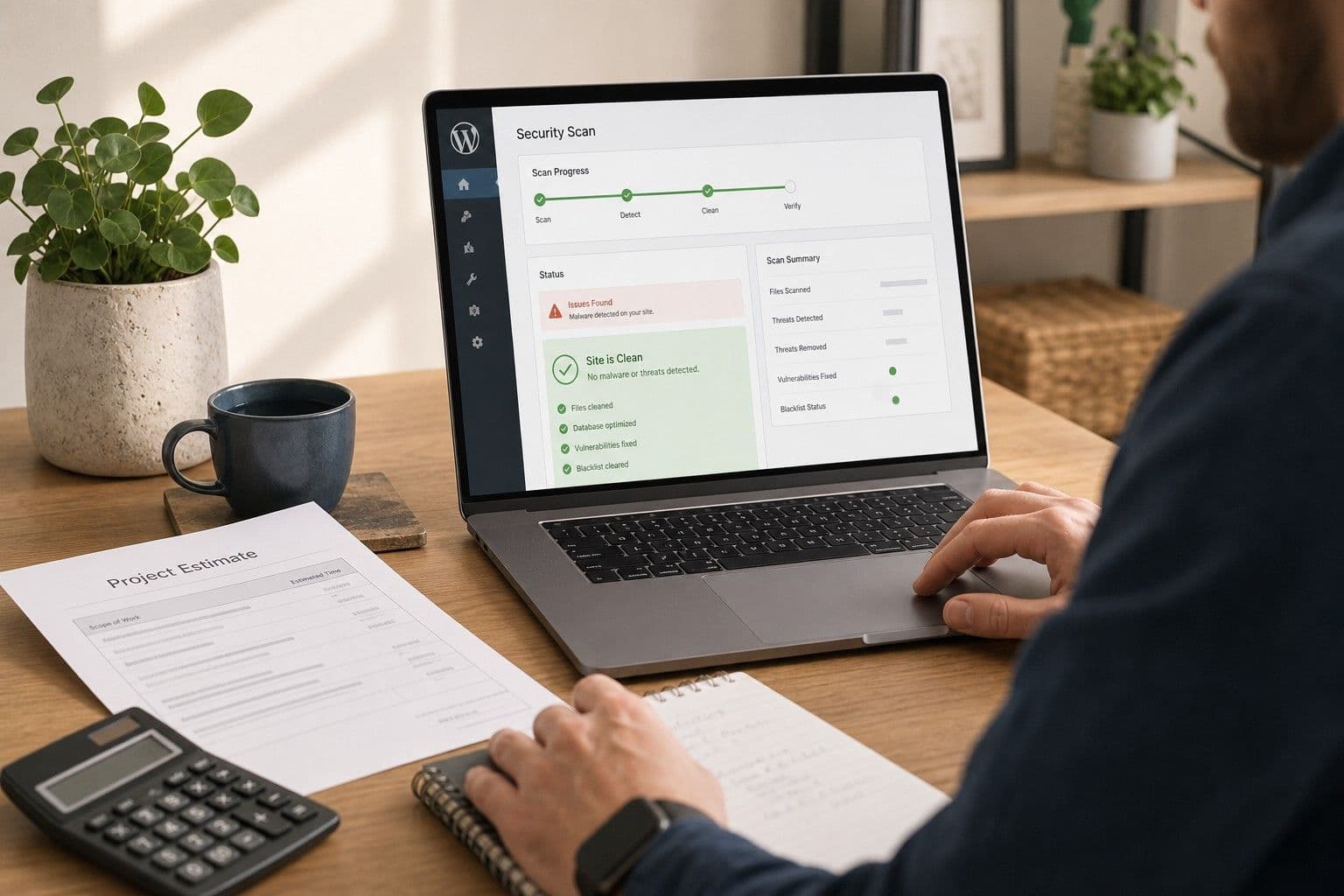
Our shows why a complete recovery may include spam removal, rogue-account cleanup, clean-file restoration, and post-incident hardening rather than a single scan.
How Long Does WordPress Malware Removal Take?
A contained infection with immediate access may be resolved within the same working day. A complex compromise can take one to several days, particularly when databases, multiple sites, suspended hosting, external review processes, or business-critical testing are involved.
The initial response and the final recovery are different milestones. A provider may quickly contain malicious traffic while investigation, cleanup, testing, and search-warning review continue. Ask for the expected response window, the next update time, and the conditions required before the site is declared clean.
Cheap Scanner Cleanup vs Professional Incident Recovery
Automated scanners are useful for finding known signatures and unexpected file changes, but they have limitations. They can miss database-only payloads, new obfuscation, stolen administrator sessions, malicious server jobs, compromised sibling sites, and the business logic needed to test a store or membership platform.
A responsible specialist uses automated tools as part of a wider process: preserve evidence, review access, compare clean sources, investigate persistence, remove malicious content, close the entry point, test the application, and monitor for recurrence.
Questions to Ask Before Hiring a Malware-Removal Provider
- Will you preserve an infected copy before making changes?
- Does the quote include database, file, user, scheduled-task, and access review?
- Will you identify and close the likely entry point?
- Are credential rotation and post-cleanup hardening included?
- How will you test forms, checkout, login, integrations, and scheduled jobs?
- Will you provide a written summary of findings and changes?
- What is included if the same confirmed entry point causes reinfection?
- Does the price include Search Console review support when a warning exists?
Costs That May Be Separate from Cleanup
Confirm whether the estimate includes premium plugin renewals, new hosting, CDN or firewall subscriptions, custom-code repairs, lost-data reconstruction, ongoing monitoring, legal advice, customer notification, payment-provider investigation, or SEO remediation. These may be necessary but should be identified separately from the core cleanup.
After recovery, ongoing exposure is reduced through tested updates, backups, access review, and monitoring. Compare our with the preventive controls in our .
When Should You Treat the Incident as an Emergency?
Seek urgent help when visitors are redirected, browsers show malware warnings, checkout behavior changes, unknown administrators appear, customer information may be exposed, the host suspends the account, or malicious pages are rapidly entering search results.
If you are not sure whether the site is compromised, review the . Do not send passwords through ordinary email or chat; use the secure access process agreed with the recovery provider.
Preguntas frecuentes
How much does it cost to remove malware from WordPress?
A contained small-site infection may fall in a lower budgeting band, while business, WooCommerce, multisite, and server-level incidents require more investigation and testing. A reliable provider should assess the site before issuing a fixed quote.
Why are some WordPress malware-removal services so cheap?
Low-cost services may run an automated scanner and delete detected files without reviewing the database, users, access, logs, sibling sites, or the original vulnerability. Ask exactly what is investigated, repaired, tested, and documented.
Can I remove WordPress malware myself?
An experienced administrator may recover a simple incident if clean backups, access, and technical expertise are available. However, deleting visible files without preserving evidence or closing the entry point can cause data loss or rapid reinfection.
Does restoring a backup remove WordPress malware?
Only when the backup is genuinely clean and the original entry point is closed. Malware can remain dormant in older backups, and a vulnerable plugin or stolen credential can compromise the restored site again.
Is WordPress hardening included in malware removal?
It should be clearly stated in the scope. At minimum, the confirmed entry point should be addressed, credentials reviewed, unnecessary access removed, and suitable preventive controls applied. Ongoing monitoring may be a separate service.
Can a provider guarantee that my WordPress site will never be hacked again?
No responsible provider can guarantee that a site will never face a different vulnerability or stolen credential. A scoped reinfection commitment may cover the same confirmed entry point for a defined period, but it is not a promise of permanent immunity.
Get a Scoped WordPress Recovery Estimate
A useful quote begins with evidence. Premier Solutions reviews the infection scope, access, business risk, backup condition, and likely entry point before confirming a fixed price. If your website is actively compromised, request for containment, cleanup, hardening, and a clear post-incident report.