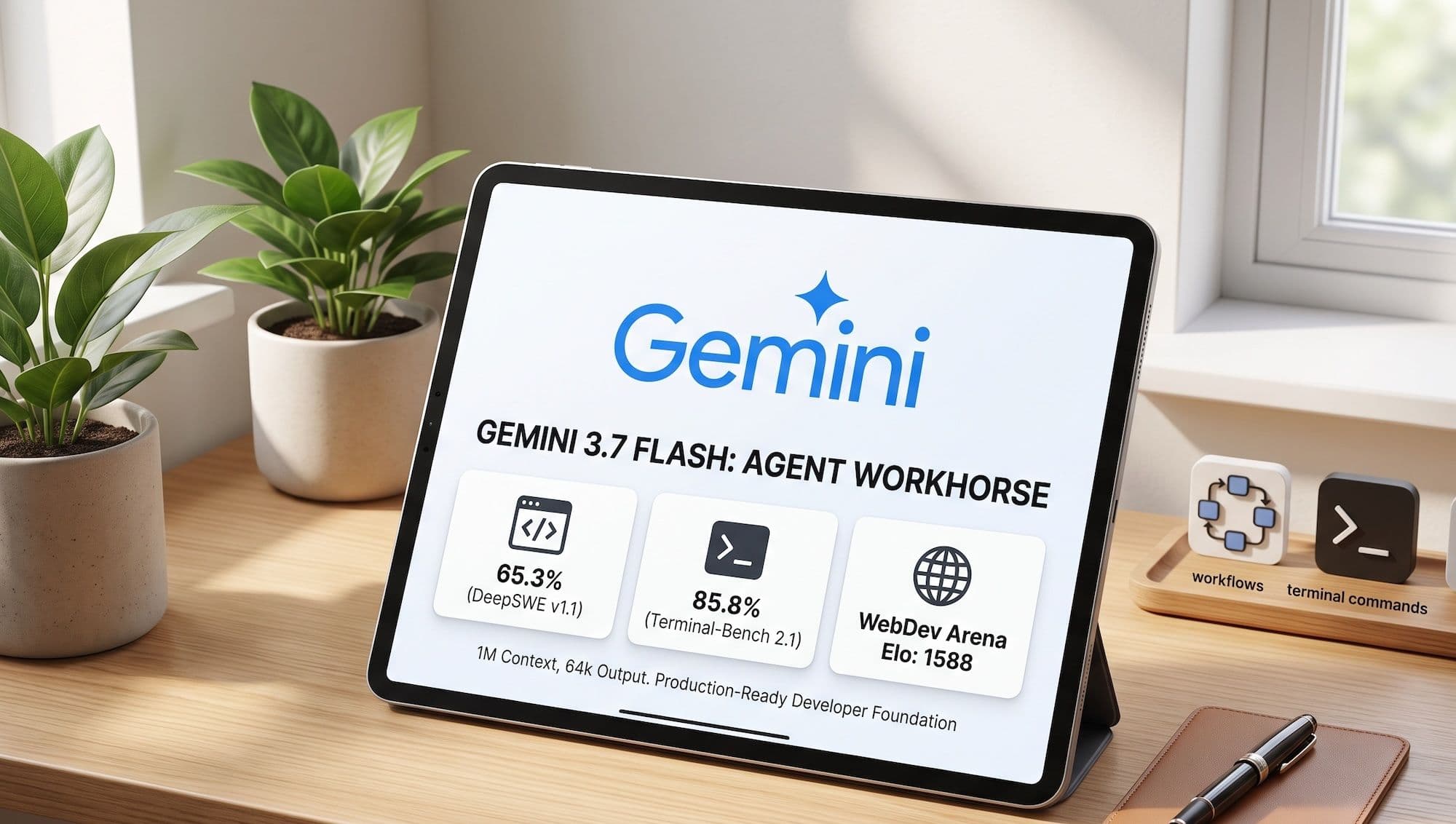
Gemini 3.8 Flash and Gemini 3.8 Flash Cyber share a name and a common foundation, but they are designed for different jobs. Flash is the general-purpose choice for building applications and automating work. Flash Cyber is a restricted defensive-security variant focused on finding and fixing software weaknesses.
Google introduced both on September 2, 2026. This guide uses official documentation checked on September 4, 2026 and compares them with GPT-6 Astra, Claude Opus 5, Claude Fable 5.1 and Grok 4.6. It is a specification-based assessment, not a claim that Premier Sol has independently benchmarked these models. Read Google’s launch announcement.
Gemini 3.8 Flash vs Flash Cyber: the essential difference
The access distinction matters more than the branding. Flash Cyber is not simply an unrestricted chatbot mode that every website owner can switch on. Google describes a specialized model with different cybersecurity mitigations, provided to trusted defenders. Google explains the two variants and their safeguards.
Our recommendation: shortlist ordinary Flash for a website assistant, document workflow or development tool. Consider Flash Cyber only when you have an authorized defensive use case and access through the appropriate program.
What Gemini 3.8 Flash can do
The stable API model ID is gemini-3.8-flash. Google lists text, image, video, audio and PDF inputs, with text output. The published limits are 1,048,576 input tokens and 65,536 output tokens. Function calling, structured outputs and search grounding are supported; computer use is marked Preview. See the Gemini 3.8 Flash specification.
That range of inputs is useful for a task such as reviewing a product demonstration alongside its documentation. It does not mean that the model generates every medium it can read. Plan separate output services when your application must create media rather than explain or summarize it.
Thinking levels are low, medium and high, with medium as the default. Google warns that longer tasks can consume more tokens because the model takes additional reasoning and tool steps. The minimal setting is unsupported. Google’s developer guide explains the tradeoffs.
If you already use an earlier Flash model, keep your current workflow as the baseline. Our provides the preceding generation’s context; use current Google documentation when checking 3.8-specific details.
What makes Flash Cyber different?
Google’s Fairwind Program combines Flash Cyber with CodeMender, its workflow for identifying, verifying and fixing vulnerabilities. Initial access prioritizes government agencies, critical infrastructure and core technology platforms. The program also sets operational requirements for participating organizations. Read the Fairwind Program overview.
The important unit of work is a verified fix, not a convincing security report. A useful defensive workflow must distinguish a real issue from a false alarm, preserve intended application behavior and show that the change survives testing. A model’s suggested patch is an input to that process, not a substitute for it.
For an authorized evaluation, use a controlled copy of software your team maintains. Ask reviewers to assess whether a reported issue is valid, whether the patch addresses the root cause and whether it introduces regressions. Do not grant broad production access simply because a model has “Cyber” in its name.
A business should also separate application-security research from everyday site protection. Updates, backups, access controls and recovery procedures still matter. Our address that broader operational responsibility; they should not be confused with guaranteed access to Google’s restricted model.
How Flash compares with other AI models
The table below lists standard, uncached API token rates in US dollars per million tokens. These are not subscription prices or all-inclusive project estimates. Gemini’s row uses its introductory rates, valid through December 31, 2026.
Sources for the rate comparison: Gemini pricing, OpenAI’s Astra model page, Claude Opus 5, Claude Fable 5.1 and Grok 4.6. Long-context adjustments, caching, processing modes, tools and other charges can change the bill.
Compared with GPT-6 Astra
Astra lists a 1,050,000-token context window and 128,000-token maximum output, with text and image input. Its standard token rates are higher than Flash’s introductory rates. OpenAI’s current notice describes a staged rollout, so confirm your account’s access before planning a launch around it.
Our assessment: compare accepted results on a complete workflow, not a single impressive answer. Include any media preprocessing required by each setup in the time and cost. For broader context, see our .
Compared with Claude Opus 5 and Fable 5.1
Both Claude models list a one-million-token context window and 128,000-token standard maximum output. Anthropic recommends starting with Opus 5 for most workloads and considering Fable for demanding tasks where Opus at higher effort falls short. Fable uses always-on adaptive thinking. See Anthropic’s model guidance.
Our assessment: use the same repository task or source-grounded research brief across providers. Judge working output, factual support and correction time. A lower token rate is valuable only if the result meets the same acceptance criteria.
Compared with Grok 4.6
Grok 4.6 lists a 500,000-token context window, text and image inputs, function calling and structured outputs. Its model page notes different rates above 200,000 context tokens. Check the Grok 4.6 specification.
Our assessment: do not equate a provider’s complete product family with a single model endpoint. Compare the exact model, tools and media pipeline your application will use. Otherwise, a seemingly fair comparison can actually measure different products.
Pricing: budget beyond the introductory offer
Google lists Gemini 3.8 Flash standard pricing at $0.75 for input and $3.75 for output per million tokens through December 31, 2026. The scheduled rates from January 1, 2027 are $1.50 and $7.50 respectively. Output pricing includes thinking tokens. Confirm the current pricing schedule.
Illustrative calculation: 10,000 uncached input tokens and 2,000 total billable output tokens cost $0.015 at the introductory standard rates, or $0.03 at the scheduled 2027 rates. This excludes tools, caching storage, extra turns and retries. It is arithmetic, not a prediction of your application’s usage.
Do not copy these rates into a Flash Cyber budget. The reviewed public sources do not establish an equivalent Cyber price table. Ask Google for the applicable access, deployment and commercial terms.
A practical selection plan for your website
- Choose one job: answering approved support questions, summarizing documents, helping a developer or reviewing authorized code.
- Define success before testing. Include factual accuracy, source support, output format, response time, review effort and permitted actions.
- Use representative examples and failure cases. Add missing information, contradictory documents and requests outside the workflow’s scope.
- Record the exact model, settings, tools and total billed usage. Compare cost per accepted result, including human review.
- Run a limited pilot and keep a fallback. Require approval before publishing content, changing production code or taking consequential account actions.
For a developer-led workflow, our and provide related background. Verify that your installed tool and account support the selected model.
For a customer-facing integration, Premier Sol’s can help connect the model to approved content, application logic and review controls.
The verdict
Gemini 3.8 Flash is the practical starting point to evaluate for general application work. Flash Cyber serves a different, restricted defensive mission. Against Astra, Claude and Grok, choose using your actual workload and full operating costs—not vendor slogans, context size alone or a promotional price without its expiry date.
Frequently asked questions
What is the main difference between Gemini 3.8 Flash and Flash Cyber?
Gemini 3.8 Flash is the general-purpose option for applications, coding and multimodal work. Gemini 3.8 Flash Cyber is the specialized defensive-security variant available to trusted defenders through Google’s Fairwind Program.
Can I access Gemini 3.8 Flash Cyber with a normal Gemini subscription?
Do not assume so. Google describes Flash Cyber access through the Fairwind Program, rather than as a standard feature of an ordinary Gemini subscription. Confirm eligibility and deployment access with Google.
Is Gemini 3.8 Flash cheaper than GPT-6 Astra and Claude Opus 5?
Its published standard API token rates are lower as checked on September 4, 2026. That does not establish a lower cost per completed task: token usage, tool charges, retries and review effort can change the total.
Does Gemini 3.8 Flash generate images or audio?
The model accepts several input types, including images and audio, but its native output is text. Its model page lists image generation, audio generation and the Live API as unsupported.
Should an AI-generated security patch be deployed automatically?
Not by default. Review the change, validate the fix in an authorized test environment, run regression tests and retain a rollback plan before approving production deployment.