WordPress scheduled tasks quietly publish posts, send emails, process queues, run backups and clean temporary data. That convenience also creates a security blind spot: a vulnerable or compromised plugin can register a recurring task that runs long after the original intrusion is forgotten.
Cron security is not about disabling automation. It is about knowing which tasks exist, who created them, what code they execute and whether the scheduler is reliable enough to expose unusual behavior.
Understand what WP-Cron actually does
WP-Cron is triggered by site activity rather than operating exactly like the system cron service on a server. On low-traffic sites, jobs may run late. On very busy sites, repeated spawn attempts can add load. Modern WordPress initiates its cron work around the request shutdown phase, but scheduling design and hosting conditions still matter.
For business-critical tasks, many teams disable request-triggered WP-Cron and call wp-cron.php from a real server scheduler. Make that change only after the replacement job is confirmed, logged and monitored. A missing scheduler can silently stop backups, emails, renewals or publishing.
1. Inventory every scheduled hook
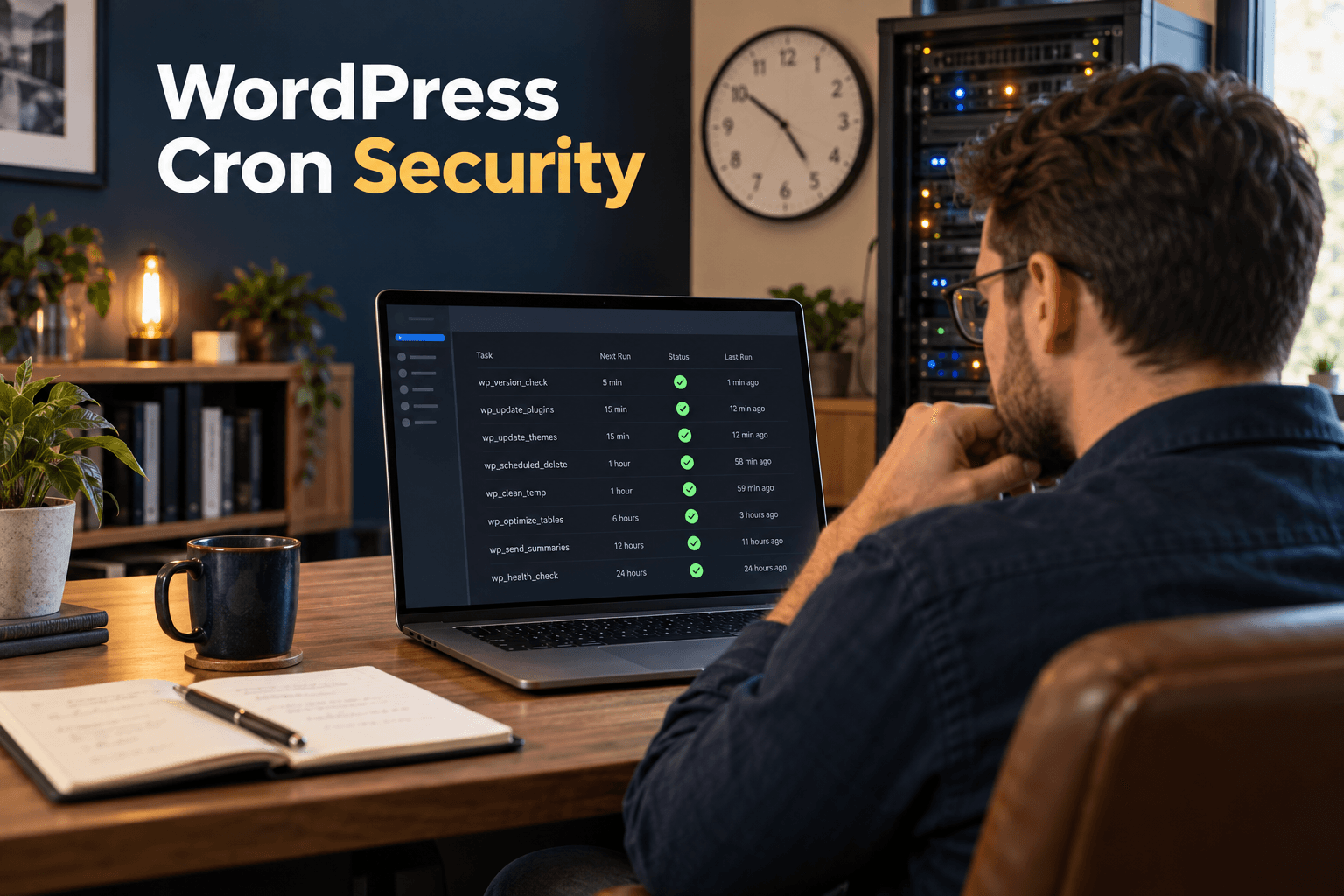
Create a baseline showing each hook name, recurrence, next run, owning plugin or theme and expected business purpose. Unknown hooks are not automatically malicious, but they should have an owner. Pay special attention to unusually frequent jobs, callbacks from disabled plugins and hooks that execute remote requests or modify users and files.
Compare the inventory with recent extensions and the controls in our WordPress plugin supply-chain security guide. A scheduled callback is only as trustworthy as the code and update path behind it.
2. Remove orphaned and suspicious jobs safely
Deactivate questionable code on staging, confirm which task it registered and inspect the callback before deleting the event. Simply removing a schedule without removing the vulnerable code allows it to return. Preserve logs and a copy of suspicious files if the task may be part of an incident.
If the task writes unfamiliar files, creates users or reinfects cleaned pages, follow the WordPress incident response plan and investigate persistence before resuming normal operations.
3. Use a reliable scheduler
A server scheduler gives predictable execution and separates cron triggering from visitor traffic. Configure the interval to match the site’s actual queue needs, prevent overlapping runs where possible and set a timeout for jobs that can hang. Keep wp-cron.php reachable only in the manner required by the hosting design; do not apply a blanket block that also stops the trusted scheduler.
- Confirm the replacement schedule before setting DISABLE_WP_CRON.
- Record the command, frequency, runtime owner and failure destination.
- Prevent duplicate execution of long-running imports, backups and feeds.
- Alert when a critical task misses its expected completion window.
4. Protect the code cron executes
Scheduled callbacks should validate input, use least-privilege credentials and avoid building shell commands from untrusted data. Store API secrets outside content fields where possible, rotate exposed credentials and restrict outbound destinations. Jobs that download files should validate the final file type and location before processing.
Test cron-dependent updates and integrations with the so production credentials and customer data are not copied into an unprotected environment.
5. Monitor both failures and unexpected success
A failed backup is important, but so is a job that suddenly runs every minute or contacts a new domain. Capture start time, completion time, status, duration and a safe summary of errors. Avoid logging passwords, tokens or personal data. Establish normal runtime ranges and alert on repeated failures, backlogs and new hooks.
Feed cron events into the same review process described in our . Correlating job changes with plugin updates, user activity and file modifications shortens investigations.
6. Treat backups as a separate recovery control
A cron-triggered backup is not proof of recoverability. Store copies away from the live server, protect storage credentials and run restore tests. If the same compromised account can delete the site and every backup, the schedule offers little resilience.
Use the restore drills in our to verify that scheduled backups are complete, clean and usable.
Cron-security checklist
- Every scheduled hook has a known owner and purpose.
- Critical jobs use a reliable scheduler and have failure alerts.
- Long-running tasks cannot overlap uncontrollably.
- Disabled plugins do not leave orphaned callbacks behind.
- Logs exclude secrets but record status, duration and anomalies.
- Backups are isolated and restore-tested.
Final takeaway
Scheduled tasks deserve the same governance as administrator accounts and production deployments. Maintain an inventory, use a dependable trigger, monitor outcomes and investigate unfamiliar callbacks. A small quarterly cron review can reveal performance problems, abandoned integrations and security persistence before they become incidents.
Frequently asked questions
Is WP-Cron insecure by default?
No. WP-Cron is a normal WordPress scheduling mechanism. Risk comes from untrusted callbacks, poor visibility, unreliable triggering or jobs that use excessive privileges.
Should I disable WP-Cron?
Only when a real server scheduler or managed hosting scheduler has been configured and tested to replace it. Disabling WP-Cron without a replacement can stop important site tasks.
Can malware use scheduled WordPress tasks?
Yes. Compromised code can register recurring callbacks for persistence or repeated actions. Investigate the callback and vulnerable code, not just the schedule entry.
How often should scheduled hooks be reviewed?
Review them after major plugin changes and at least quarterly on important sites. High-risk ecommerce or membership sites may benefit from automated change alerts.