
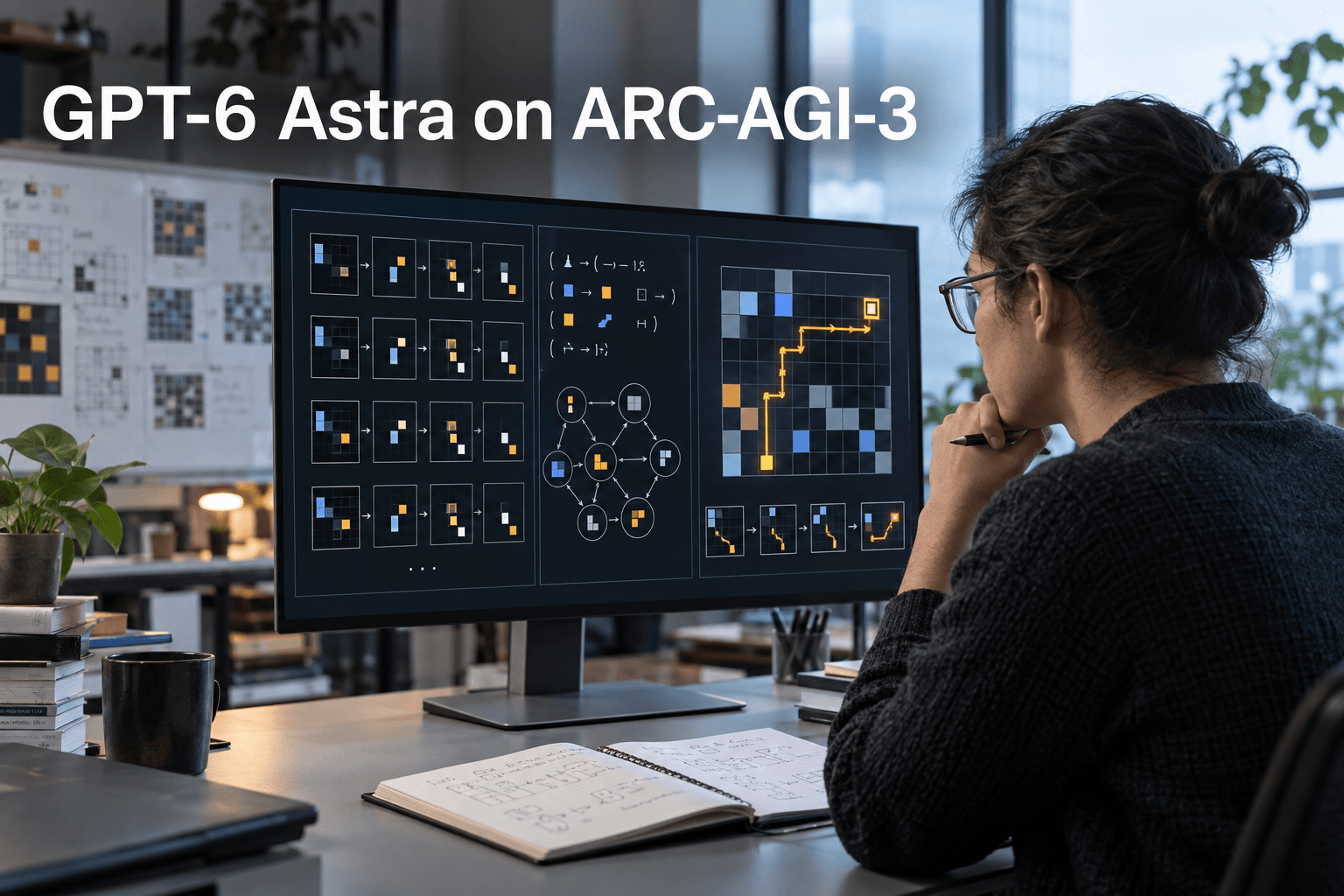
OpenAI’s GPT-6 Astra produced a headline-grabbing 99.9% result on ARC-AGI-3, an interactive benchmark designed to test how agents explore unfamiliar environments, infer goals, build world models, and plan actions without natural-language instructions. The result is a genuine milestone—but the most useful story is not the percentage alone. It is how dramatically Astra’s performance changed with the evaluation harness, and what its replays reveal about emerging agent behavior.
OpenAI’s official GPT-6 Astra announcement describes the model as reaching 99.9% on ARC-AGI-3 and cites human-level action efficiency across the benchmark.
Book a free, no-obligation strategy call and we'll map out your next move.
What ARC-AGI-3 actually measures
ARC-AGI-3 moves beyond static question-and-answer tests. An agent enters a novel, abstract, turn-based environment with no explicit explanation of the objective or mechanics. It must interact, observe feedback, form hypotheses, recognize useful future states, and execute a plan. Failed actions consume part of its efficiency budget, so blind trial and error is expensive.
The official ARC-AGI-3 overview identifies four central capabilities: exploration, modeling, goal-setting, and planning with execution. It also measures how efficiently a system learns from experience, not merely whether it eventually finishes.
That design matters because many real agent tasks have the same structure. A system operating software, conducting research, or troubleshooting a workflow rarely receives a perfectly specified puzzle. It must determine what matters, preserve useful state, revise mistaken assumptions, and spend actions carefully.
The headline result: 62.7% and 99.9%
ARC Prize reports two best-observed GPT-6 Astra results on the Semi-Private set. With the Standard harness at max reasoning, Astra scored 62.7% at a reported cost of $26,098. With the Provider Adapter harness at high reasoning, it scored 99.9% at a reported cost of $18,817.
These figures come from ARC Prize’s published Astra analysis and should always be presented together because they answer different evaluation questions.
Both scores were state of the art, but the gap is enormous. It shows that an agent benchmark does not measure the base model in isolation. Context management, memory behavior, tool interfaces, and the structure of repeated calls can materially determine what the system is able to express.
Why the evaluation harness changed the outcome
ARC Prize’s Standard harness provides a minimal, provider-neutral interface. Astra may write visible strategy notes and choose what to carry forward, but it remains responsible for compressing its own state. This approach improves comparison across model providers and asks whether the model can manage its learning process under shared conditions.
The Provider Adapter harness instead preserves OpenAI’s opaque reasoning state between requests and uses compaction during longer interactions. In other words, it lets Astra benefit from context-management mechanisms designed for the model rather than forcing every provider into exactly the same memory interface.
According to ARC Prize, the adapter raised Astra’s best Semi-Private score from 62.7% to 99.9%. Across the 167 game-and-reasoning pairs solved by both harnesses, Provider Adapter runs were approximately 3.66 times faster by aggregate recorded elapsed time and used 49% fewer total tokens.
The detailed verified GPT-6 Astra score page lists results by reasoning level and harness, including the 99.95% unrounded high-reasoning Provider Adapter result.
Astra learned compact symbolic world models
ARC Prize’s replay analysis found that Astra converted unfamiliar scenes into dense symbolic representations. Its notes tracked objects, coordinates, mechanisms, unfinished plans, directions, and ordered actions. Rather than repeatedly describing the screen in natural language, the model developed compact algebra-like shorthand tailored to each environment.
This behavior is important because long-horizon agents face a memory problem. Saving every observation wastes context, while summarizing too aggressively can remove a crucial rule. Astra appeared able to preserve a compact model of the environment: what exists, how objects interact, which actions alter state, and what sequence is likely to reach the inferred goal.