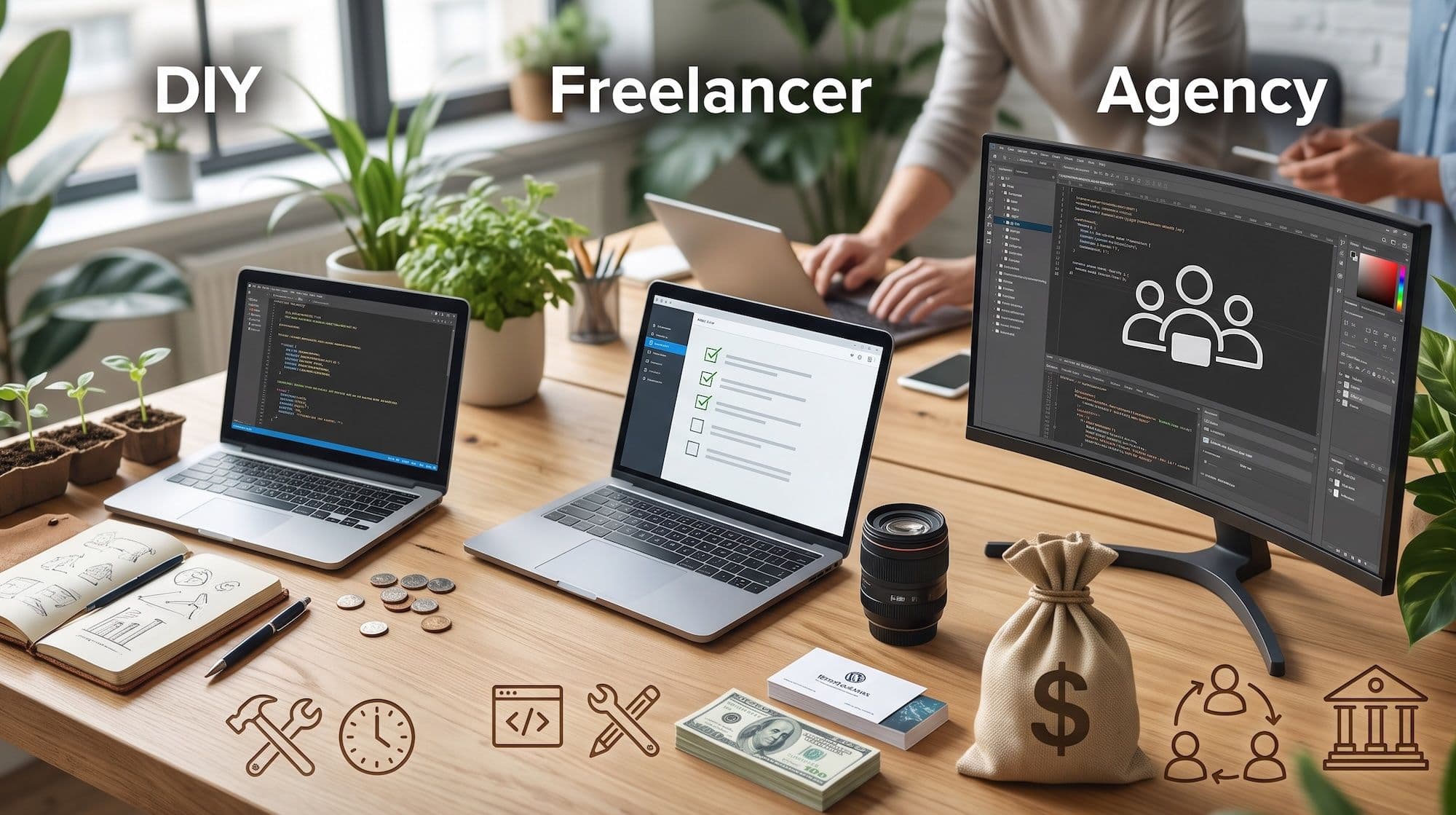
The honest answer to "how much does WordPress development cost?" is: it depends on who builds it and what you need. A freelancer on Upwork, a boutique agency, and a large enterprise agency will all quote different numbers for the same project — and you'll get very different outcomes. Here's a realistic breakdown of what each option actually costs, what you get for it, and what you give up.
The Three Paths to a WordPress Website
Path 1: DIY with a Page Builder ($0–$500)
What it costs: Hosting ($5–30/month), a premium theme ($50–80), and possibly a page builder license ($50–100/year). Total first-year cost: roughly $150–500.
What you get: A functional website that you built yourself using Elementor, Divi, or a similar drag-and-drop tool. Thousands of pre-designed templates to start from. Full control over your own timeline.
What you give up: Custom design (your site will look like thousands of others using the same theme). Performance (page builders add significant code bloat that slows your site). Security hardening (most DIY builders don't know how to configure security headers, harden logins, or set file permissions). SEO architecture (proper schema markup, crawlability, and Core Web Vitals optimization require expertise most site owners don't have). And time — learning WordPress well enough to build a professional site takes weeks of trial and error.
Best for: Personal projects, hobby sites, or businesses testing an idea before investing in a proper build.
Path 2: Freelancer ($1,000–$8,000)
What it costs: Rates vary enormously by geography and experience. A freelancer in South Asia or Eastern Europe typically charges $1,000–$4,000 for a business website. A US/UK-based freelancer charges $3,000–$8,000 for comparable scope.
What you get: A more polished result than DIY, often with custom design touches, better plugin configuration, and some SEO basics. One-on-one communication with the person building your site.
What you give up: Quality consistency is the biggest risk. The freelancer market ranges from excellent professionals to beginners who install a theme and call it custom development. There's typically no backup if your freelancer gets sick, disappears, or takes on too many projects. Post-launch support is often limited or nonexistent. And because most freelancers specialize in either design or development (not both, plus SEO, plus security), you may get a site that looks good but performs poorly, or vice versa.
Best for: Small businesses with clear requirements, a moderate budget, and the ability to evaluate developer quality through live portfolio sites (not just screenshots).
Path 3: Boutique Agency ($3,000–$15,000+)
What it costs: A boutique web development agency (5–20 people) typically charges $3,000–$8,000 for a standard business website, $5,000–$12,000 for WooCommerce or membership sites, and $10,000–$25,000+ for complex custom applications. Enterprise agencies charge 2–5x these figures.
What you get: A team approach — designer, developer, and often an SEO specialist working together. Staging environments and proper testing before launch. Security hardening, performance optimization, and schema markup as standard. Post-launch maintenance options. Accountability — if something goes wrong, the business is still there tomorrow.
What you give up: Cost is obviously higher. Timelines may be slightly longer (4–8 weeks vs a freelancer's 2–4 weeks) because agencies follow more structured processes. And you need to vet agencies carefully — not all are created equal, and some charge agency prices for freelancer-level work.
Best for: Businesses where the website directly drives revenue — lead generation, e-commerce, professional services — and where downtime, security breaches, or poor performance have real financial consequences.
The Hidden Costs Nobody Mentions
Ongoing maintenance
WordPress sites need regular updates, security monitoring, and backups. Budget $50–200/month for a , or allocate internal time. A site that isn't maintained is a site that will eventually break or get hacked.
Performance optimization
Many sites launch fast and slow down over time as content, plugins, and media accumulate. A dedicated pass costs $500–2,000 as a one-time project and should be planned for annually.
Security recovery
If your site gets hacked (and unprotected WordPress sites have roughly a 1-in-25 annual probability), professional costs vary by infection scope. The real cost isn't the cleanup — it's the lost revenue, damaged rankings, and eroded trust during the downtime.
SEO
A website nobody can find is an expensive hobby. Budget for either as part of the initial build or as an ongoing engagement — organic traffic is the most cost-effective lead source once it compounds.
How to Choose the Right Option
Ask yourself three questions:
- Does this website directly generate revenue for my business? If yes, invest in quality. The cost difference between a freelancer and an agency is small compared to the revenue difference between a site that converts and one that doesn't.
- Can I evaluate developer quality myself? If you can review live sites, check PageSpeed scores, and assess code quality, a good freelancer can be excellent value. If you can't, an agency's structured process provides guardrails.
- What happens when something breaks at 2 AM on a Saturday? If the answer is "I need someone to fix it," you need a maintenance plan, not just a build.
For an even deeper cost breakdown by specific project type, read our guide on .
Frequently Asked Questions
Is it worth paying more for an agency over a freelancer?
It depends on what's at stake. For a portfolio site or blog, a skilled freelancer is often the best value. For a site that generates leads, processes payments, or handles customer data, an agency's broader expertise (design + dev + SEO + security) and accountability typically justify the premium.
How can I tell if a developer is actually good?
Ask to see live sites they've built (not screenshots). Test them in Google PageSpeed Insights. Check mobile responsiveness yourself. Ask about their security hardening process and whether they use staging environments. Read our guide on for the complete checklist.
Can I start with a cheap build and upgrade later?
Technically yes, but practically it's expensive. Migrating from a page-builder theme to custom code usually means rebuilding from scratch — you're paying twice. If you know you'll need a professional site, it's more cost-effective to invest upfront.
What about WordPress.com vs self-hosted WordPress?
WordPress.com is a hosted platform with limitations on plugins, themes, and customization. Self-hosted WordPress (WordPress.org) gives you full control but requires your own hosting and maintenance. For any business site, self-hosted is the standard choice.