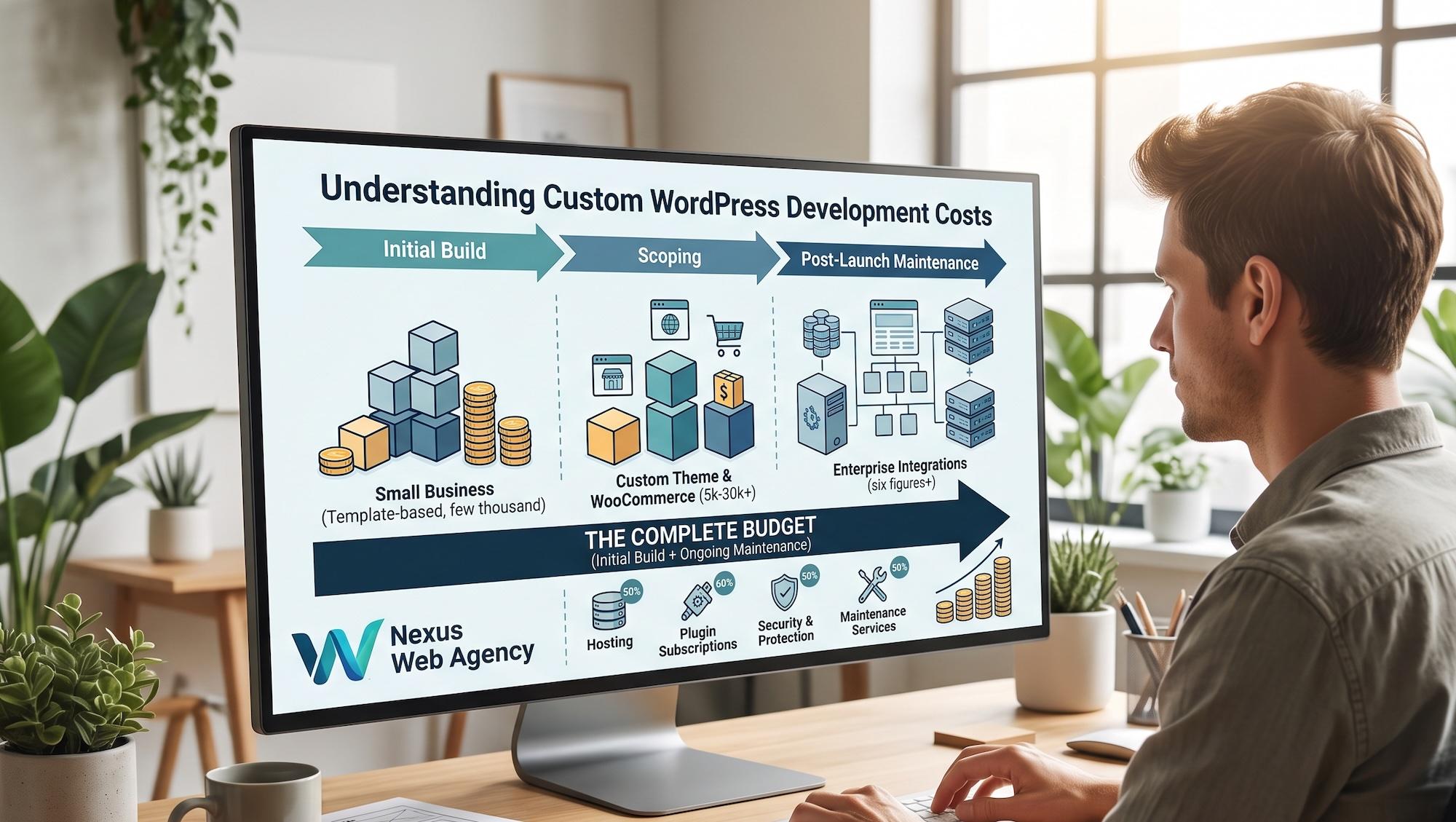
“How much does custom WordPress development cost?” is one of those questions where every honest answer starts with “it depends” — and then, frustratingly, never actually gives you a number. We're going to fix that. Based on real project pricing across the industry in 2026, custom WordPress development runs from around $2,000 for a focused single plugin to $30,000 or more for a fully custom, feature-rich business site. This guide breaks down exactly where in that range your project is likely to land, and what drives the difference.
WordPress itself is free and still powers roughly 41-43% of all websites worldwide — more than every other content management system combined. But “free software” and “free website” are two very different things. The real wordpress development cost comes from design, custom coding, content, plugins, hosting, and the people who put it all together.
The quick answer: cost by project type
What actually drives the price
- Design complexity — a templated layout vs. a fully custom, brand-specific design
- The number of unique page templates the site needs
- Custom functionality and integrations — CRMs, payment processors, booking tools
- Ecommerce requirements, including catalog size and payment complexity
- Content volume and migration needs from an existing site
- Developer location and experience level — agency, freelancer, or in-house
Budgeting by business stage
The “right” number also depends on where your business actually is, not just what features you want.
Early-stage or solo business. A premium theme with light customization ($1,000–$3,000 all-in) is usually the smarter move. The goal at this stage is validating the offer, not perfecting the platform — a custom theme build is money better spent once the business has traction.
Growing small business. This is where a custom-designed site ($3,000–$15,000) starts to pay for itself: a distinct brand presence, better conversion-focused page templates, and enough flexibility to add features as the business grows.
Established or scaling business. A fully custom theme, custom plugins, or a WooCommerce build ($10,000–$30,000+) makes sense once off-the-shelf plugins can't keep up with your actual operational requirements — inventory complexity, a CRM integration, or a checkout flow a page builder simply can't produce.
Enterprise. At six figures and up, you're typically paying for migration planning, multi-system integrations, and a level of QA and architecture most small projects never need — not for WordPress itself, which remains the same free core software throughout.
DIY, or hire it out?
Page-builder tools like Elementor have made it genuinely possible for a non-developer to assemble a professional-looking WordPress site without hiring anyone. If your requirements stop at design and content, that route can save the entire development line item. The moment your project needs custom functionality that doesn't exist in the plugin ecosystem — or needs to look meaningfully different from every other site built on the same template — that's the point where hiring a developer or agency starts producing a better return than more hours spent self-building.
Design and custom theme costs
A premium, off-the-shelf theme typically costs $30 to $250 as a one-time purchase and can be customized to look reasonably on-brand for $1,000 to $5,000 in additional design and setup work. That's the cost-effective path for straightforward brochure sites that don't need a wholly unique look.
A fully custom WordPress theme — designed and coded from scratch, with no page-builder shortcuts — is a different investment entirely. Because the theme becomes the foundation for the entire site, pricing typically starts around $5,000 to $10,000 for a basic custom build and climbs past $25,000 for a highly complex theme with many unique templates and interactions. The main cost driver isn't the coding itself; it's how many genuinely different page layouts the site actually needs.
Custom plugin development costs
Custom plugins break into two rough tiers. At the lower end ($2,000 to $3,000), you're looking at straightforward functionality with a minimal admin interface and no external integrations — a specialized shortcode, a custom content type, or a simple automation trigger. At the higher end ($4,000 to $6,000 or more), the plugin includes a custom admin dashboard, user-facing interfaces, or integration with third-party services, like a booking system or a membership feature that goes beyond what off-the-shelf plugins offer.
The single biggest cost swing within “custom plugin” work is whether the functionality has been built before. A developer who has solved a similar problem can move quickly; genuinely novel functionality requires more discovery, testing, and back-and-forth, which shows up directly in the invoice.
Ecommerce and WooCommerce costs
Adding a WooCommerce store to WordPress introduces its own cost layer: product catalog structure, shopping cart logic, secure payment gateway integration, shipping rules, and often inventory synchronization with an existing system. A straightforward store with a modest product count can land in the $8,000 to $15,000 range; a store with custom checkout flows, subscription billing, multi-currency support, or ERP integration can push well past $30,000.
Put these ideas to work.
From a specific fix to a complete website, we can help you define the scope and get it done.
Discuss my websiteCustom WordPress Web DevelopmentShare your goals. We typically reply within 4 hours with questions and practical next steps.
The ongoing costs most quotes leave out
The number on your initial invoice is only part of the wordpress development cost picture. A WordPress site carries recurring costs for as long as it's live, and these are the line items that catch people off guard:
Skipping the maintenance line item is the single most common budgeting mistake we see. A WordPress site that isn't kept updated — core, theme, and every plugin — becomes a security liability fairly quickly, and the cost of recovering a hacked site almost always exceeds a year of proper maintenance.
Freelancer vs. agency vs. in-house
Offshore freelancers and agencies in regions with a lower cost of living often quote noticeably less than U.S. or Western European teams. That can be a legitimate way to stretch a budget, but it's worth factoring in communication overhead, time zone gaps, and the extra QA oversight that distributed teams sometimes require — those hidden costs don't show up on the quote, but they show up in the project timeline.
How to get a quote you can actually trust
Vague quotes (“$500 to $50,000”) aren't a budget, they're a guess. Before you accept any WordPress development cost estimate, make sure the scope answers these questions:
- How many unique page templates does the site actually need?
- Is the design fully custom, or built on an existing theme framework?
- Which specific integrations are included, and which cost extra?
- Is content migration from an existing site included in the quote?
- What does post-launch support include, and for how long?
- Who owns the custom code and design files once the project ends?
A real example
Cost estimates get a lot more concrete once you see them applied to a real brief. Our custom WordPress theme build for DieRabatte.de is a good example of what a fully custom theme project actually involves — unique templates, brand-specific design, and functionality that a stock theme couldn't deliver, all scoped around the client's real requirements rather than a generic price list.
Frequently Asked Questions
Why do WordPress cost estimates vary so much between companies?
Because “WordPress website” describes a huge range of possible projects. A template-based brochure site and a custom-coded enterprise platform both run on WordPress, but they require wildly different amounts of design, development, and testing time — which is why a single flat number is rarely useful.
Is a $500 WordPress website actually worth it?
For a very simple personal site or an early-stage side project, yes — a premium theme and light setup can be a reasonable starting point. For a business that depends on the site for leads or sales, a $500 build usually means limited customization, generic design, and little to no ongoing support, which tends to cost more in lost opportunity than it saves upfront.
How much should I actually budget for ongoing WordPress maintenance?
A reasonable planning number is $50 to $200 per month for a small-to-mid-size business site, covering updates, backups, uptime monitoring, and basic security. Larger or ecommerce sites often justify a full agency retainer in the $119 to $449 per month range.
Does hiring an agency always cost more than a freelancer?
Usually, yes, on an hourly basis — but an agency typically bundles design, development, SEO, and QA under one project, which can reduce coordination overhead compared to hiring several freelancers separately. Freelancers make sense for well-scoped, single-discipline work.
What's the real cost difference between a custom theme and a page-builder site?
A page-builder site (Elementor, for example) can be assembled for a few thousand dollars and is faster to launch. A fully custom-coded theme costs more upfront — often $5,000 to $10,000 or more — but generally performs better, gives you tighter design control, and avoids the long-term bloat that heavy page-builder plugins can introduce.
Summary
Custom WordPress development cost isn't one number — it's a range that depends almost entirely on scope. A templated small-business site can be live for a few thousand dollars; a fully custom theme, plugin, or WooCommerce build can run from $5,000 well past $30,000; and enterprise builds with heavy integrations can exceed six figures. Whatever tier your project lands in, budget for the ongoing costs — hosting, plugins, security, and maintenance — alongside the upfront build, since skipping them is the most common way a WordPress budget goes wrong after launch.
Reference Links
- WordPress Website Cost in 2026 — OuterBox
- WordPress Costs: How Much Does a WordPress Website Cost in 2026? — WebFX
- WordPress Website Cost Guide — Elementor
- Custom WordPress Development Cost: 2026 Pricing Guide — FatLab Web Support
Want an accurate quote for your project?
Generic price lists can only tell you so much. Tell us what you're building and we'll give you a real, scoped number — not a range pulled from a blog post.
Get a custom WordPress development quote →
Need a custom theme or plugin specifically? See our WordPress theme & plugin development services, or if security is the bigger concern, start with our WordPress security services.