In the rapidly advancing world of artificial intelligence, the ChatGPT prompt is a fundamental interface between humans and AI models. It serves as the primary mode by which users instruct, interact with, and extract value from AI systems like OpenAI’s groundbreaking GPT-5. As the fifth generation of OpenAI’s large language model, GPT-5 introduces remarkable improvements in language understanding, reasoning, and generation capabilities. Using effective ChatGPT prompts is essential to unlock the full potential of GPT-5, driving better creativity, accuracy, and productivity.
This guide will explain what a prompt is, provide a comprehensive ChatGPT 5 prompting guide, and share advanced strategies for mastering AI chat interactions by leveraging the power of GPT-5.
What is a ChatGPT Prompt?
Before diving into advanced techniques, it’s critical to understand the essence of a prompt. Simply put, a prompt is the input—usually text—that you provide to an AI language model to initiate a response or completion.
Prompt Types:
- Instructional prompts: Direct instructions, e.g., “Explain quantum computing.”
- Conversational prompts: Part of an ongoing chat or dialogue, e.g., “Can you elaborate on that?”
- Contextual prompts: Including prior conversation history or specific information to guide the model.
- Creative prompts: Invitations to generate stories, poems, code, or other original content.
The quality and precision of the prompt heavily influence the relevance, coherence, and utility of the AI output.
Introduction to GPT-5 Prompting
GPT-5 represents a synthesis of OpenAI’s most capable research milestones. The GPT 5 prompting guide emphasizes prompt engineering best practices, exploiting new features like real-time routing of model subcomponents, extended context windows (up to 1,000,000 tokens), and multimodal inputs (text + image).
Unique GPT-5 Prompting Features:
- Dynamic model routing: Use prompt cues like "Think hard about this" to switch to deeper reasoning modes.
- Multimodal prompts: Combine textual descriptions with images for richer context.
- Explicit chain-of-thought (CoT): Encourage the model to outline reasoning steps.
- Safety guidance: Embed explicit instructions to reduce hallucinations and biases.
How to Craft Effective ChatGPT Prompts: Step-by-Step Guide
Step 1: Be Clear and Specific
State your objectives clearly to help GPT-5 understand the task. For example:
"Write a brief summary of the key challenges in renewable energy adoption."
Avoid vague or overly broad instructions.
Step 2: Use Iterative Refinement
Break complex tasks into subtasks or ask follow-up questions to refine the response. For example:
"First, list the main challenges. Then, provide possible solutions for each."
Step 3: Employ Chain-of-Thought Prompts
Encourage GPT-5 to explain its reasoning step-by-step:
"Explain your solution step by step, detailing why each step is necessary."
Step 4: Control Tone and Style
Guide the tone to fit your audience or purpose, e.g.:
"Explain this concept as if to a high school student."
Or
"Write a formal business proposal letter."
Step 5: Use Prompt Framing and Contextual Anchors
Embed background information or predefined constraints within the prompt:
"Considering the recent climate policies enacted in 2025, summarize impacts on industrial emissions."
Put these ideas to work.
From a specific fix to a complete website, we can help you define the scope and get it done.
Discuss my websiteCustom Web & Application DevelopmentShare your goals. We typically reply within 4 hours with questions and practical next steps.
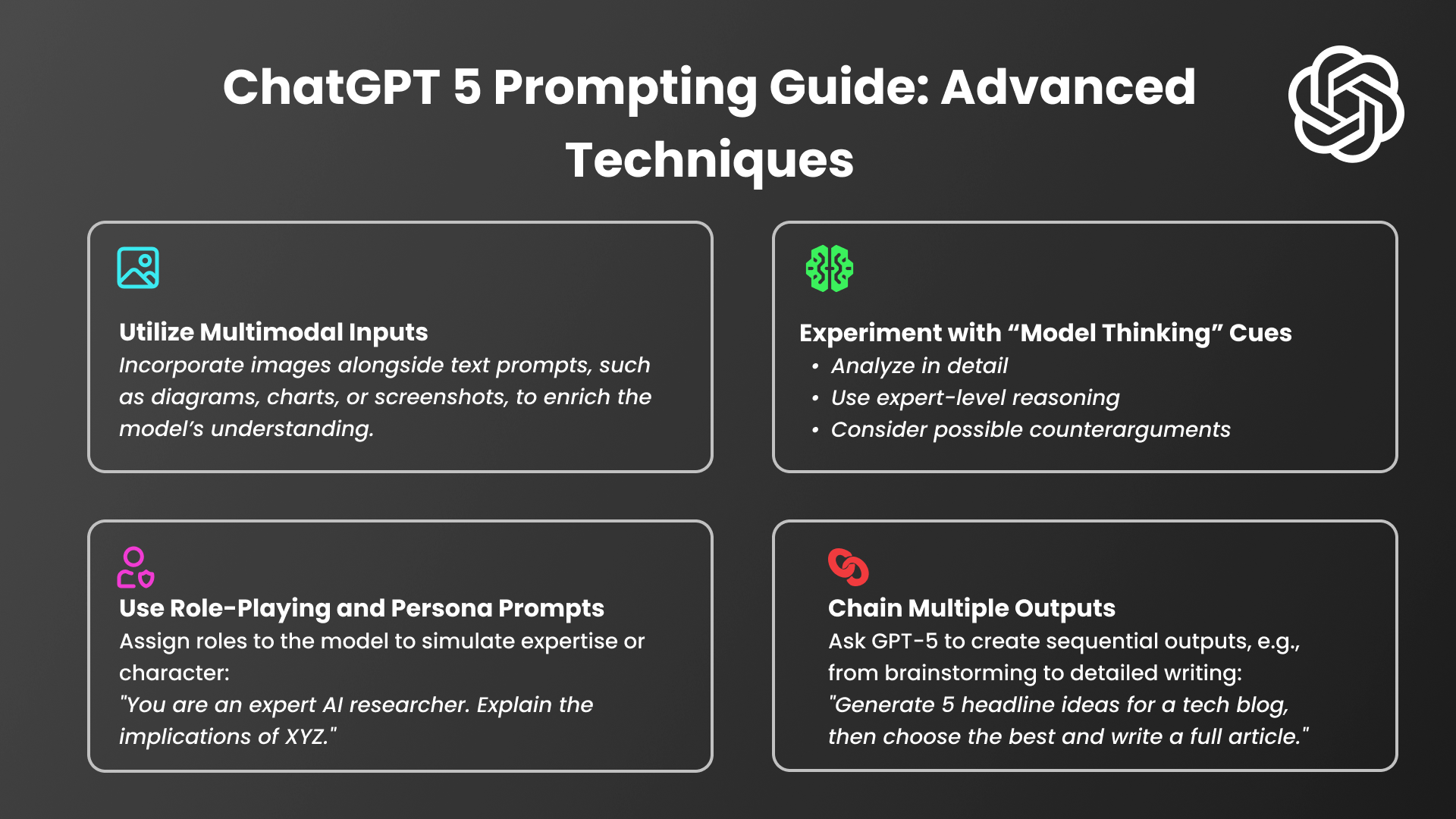
ChatGPT 5 Prompting Guide: Advanced Techniques
Utilize Multimodal Inputs
Incorporate images alongside text prompts, such as diagrams, charts, or screenshots, to enrich the model’s understanding.
Experiment with “Model Thinking” Cues
Signal GPT-5 to activate heavyweight reasoning components with triggers like:
- "Analyze in detail..."
- "Use expert-level reasoning..."
- "Consider possible counterarguments..."
Use Role-Playing and Persona Prompts
Assign roles to the model to simulate expertise or character:
"You are an expert AI researcher. Explain the implications of XYZ."
Chain Multiple Outputs
Ask GPT-5 to create sequential outputs, e.g., from brainstorming to detailed writing:
"Generate 5 headline ideas for a tech blog, then choose the best and write a full article."
Employ System and User Message Structure
Differentiate instructions (system messages) from user requests to optimize interactions in API or chatbot applications.
AI Chat Prompt Best Practices for Consistent Success
- Avoid Ambiguity: GPT-5 prefers explicit context.
- Set Constraints: Define length, format, or style explicitly.
- Prompt with Examples: Provide sample input/output pairs to guide style.
- Use “Prompt Engineering” Tools: Utilize snippets, templates, and chaining for efficiency.
- Evaluate and Iterate: Continuously test prompts against desired criteria.
Common Use Cases for ChatGPT Prompting
- Content Generation: Blog posts, social media, product descriptions.
- Customer Support: Automated replies and troubleshooting.
- Coding Assistance: Generate, debug, and explain code snippets.
- Research Summaries: Extract key points from scientific publications.
- Learning & Tutoring: Personalized lesson explanations and quiz generation.
Mastering ChatGPT Prompts: Tips from Experts
- Frame context before the main question.
- Use natural language with explicit instructions.
- Harness system messages when available.
- Combine short and long prompts for layered responses.
- Use creativity prompts for innovative output.
Frequently Asked Questions (FAQs)
1. What is a ChatGPT prompt?
A ChatGPT prompt is the input or instruction you give to ChatGPT to generate responses, including questions, commands, or contextual info.
2. How does GPT-5 improve prompting?
GPT-5 introduces dynamic routing, multimodal prompt support, extended context, and better reasoning to understand and respond to complex prompts more effectively.
3. What is the best way to structure prompts for GPT-5?
Be clear, specific, use chain-of-thought prompting, iterative refinement, and role-playing to maximize output quality.
4. Can GPT-5 handle images in prompts?
Yes, GPT-5 supports multimodal inputs, allowing you to include images with text for enhanced context.
Summary
The ChatGPT prompt is the key driver to extract maximum value from OpenAI’s GPT-5. By understanding what prompts are, how GPT-5 enhances prompt processing, and by applying expert prompting strategies—from clarity and specificity to multimodality and chain-of-thought reasoning—developers and users can unlock unprecedented AI capabilities. Whether you’re creating content, coding, researching, or automating workflows, mastering the art of ChatGPT prompts with the latest GPT-5 prompting guide ensures more accurate, creative, and reliable outcomes across diverse applications.
Reference Links