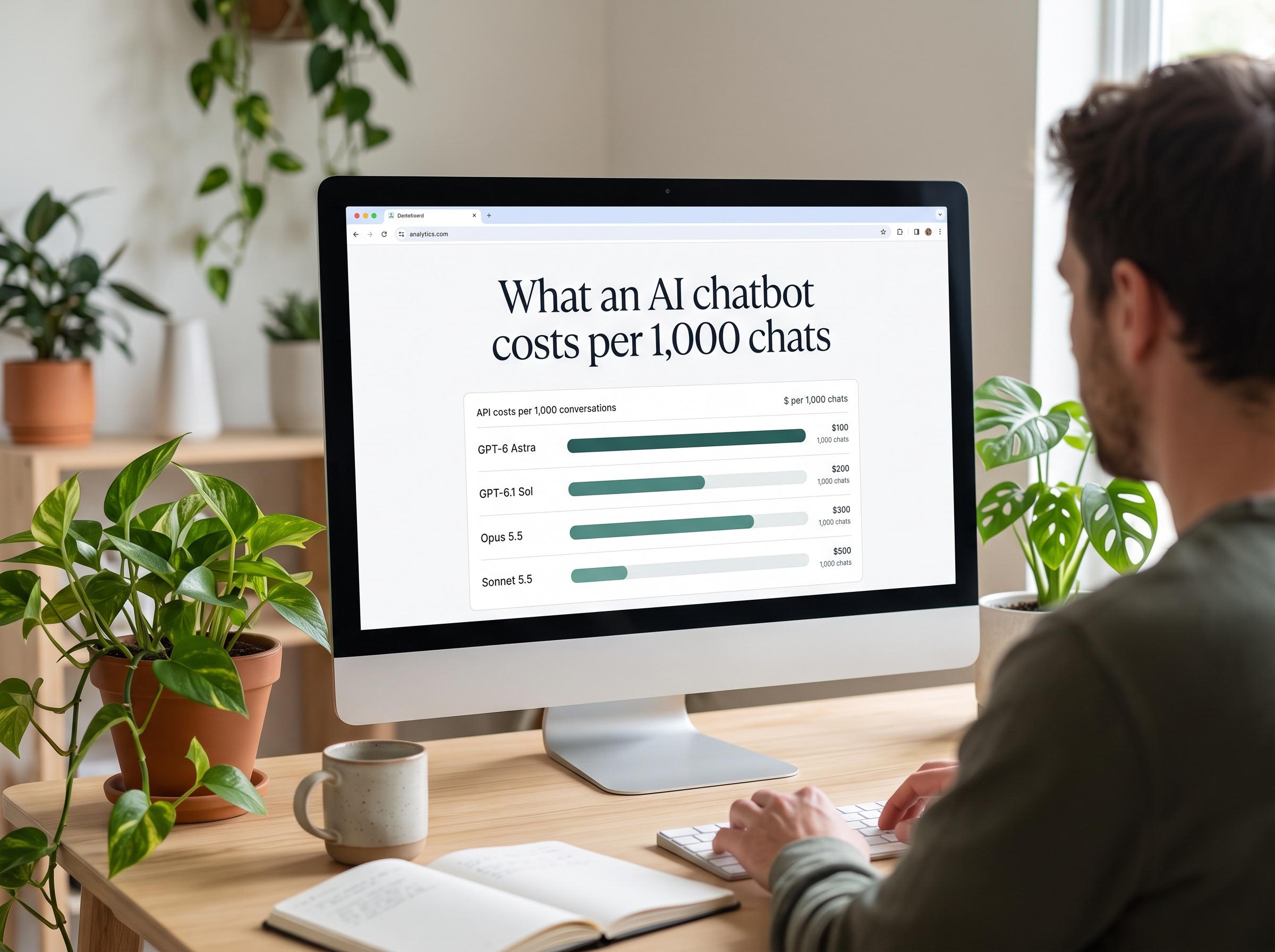
At list prices, 1,000 chatbot conversations of 3,000 input and 500 output tokens cost about $11 on Claude Sonnet 5.5 or GPT-6.1 Sol, $22 on Claude Opus 5.5, $55 on GPT-6 Astra and about 55 cents on GPT-6 Luna. Caching a shared prompt cuts each of those figures by roughly a third.
That is the model bill only, and it moves with your conversation length. This guide shows the working so you can replace our assumptions with your own.
The assumptions
- 1,000 conversations, each with one model call of 3,000 input tokens (system prompt, retrieved knowledge and the user's question) and 500 output tokens.
- Standard processing at list prices in USD, with no batch discount and no long-context surcharge.
- For the caching column, 2,000 of the 3,000 input tokens are read from cache at the cached-input price. The one-time cost of writing the cache is left out.
Real chats make several calls and resend the history each time, so treat these as a floor.
Prices used
| Model | Input per 1M | Cached input per 1M | Output per 1M |
|---|---|---|---|
| Claude Sonnet 5.5 | $2.00 | $0.20 | $10.00 |
| Claude Opus 5.5 | $4.00 | $0.20 | $20.00 |
| GPT-6.1 Sol | $2.00 | $0.10 | $10.00 |
| GPT-6 Astra | $10.00 | $1.00 | $50.00 |
| GPT-6 Luna | $0.10 | $0.01 | $0.50 |
Sources: Anthropic's Opus 5.5 model page and OpenAI's API pricing page. Sonnet 5.5's input and output prices come from Anthropic's model comparison table; confirm its cached-input price on Anthropic's own Sonnet 5.5 page.
The result
| Model | Per 1,000 chats | With caching | Per chat |
|---|---|---|---|
| Claude Sonnet 5.5 | $11.00 | $7.40 | about 1.1 cents |
| Claude Opus 5.5 | $22.00 | $14.40 | about 2.2 cents |
| GPT-6.1 Sol | $11.00 | $7.20 | about 1.1 cents |
| GPT-6 Astra | $55.00 | $37.00 | about 5.5 cents |
| GPT-6 Luna | $0.55 | $0.37 | about 0.06 cents |
The arithmetic for Sonnet 5.5 is (3,000 ÷ 1,000,000 × $2 + 500 ÷ 1,000,000 × $10) × 1,000 = $11. Swap in each model's prices for the others.
Gemini 4 Argon is left out because it is not publicly available and reported prices conflict.
What changes the number
- Conversation length. Each turn resends the history, so a ten-turn chat sends far more input than a one-turn chat.
- Caching. A cached read is much cheaper than fresh input, but writing the cache costs more than normal input: $5 per million tokens for a five-minute write on Opus 5.5 and $12.50 on GPT-6 Astra.
- Thinking tokens. Opus 5.5 always uses adaptive thinking, so check how thinking tokens are billed before you trust an estimate built only on the visible reply.
- Batch. Both vendors take 50% off for work that does not need an instant answer, such as summarizing last night's transcripts.
- Tools. OpenAI charges $10 per 1,000 web search calls on top of the tokens.
- Verbosity. Models use different amounts of tokens for the same task. On the Vals Index, Sonnet 5.5 cost $21.34 per test and Opus 5.5 cost $32.14, which is not the 2-to-1 gap their list prices suggest. Measure cost per task, not price per token.
Put these ideas to work.
From a specific fix to a complete website, we can help you define the scope and get it done.
Discuss my websiteCustom Web & Application DevelopmentShare your goals. We typically reply within 4 hours with questions and practical next steps.
What the bill leaves out
Hosting, a knowledge base or search index, monitoring, moderation, a human handover path and development time all sit outside the model bill.
Get your own number in a day
- Sample 50 real questions from your inbox or support tickets.
- Run them through the model and log the input and output token counts the API returns.
- Multiply the average by your monthly volume, then add a 30% buffer.
- Set a monthly spend limit in the provider's console before launch.
Frequently asked questions
Is the cheapest model good enough for a website chatbot?
Only if it passes your own test. GPT-6 Luna costs a fraction of the others, but cheap answers that are wrong cost you leads. Test on 50 real questions before you decide.
Will caching really cut the bill by a third?
It does in this example, where two thirds of the input is a shared prompt that is read from cache. Your saving depends on how much of each request repeats.
Does a longer conversation cost more?
Yes. The whole history is sent again on each turn, so input tokens grow with every message unless you trim or summarize it.
Planning a chatbot for your site?
Model choice is one line item. We design the whole build, from retrieval and guardrails to logging and spend limits, for WordPress and Next.js sites. See our AI integration and chatbot development services.