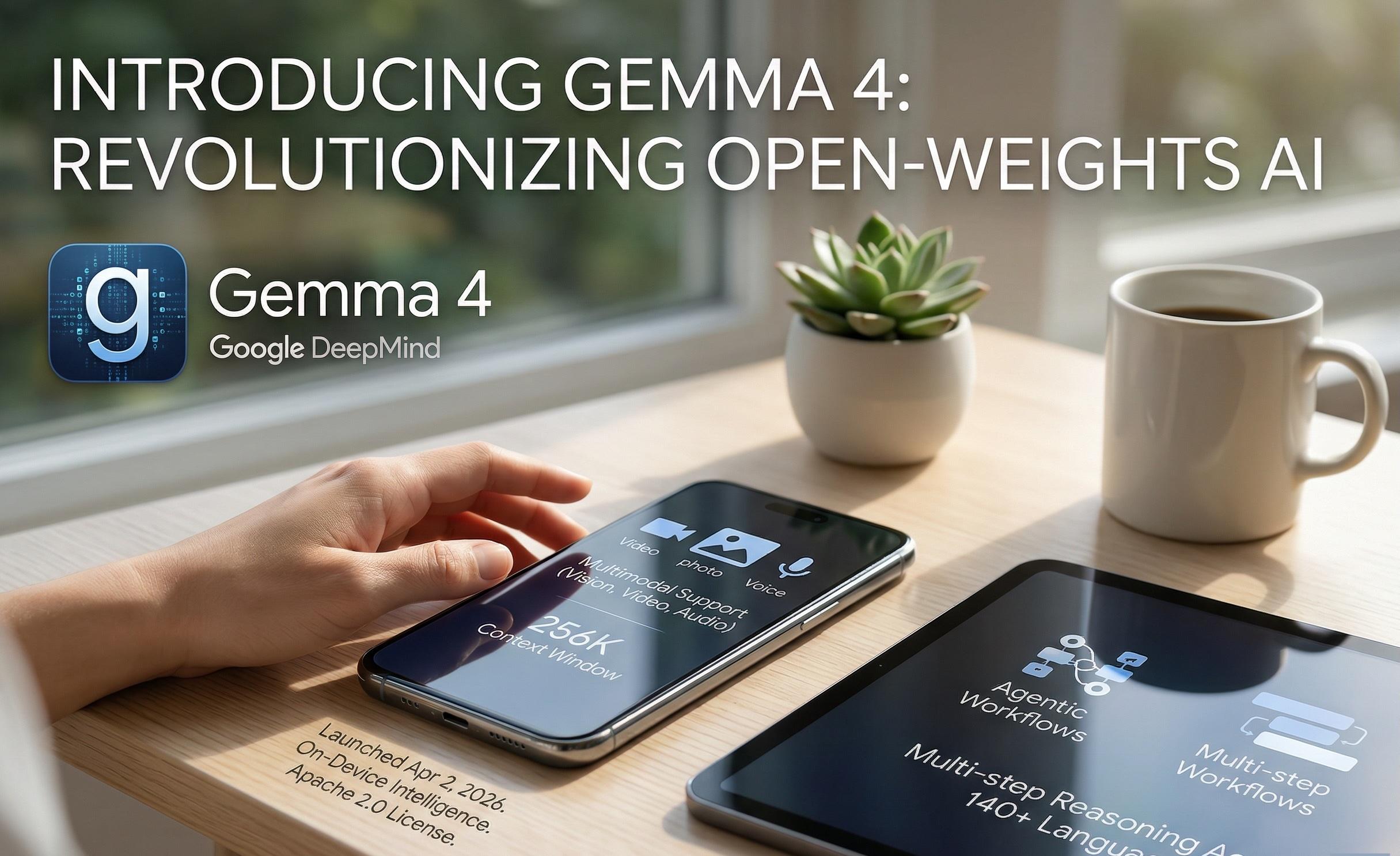
Google introduced Gemma 4 on April 2, 2026 as a family of open models for edge devices, developer workstations and cloud deployment. The lineup now includes the later Gemma 4 12B Unified model, making model selection less straightforward: the right choice depends on available memory, input modalities, context requirements and expected workload.
The short answer: start with E2B or E4B for mobile and constrained edge use, consider 12B for local multimodal work on a capable laptop, choose 26B A4B when inference efficiency matters, and use 31B when maximum quality is more important than memory and throughput.
What is Gemma 4?
Gemma 4 is a family of open-weight models from Google DeepMind. The models accept text and images, generate text, support function calling and include reasoning capabilities. Audio input is available on E2B, E4B and 12B. The family uses dense, Mixture-of-Experts and unified architectures across five sizes.
Google releases Gemma 4 under the Apache 2.0 license and provides pre-trained and instruction-tuned weights. That supports commercial and research use, but teams should still review the license, acceptable-use requirements and obligations that apply to their deployment.
Gemma 4 model lineup
The E in E2B and E4B means effective parameters. These smaller models use Per-Layer Embeddings: their total embedding footprint is larger than the number of parameters doing the main inference work. The A4B label on the 26B model means roughly four billion parameters are active for each token even though the full Mixture-of-Experts model contains 25.2 billion parameters.
Gemma 4 E2B: smallest edge model
E2B targets mobile and tightly constrained environments. It supports text, image and audio input with a 128K context window. Its smaller active parameter count lowers the deployment barrier, but quality is also below the larger models on Google’s reasoning, coding and multimodal evaluations.
Use E2B for prototypes and applications where local execution, latency or footprint matters more than maximum reasoning quality. Test the exact quantized build on the target device because context length, image input and runtime overhead can significantly change memory use.
Gemma 4 E4B: stronger mobile and laptop option
E4B retains audio and visual input while providing more capacity than E2B. Google positions it for mobile devices and laptops. It is a sensible starting point for on-device assistants, transcription-supported workflows and lightweight local applications that need more quality than E2B.
Gemma 4 12B Unified: the missing middle
Google added Gemma 4 12B on June 3, 2026. It fills the gap between the small edge models and the larger workstation models, and it is now essential to any complete Gemma 4 comparison.
The 12B model uses a unified, encoder-free architecture. Instead of relying on separate large vision and audio encoders, it projects image patches and audio waveforms directly into the model’s embedding space. Google says this reduces multimodal latency and allows the model to be fine-tuned as a single system.
It supports text, image and audio input, has a 256K context window and is designed to run locally on laptops with about 16GB of VRAM or unified memory when an appropriate model format and runtime are used.
Google Developers: Gemma 4 12B developer guide
Gemma 4 26B A4B: efficient workstation model
The 26B model uses a Mixture-of-Experts architecture with 25.2 billion total parameters and 3.8 billion active parameters. It provides access to a larger knowledge and reasoning capacity without activating the entire model for every token.
Google recommends 26B A4B as a useful general starting point when lower resource requirements and faster inference matter. It supports text and image input, but not native audio input.
Gemma 4 31B: highest-capacity dense model
The 31B dense model has the strongest results across most of Google’s published Gemma 4 benchmarks, but it also has the largest memory requirement. It is intended for larger servers, clusters or powerful local workstations.
Avoid describing its leaderboard position as permanently “at the top.” Google’s launch announcement reported that the 31B model ranked third and the 26B model sixth among open models on Arena AI as of April 1, 2026. Leaderboards change, so the date and evaluation context must remain attached to the claim.
Google’s April 2026 Gemma 4 launch announcement
Approximate model-loading memory
Google’s documentation provides the following approximate accelerator-memory requirements. These estimates include about 20% loading overhead but exclude additional runtime costs such as the context KV cache, input data and application code.
These are planning figures, not guaranteed application requirements. Long prompts can substantially increase KV-cache memory. Runtime, quantization format, batch size, image or audio processing and operating-system overhead also affect whether a model fits.
Current Gemma 4 model overview and memory guidance
Core Gemma 4 capabilities
Long context
E2B and E4B support 128K-token contexts. The 12B, 26B A4B and 31B models support 256K. A large context window can hold extensive source material, but retrieval and relevance filtering still improve cost, latency and answer quality.
Multimodal input
All five models can process text and images. E2B, E4B and 12B also accept audio. Video understanding is performed through sequences of frames. Outputs are text; the models do not natively generate images or audio.
Function calling and agent workflows
Gemma 4 supports structured function calling and system instructions, which makes it suitable for agentic applications. The model proposes tool calls; the surrounding application is responsible for permissions, validation, execution and error handling.
Multilingual support
Google says Gemma 4 was pre-trained on more than 140 languages and provides out-of-the-box support for more than 35. Performance will vary by language and task, so multilingual applications should use a language-specific evaluation set.
Put these ideas to work.
From a specific fix to a complete website, we can help you define the scope and get it done.
Discuss my websiteCustom Web & Application DevelopmentShare your goals. We typically reply within 4 hours with questions and practical next steps.
How to choose the right Gemma 4 model
- Choose E2B when the smallest practical footprint is the priority and the task is relatively constrained.
- Choose E4B for better quality on mobile or laptop hardware while retaining native audio.
- Choose 12B for local multimodal applications that need audio, longer context and stronger reasoning.
- Choose 26B A4B for efficient high-throughput text and image workloads on workstations or small servers.
- Choose 31B when published benchmark quality matters more than memory, latency and infrastructure cost.
Before committing, test at least two nearby sizes with the same prompts, quantization, context length and hardware. Measure accuracy, latency, peak memory, tokens per second and task completion—not model size alone.
Deployment options
Local and desktop deployment
Google supports Gemma through tools and runtimes including LiteRT-LM and provides model weights through Kaggle and Hugging Face. Community runtimes such as llama.cpp, MLX, Ollama and vLLM may provide additional formats and hardware support. Confirm that the model file and runtime are official or trusted before deployment.
Hosted API and cloud deployment
For teams that do not want to manage inference infrastructure, Google documents hosted access to the 31B and 26B A4B instruction-tuned models through the Gemini API. Gemma models can also be deployed through Google Cloud services such as Vertex AI, GKE and Cloud Run.
Google AI for Developers: running Gemma with the Gemini API
Limitations and responsible deployment
Gemma 4 can generate inaccurate, biased or unsafe output. Smaller models may struggle more with complex reasoning, while larger models increase cost and infrastructure requirements. Long context does not guarantee that the model will use every detail correctly.
- Validate outputs before using them for financial, medical, legal or security decisions.
- Restrict and log tool calls in agentic workflows.
- Do not expose secrets through prompts or unrestricted local folders.
- Evaluate the exact language, domain and quantization used in production.
- Add rate limits, content controls and human confirmation for consequential actions.
Related AI model and agent guides
- For a proprietary low-latency alternative, compare Gemini 3.7 Flash and Gemini 3.6 Flash.
- Understand Gemma’s wider model lineage in our Gemini 3 technical guide.
- For agent-first development tooling, read our Google Antigravity guide.
- Developers building terminal workflows can continue with our Gemini CLI guide.
- For architecture terminology, see our AI agent vs LLM vs RAG comparison.
- For another open-weight model family, compare OpenAI’s gpt-oss models.
Frequently asked questions
How many Gemma 4 models are there?
Google’s current core lineup has five sizes: E2B, E4B, 12B Unified, 26B A4B and 31B.
Which Gemma 4 models support audio?
E2B, E4B and 12B support native audio input. The 26B A4B and 31B models support text and image input.
Which Gemma 4 model is best for a laptop?
E4B is the lighter option. The 12B model provides stronger multimodal capability and Google positions it for capable laptops, including systems with approximately 16GB of VRAM or unified memory. Actual fit depends on quantization, context and runtime.
What is the context window?
E2B and E4B support 128K tokens. The 12B, 26B A4B and 31B models support 256K tokens.
Can Gemma 4 be used commercially?
Google releases Gemma 4 under Apache 2.0 and describes it as supporting responsible commercial use. Review the current license and usage policies for your application.
Summary
Gemma 4 now spans five models rather than the four included in the original launch guide. E2B and E4B serve mobile and edge workloads, 12B brings unified text-image-audio processing to capable laptops, 26B A4B balances capacity and inference efficiency, and 31B provides the strongest published results at the highest memory cost. Choose through workload-specific testing rather than parameter count or leaderboard position alone.