
Custom React & Next.js Development
React and Next.js development for fast, SEO-optimized web applications. SSR/SSG, headless CMS, TypeScript, Tailwind — built by the team that runs premiersol.co on the same stack.
Performance figures, response times, and support examples on this page depend on the project. Final targets, coverage, and acceptance criteria are agreed in writing before work begins.
Traditional websites built with server-rendered HTML are limited in interactivity. Single-page React applications are fast but invisible to search engines. Next.js solves both problems — it's the framework behind Netflix, Uber, and TikTok, combining React's component-driven UI with server-side rendering that Google and AI crawlers can index perfectly. If you need a web application that's fast, interactive, and ranks, this is the stack.
What We Build
- Full-stack Next.js web applications — SaaS platforms, client portals, dashboards, and complex data-driven tools built with Server-Side Rendering (SSR) and Static Site Generation (SSG) for perfect SEO and instant page loads.
- Headless CMS integrations — we connect Next.js to Sanity CMS, Contentful, or headless WordPress via APIs, giving you total design freedom with a familiar content management experience. Our own agency site (premiersol.co) runs on Next.js 16 + Sanity CMS — we use this stack daily.
- Headless e-commerce — Next.js frontend with Shopify, WooCommerce, or custom commerce backends for stores that need maximum speed and flexibility beyond what native themes allow.
- Progressive Web Apps (PWAs) — app-like experiences that work in mobile browsers with offline support and push notifications, without requiring an app store listing.
- TypeScript and Tailwind CSS as standard — every build uses TypeScript for reliability (bugs caught before production) and Tailwind for responsive, maintainable UI.
Projects We've Delivered
We built ProxiesThatWork — a high-performance Next.js web application with complex API data fetching for a proxy purchasing platform. We also developed a single-page portfolio application using React and Next.js, optimized for fast interaction and clean architecture.
Not sure whether Next.js or WordPress is right for your project? Read our comparison: Next.js vs WordPress in 2026: Which Platform Should You Choose?
Related services and insights
Continue exploring: custom web application development.
What the service covers
Next.js App Router & React Server Components
Leveraging the latest Next.js architecture for streaming SSR, parallel data fetching, and zero-JavaScript server components — delivering the fastest possible initial page loads.
TypeScript-First Development
Components, utility functions and API routes are written in strict TypeScript, so type errors are caught at compile time rather than after release.
Headless CMS Integration (Sanity, Contentful, Strapi)
Decoupled content management with real-time preview, visual editing, and type-safe SDKs. Your content team edits in a purpose-built studio while the frontend stays blazing fast.
Tailwind CSS v4 Design System
A component-driven design system built on Tailwind CSS v4 with CSS custom properties, container queries, and dark mode support — no runtime CSS overhead.
What the work aims to improve
Fast, App-Like Page Transitions
App-Like NavigationClient-side navigation with prefetched routes makes page transitions feel near-instant on typical connections. Combined with edge caching, the result is a smooth, app-like experience on the web.
Crawlable, SEO-Ready Pages
Server-Rendered HTMLServer-side rendering or static generation delivers complete HTML, structured data and Open Graph tags on first load, so pages are built to be crawled and indexed without client-side rendering gaps. Rankings still depend on content, links and competition.
Developer Experience & Velocity
Rapid IterationTypeScript, hot module replacement, component-level error boundaries, and comprehensive Storybook documentation keep development velocity high throughout the project lifecycle.
How the work is delivered
Architecture & Component Planning
Defining the route structure, data-fetching strategy (SSR vs SSG vs ISR), component hierarchy, state management approach, and CMS content schema.
Design System & Component Library
Building a Tailwind-based component library with responsive layouts, animation primitives, and accessibility baked in — documented in Storybook for team reference.
Feature Development & API Integration
Implementing business features, connecting CMS data sources, building API routes, and integrating third-party services — with test coverage at every layer.
Performance Optimization & Deployment
Bundle analysis, image optimization, font subsetting, edge caching configuration, and Vercel/AWS deployment with CI/CD pipelines and preview environments.
Before we start
- Share the starting point
- Send your website URL, platform, the problem to solve, and any deadline or budget constraints. An existing site may need an assessment before a solution can be recommended.
- Agree what is included
- Confirm deliverables, exclusions, dependencies, and pricing before work begins. Hosting, paid tools, content entry, and ongoing support should be discussed separately when needed.
- Define acceptance checks
- Agree which pages, devices, integrations, and measurements will be checked. Compare results with a documented baseline where performance or search work is involved.
- Plan access and handover
- Discuss account ownership, the access needed for delivery, documentation, and any training or maintenance arrangements. Confirm ongoing support in the written scope.
Please do not send passwords, API keys, or customer records through the inquiry form or chat.
Frequently Asked Questions
Why choose Next.js over a traditional WordPress site?
Next.js is a strong choice when you need application-like interfaces, server rendering, and fine control over delivery. WordPress can also be fast and secure when engineered well. The choice should depend on editorial workflow, functionality, team skills, and maintenance—not a blanket performance or security claim.
Can I still manage my content without a developer?
Absolutely. We pair Next.js with a headless CMS like Sanity, which provides an intuitive visual editor for your content team. They update text, images, and pages in real time — while the frontend stays fast and secure.
What affects the cost of a custom React or Next.js project?
Cost depends on the number of page templates and interactive features, how many APIs, data sources or CMS integrations are involved, authentication requirements, and how complete your designs are. We confirm scope, deliverables and price in writing before any build work begins.
Is Next.js genuinely better for SEO than plain React?
Next.js renders on the server, so crawlers and AI engines receive complete HTML rather than an empty shell they must execute JavaScript to fill. Plain client-side React frequently produces pages that appear blank to crawlers that do not run JavaScript — a common and quietly severe cause of invisible content. If organic search matters to your project, this difference alone usually decides the choice.
What is the difference between SSR, SSG, and ISR?
Static generation renders pages at build time and serves them instantly — ideal for content that changes rarely. Server-side rendering builds the page per request, suiting data that must be current. Incremental Static Regeneration sits between them: pages are static but refresh on a schedule or on demand. Most real applications use all three across different routes, and matching the strategy to each route's data volatility is what produces a site that is fast everywhere rather than fast on average.
Can you migrate our existing React app to Next.js?
Often yes, and usually incrementally rather than as a single risky rewrite. A common path is migrating high-value pages first — those where performance and search visibility matter most — while the existing application continues serving everything else. We map URLs and set up redirects before launch to protect accumulated search equity. Whether migration is worth it depends on what is actually costing you: if the issue is a slow back end, a front-end rewrite will not fix it, and we will say so.
Do we need TypeScript?
For most projects, yes — and it pays for itself quickly on anything that will be maintained beyond a few months. TypeScript catches an entire category of errors at build time rather than in production, and it makes the codebase substantially easier for a future developer to understand and change safely. On very small, short-lived projects the overhead may not be justified, and we will tell you when that is the case.
How long does a custom Next.js build take, and is it tested before launch?
Timing depends on the number of templates, integrations and interactive features, and how quickly designs, content and approvals arrive. You receive a timeline in the written scope. We build and test on a preview environment, not on your live site, and you receive the Git repository at handover.
Explore published projects
View All Projects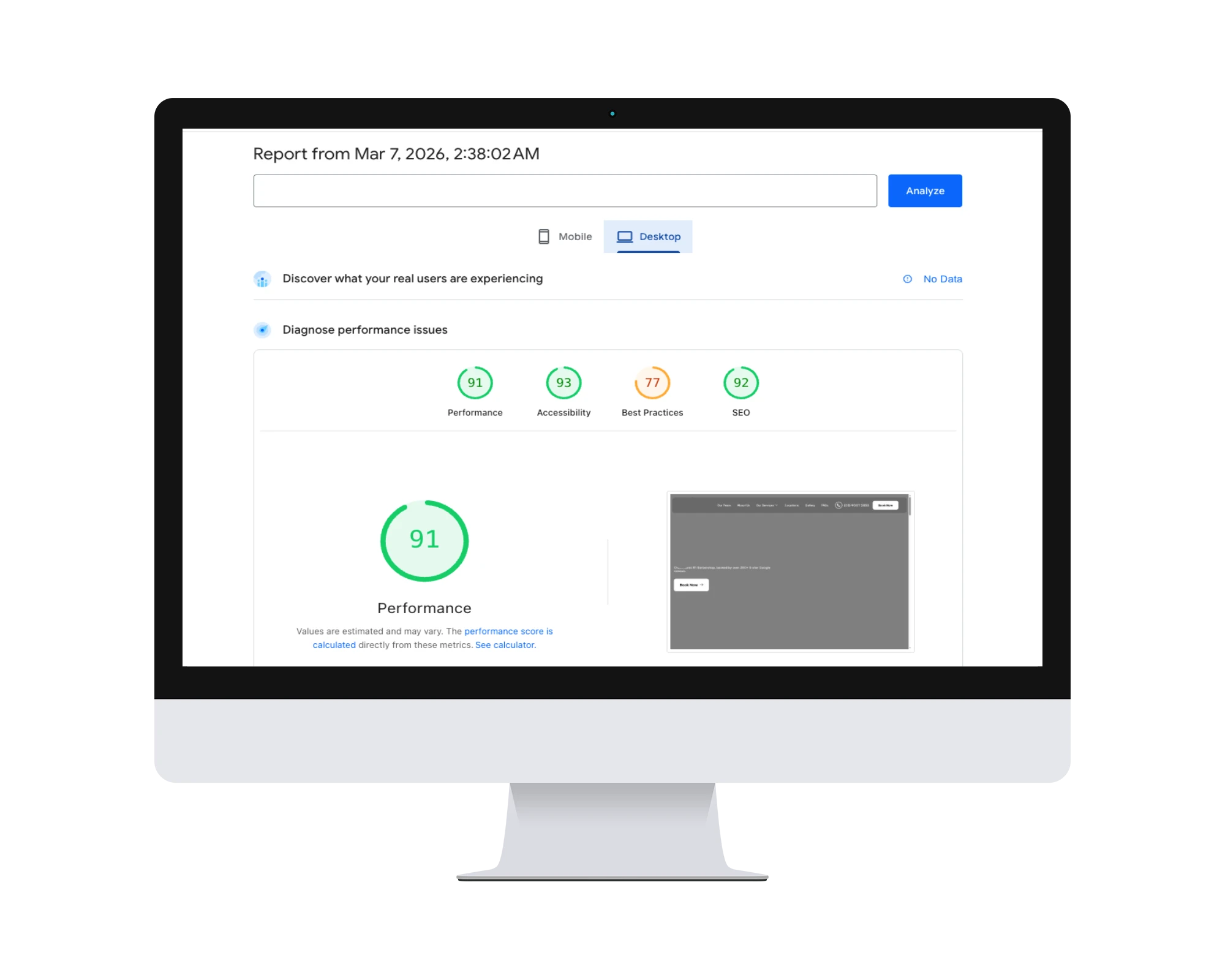
WordPress Speed Optimization: Rescuing a Sub-20 Desktop Score
Premier Solutions rescued a WordPress site failing desktop speed tests (under 20/100) using next-gen WebP images, multi-tiered caching, and JS minification to deliver top-tier Core Web Vitals.
View Case Study
WordPress Security Recovery: Complete Malware Removal & Hardening
A WordPress malware-recovery case study covering spam removal, rogue administrators, clean-file restoration and post-cleanup hardening.
View Case Study
High-Performance Single-Page Portfolio: Next.js & React.js Development
Premier Solutions engineered a fast, single-page personal portfolio with Next.js and React.js — a responsive, highly optimized digital presence with an app-like experience.
View Case StudyExplore our services

AI Search Optimization (AEO & GEO)
Improve how search and AI answer engines understand your website through crawlability, clear content, relevant structured data, and consistent business information.
Learn More
AI Integration & Chatbot Development
Connect Claude, ChatGPT, or Gemini to your website. We build custom AI chatbots, RAG knowledge systems, MCP integrations, and AI-powered workflows for WordPress and Next.js platforms.
Learn More
WordPress Maintenance & Care Plans
Monthly WordPress maintenance with tested updates, security monitoring, daily backups, uptime checks and priority support.
Learn MoreGuides for this service
- Next.js Development Agency for Fast, SEO-Ready SitesNext.js development services for fast, SEO-friendly websites and web apps: server rendering, headless CMS, integrations and Core Web Vitals.
- Headless WordPress with Next.js: Is It Worth It?What headless WordPress is, when pairing WordPress with Next.js is worth it, and how to migrate without losing SEO. Expert setup and support.