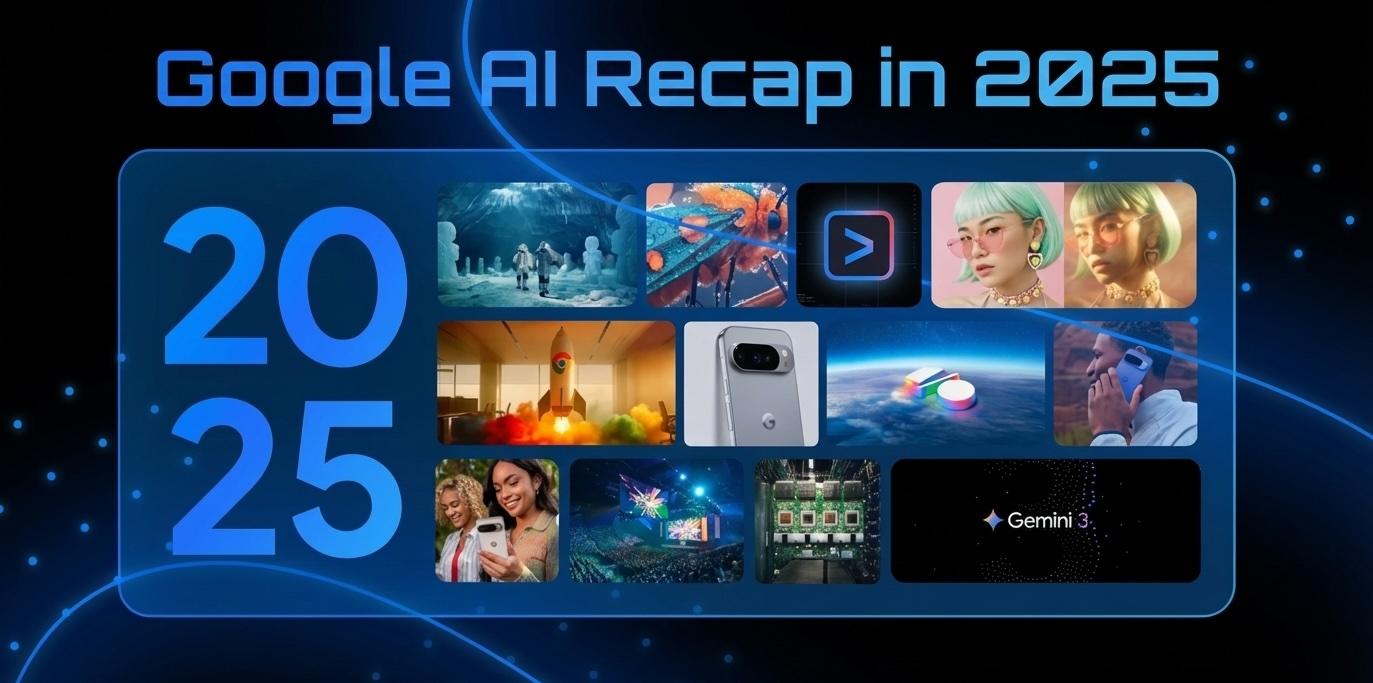
If 2024 was the year of the chatbot, Google AI in 2025 defined the era of the agent. Over the last twelve months, Google has executed one of the most aggressive technical pivots in its history, moving from experimental tools to a fully integrated, agentic ecosystem. Driven by intense competition and a renewed "Code Red" urgency, the tech giant unleashed a barrage of breakthroughs that fundamentally reshaped how we code, create, and search.
From the late-year release of the industry-leading Gemini 3 to the surprise launch of the Google Antigravity IDE, Google AI in 2025 was characterized by a shift from passive assistance to active autonomy. This comprehensive recap breaks down every major announcement, technical leap, and strategic shift that defined Google AI in 2025, offering a clear view of where the technology stands and where it is heading.
The Crown Jewel: A New Era with Gemini 3
The narrative of Google AI in 2025 culminated in November with the launch of Gemini 3. While Gemini 2.5 (released in March) kept Google competitive, Gemini 3 established a new ceiling for multimodal intelligence.
Gemini 3 Deep Think
The standout feature of this generation was Gemini 3 Deep Think. Moving beyond simple token prediction, this "System 2" reasoning mode allows the model to "pause" and deliberate before responding. It engages in an internal chain-of-thought process—iteratively testing hypotheses, debugging its own logic, and planning multi-step solutions. This capability was instrumental in Gemini 3 achieving gold-medal standards at the International Mathematical Olympiad, proving that Google AI in 2025 had finally cracked the code on deep, abstract reasoning.
Learn, Build, and Plan
Google marketed Gemini 3 not just as a model, but as a universal engine to "Learn, Build, and Plan anything."
- Learn: The model can ingest massive datasets—entire textbooks, hours of video lectures, or complex legal briefs—and synthesize them into interactive study guides or Socratic tutoring sessions.
- Build: With improved coding capabilities, Gemini 3 powers the new generation of agentic coding tools, capable of refactoring legacy codebases or scaffolding entire apps from a single prompt.
- Plan: Its extended context window and reasoning allow it to handle logistical nightmares, from corporate merger roadmaps to intricate travel itineraries, resolving conflicts and dependencies autonomously.
The Developer Revolution: Google Antigravity
For software engineers, the defining moment of Google AI in 2025 was the release of Google Antigravity. Recognizing that chat interfaces were insufficient for complex software engineering, Google launched this "AI-first" Integrated Development Environment (IDE) to compete with tools like Cursor and Windsurf.
Google Antigravity redefines the developer experience by treating the AI not as a copilot, but as a proactive partner. It features a "Mission Control" interface where developers can dispatch autonomous agents to handle asynchronous tasks. You might assign one agent to write unit tests for a module while another researches a documentation update—all running in parallel.
- Planning Mode vs. Fast Mode: Developers can toggle their agents between "Planning Mode" (where the agent generates artifacts like task lists and architectural diagrams for review) and "Fast Mode" (for quick, low-stakes code execution).
- Browser Control: A key differentiator for Google AI in 2025, Antigravity agents can launch a headless browser to "see" the web apps they are building, verifying UI elements and visual functionality in real-time.
Visual Mastery: Nano Banana and Nano Banana Pro
In the realm of creative media, Google AI in 2025 took a playful yet powerful turn with the rebranding of its image generation capabilities under the Nano Banana moniker.
- Nano Banana: Launched in August as the "Gemini 2.5 Flash Image" model, this tool prioritized speed and efficiency, becoming a favorite for rapid prototyping and social media content.
- Nano Banana Pro: The November release of Nano Banana Pro (Gemini 3 Pro Image) brought professional-grade precision. It addressed the biggest pain points of generative art: text rendering and consistency.
- Style Reference: Users can upload up to 14 reference images, effectively giving the model a "style guide" to ensure brand consistency across logos, characters, and color palettes.
- Text Rendering: Finally solving the "gibberish text" issue, Nano Banana Pro generates crisp, legible typography within images, making it viable for marketing posters and UI mockups.
Put these ideas to work.
From a specific fix to a complete website, we can help you define the scope and get it done.
Discuss my websiteCustom Web & Application DevelopmentShare your goals. We typically reply within 4 hours with questions and practical next steps.
Search and Workspace: The AI Utility
While frontier models grabbed headlines, the integration of Google AI in 2025 into everyday products cemented its utility.
AI Overviews and AI Mode
The controversial "Search Generative Experience" evolved into standard AI Overviews. After a volatile start to the year, Google stabilized the feature, which now appears on roughly 15-20% of queries. The focus shifted from purely informational queries to complex transactional and navigational tasks. The introduction of "AI Mode" in Search allowed users to perform "Deep Search" queries—generating detailed, cited reports that synthesize hundreds of web sources into a comprehensive briefing.
Workspace and Google Vids
In Google Workspace, the "Help Me Write" features matured into full-blown collaborative agents. The most significant addition was Google Vids, an AI-powered video creation app for enterprise. It allows users to generate training videos, executive updates, and project recaps by simply dropping in a Drive folder or a prompt. The AI writes the script, selects stock footage (or generates it with Veo 2/3), and adds voiceovers, democratizing video production for the office.
Conclusion
Looking back, Google AI in 2025 was a year of maturing capability and strategic realignment. The company successfully moved past the "hallucination" era into the "reasoning" era. With Gemini 3 providing the brains, Google Antigravity providing the hands, and Nano Banana providing the eyes, Google has built a cohesive, agentic ecosystem. As we move into 2026, the foundation laid by Google AI in 2025 suggests a future where our devices don't just answer our questions—they do our work.
Frequently Asked Questions (FAQs)
1. What is the difference between Nano Banana and Nano Banana Pro?
Nano Banana refers to the Gemini 2.5 Flash Image model, optimized for high speed and low latency, making it ideal for quick drafts and simple visuals. Nano Banana Pro is the advanced Gemini 3 Pro Image model, designed for professional workflows. It supports up to 14 reference images for style consistency, renders accurate text, and handles complex prompt adherence better than the standard version.
2. Is Google Antigravity free to use?
As of the late 2025 public preview, Google Antigravity is available for free to individual developers. It includes generous access to Gemini 3 models for powering agents. However, Google has hinted at future paid tiers for enterprise features, such as advanced team collaboration, unified fleet management, and higher rate limits for the underlying models.
3. How does Gemini 3 Deep Think work?
Gemini 3 Deep Think utilizes a "System 2" reasoning approach. Instead of predicting the next word immediately, the model generates hidden "thought tokens." It uses this internal monologue to break down complex problems, verify its own assumptions, and plan a multi-step response before presenting the final answer to the user. This significantly reduces errors in math, coding, and logic tasks.
4. What happened to Google Search in 2025?
Google Search evolved significantly with the stabilization of AI Overviews, which now provide direct answers for complex queries. Additionally, Google introduced AI Mode in Search, a feature that allows for "Deep Research." This mode can autonomously perform hundreds of background searches to compile comprehensive reports, essentially automating the process of browsing multiple tabs for deep topics.
Summary
Google AI in 2025 was defined by the transition to agentic intelligence. The headline release was Gemini 3, featuring Deep Think reasoning capabilities that allow for complex problem-solving. Creative tools saw a major upgrade with Nano Banana Pro, offering professional-grade image control. For developers, Google Antigravity introduced an agent-first IDE that automates coding workflows.
Reference Links