
The landscape of frontend development is undergoing a seismic shift. For years, developers have manually tuned applications for performance, wrestling with dependency arrays and memoization hooks. Today, that era ends. With the convergence of the React Compiler, React 19.2.3, and Next.js 16.1.1, we are entering a new age of automatic optimization and unparalleled developer experience.
This comprehensive guide explores how these three technologies intertwine to create a faster, more efficient web. We will dive deep into the mechanics of the React Compiler, the stability features of React 19.2.3, and the robust infrastructure of Next.js 16.1.1. Whether you are a senior engineer or a curious beginner, understanding the React Compiler is now a non-negotiable skill.
The Revolution: Introducing the React Compiler
At the heart of this update is the React Compiler. For as long as React has existed, re-renders have been both its superpower and its kryptonite. React’s declarative nature means developers describe the UI, and React handles the updates. However, inefficient re-renders often plagued complex apps, forcing developers to use manual optimization tools like useMemo, useCallback, and React.memo.
The React Compiler changes everything. It is an automatic optimizing compiler that understands the rules of JavaScript and React. It analyzes your code at build time and automatically rewrites it to memoize values and components. This means you no longer need to manually write memoization logic. The React Compiler handles it for you.
How the React Compiler Works
The React Compiler uses advanced static analysis to determine which parts of your component tree need to re-render and which do not. It effectively "learns" the data flow of your application. When a state change occurs, the React Compiler ensures that only the specific DOM nodes dependent on that state are updated.
Without the React Compiler, if a parent component re-renders, all its children re-render by default unless manually memoized. With the React Compiler, this "cascading re-render" problem is eliminated. The compiler intelligently inserts memoization barriers, ensuring that a component only re-renders if its specific props have materially changed.
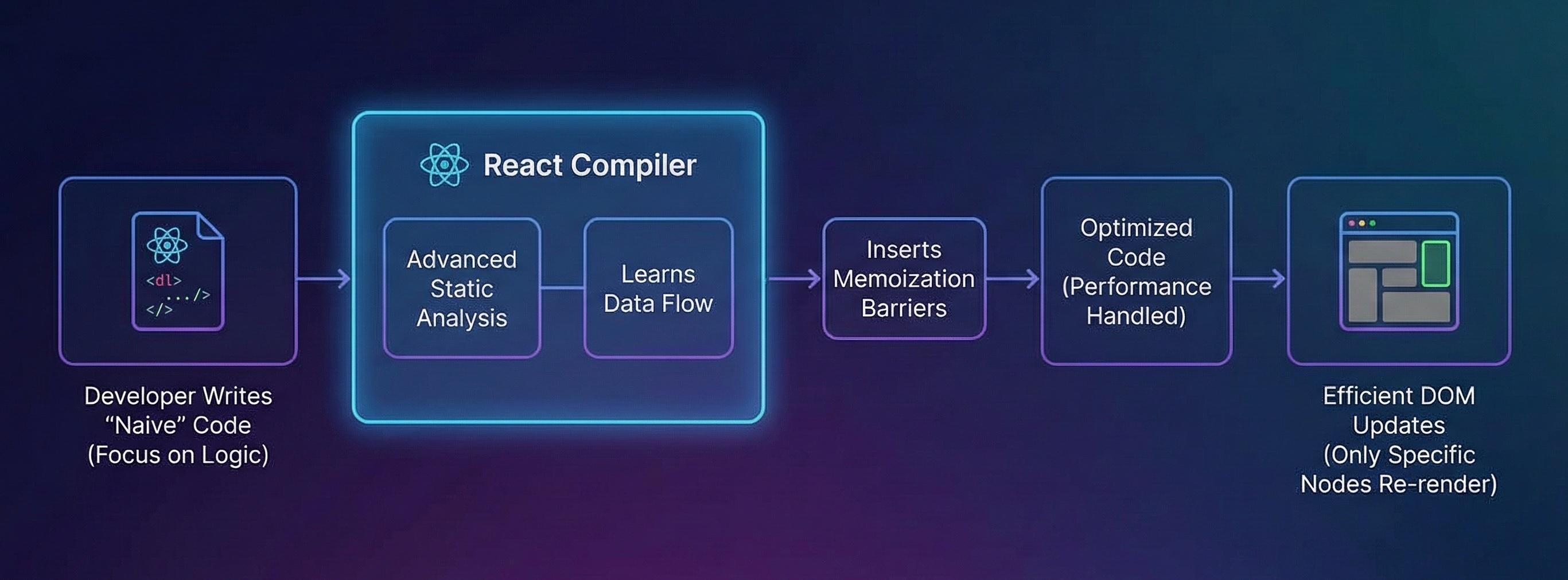
This is not just a minor tweak; it is a fundamental shift in how we write React. The React Compiler allows developers to write "naive" code—code that focuses purely on business logic—while the compiler handles the performance characteristics. The days of debating whether to memoize a simple function are over because the React Compiler makes that decision mathematically and optimally every time.
Benefits of the React Compiler
The primary benefit of the React Compiler is improved runtime performance. Applications feel snappier, especially on lower-end devices, because the main thread is not bogged down by unnecessary reconciliation work.
Secondly, the React Compiler drastically improves the Developer Experience (DX). You can delete thousands of lines of useMemo and useCallback from your codebase. This makes your code cleaner, easier to read, and harder to break. The React Compiler essentially manages the dependency arrays for you, eliminating the class of bugs where a stale closure causes the UI to desync from the state.
Thirdly, the React Compiler is designed to be safe. It acts conservatively. If it cannot prove that a piece of code is safe to optimize (for example, if it violates the Rules of React), it will skip optimization for that specific part and continue optimizing the rest. This ensures that adopting the React Compiler does not break your existing application logic.
React 19.2.3: Stability and New Primitives
While the React Compiler steals the headlines, the underlying runtime, React 19.2.3, provides the necessary primitives to support modern application needs. React 19.2.3 is a stability release that refines the groundbreaking features introduced in React 19.0, focusing on concurrent rendering and server-side capabilities.
The <Activity> Component
One of the most exciting features solidified in React 19.2.3 is the <Activity> component (formerly known as Offscreen). This primitive allows developers to mark parts of the component tree as "inactive" without unmounting them.
In previous versions, if you wanted to hide a tab or a heavy chart, you typically unmounted it to save memory. However, unmounting destroys the state. When the user navigated back, the component had to mount from scratch, resetting the state and causing a layout shift.
With React 19.2.3, you can wrap that component in <Activity mode="hidden">. React will visually hide the content and deprioritize its updates, but the state remains "warm" in memory. When the user switches back, the content appears instantly with the previous state intact. This works hand-in-hand with the React Compiler, which ensures that these hidden components do not cause background re-renders that eat up CPU cycles.
useEffectEvent Hook
React 19.2.3 introduces useEffectEvent, a specialized hook that solves a common pain point: using reactive values inside an effect without triggering the effect.
Often, you want an effect to run only on specific triggers (like onMount), but the effect needs access to the latest value of a prop or state (like a theme or logger). Adding that value to the dependency array would cause the effect to re-run unnecessarily. useEffectEvent creates a stable function handle that always sees the fresh props but does not invalidate the effect's dependencies. This simplifies code and, when combined with the React Compiler, ensures that your side effects are strictly predictable.
Next.js 16.1.1: The Perfect Host
The React Compiler needs a build system to function, and Next.js 16.1.1 is the first major framework to provide stable, production-ready support for it. Next.js 16.1.1 is not just a wrapper; it is a vertically integrated stack designed to maximize the potential of React 19.
Turbopack is Now the Default
Next.js 16.1.1 marks the moment where Turbopack becomes the stable, default bundler for development. Written in Rust, Turbopack is significantly faster than Webpack. It is engineered to handle the intense static analysis required by the React Compiler.
When you run next dev in Next.js 16.1.1, you will notice near-instant server starts and Hot Module Replacement (HMR) that feels instantaneous, even in massive codebases. This speed is crucial because the React Compiler adds a compilation step. Turbopack offsets this cost, ensuring that your feedback loop remains tight.
Stable React Compiler Support
Next.js 16.1.1 introduces a simple configuration flag to enable the React Compiler. In your next.config.js, you simply set experimental: { reactCompiler: true } (note: in 16.1.1 this may have moved to a top-level or stable key, check official docs, but the integration is seamless).
Next.js handles the complex Babel setup and plugin integration automatically. It also integrates the React Compiler linter into the build process. If you write code that violates React's rules—like mutating a prop or using a hook conditionally—the build will warn you, explaining exactly why the React Compiler cannot optimize that segment.
Server Actions and Caching
Next.js 16.1.1 refines the caching heuristics for Server Actions. With the React Compiler optimizing the client-side interactivity, Next.js focuses on moving heavy lifting to the server. The framework now creates smarter boundaries between server and client code. The React Compiler is smart enough to recognize "use client" boundaries and optimize the serialization process, ensuring that data passed from server to client is minimal and efficient.
The Synergy: How They Work Together
The magic happens when you combine the React Compiler, React 19.2.3, and Next.js 16.1.1. This triad creates a "pit of success" for developers.

Imagine a large e-commerce dashboard.
- Next.js 16.1.1 serves the initial HTML using Server Components, fetching data directly from the database without client-side waterfalls.
- React 19.2.3 hydrates the page efficiently.
- The React Compiler ensures that as the user types in a search filter, only the product list updates. The header, the sidebar, and the footer remain static in the DOM, consuming zero resources.
- If the user switches tabs, the
<Activity>component keeps the dashboard state alive in the background.
This level of performance used to require a team of dedicated performance engineers. Now, it is the default behavior provided by the React Compiler within the Next.js ecosystem.
Put these ideas to work.
From a specific fix to a complete website, we can help you define the scope and get it done.
Discuss my websiteCustom React & Next.js DevelopmentShare your goals. We typically reply within 4 hours with questions and practical next steps.
Hands-On: Enabling the React Compiler in Next.js 16.1.1
Migrating to this new stack is surprisingly straightforward, but requires attention to detail.
Step 1: Upgrade Dependencies First, ensure you are on the latest versions.
npm install react@latest react-dom@latest next@latest
This installs React 19.2.3 and Next.js 16.1.1.
Step 2: Install the Compiler Plugin You need the babel plugin for the React Compiler if you are not using the SWC-only route, although Next.js 16 largely bundles the logic.
npm install babel-plugin-react-compiler
Step 3: Update Configuration Open next.config.js and enable the compiler.
const nextConfig = {
  experimental: {
    reactCompiler: true,
  },
};
module.exports = nextConfig;
Step 4: Audit Your Code Run your development server. The React Compiler is now active. You may see ESLint warnings. These are good! They are telling you where your code violates React rules. Common violations the React Compiler flags include:
- Mutating state directly (e.g.,
state.value = 5). - Writing to
ref.currentduring render. - Using hooks inside loops or conditions.
Fixing these issues helps the React Compiler do its job. Once the warnings are gone, your app is automatically optimized.
Performance Benchmarks: The React Compiler Effect
Early benchmarks of the React Compiler show staggering results. In heavy visualization apps (like stock charts or drag-and-drop interfaces), the React Compiler can reduce re-renders by over 60%.
In a standard Next.js 16.1.1 application, enabling the React Compiler typically reduces the Total Blocking Time (TBT) by 20-40%. This is because the JavaScript execution time on the main thread is significantly reduced. The browser spends less time computing diffs and more time responding to user input.
Crucially, the React Compiler improves scalability. As you add more features and components to your app, performance usually degrades. With the React Compiler, performance remains linear. The compiler ensures that adding a new, unrelated component does not slow down existing ones. This "performance insurance" is perhaps the most valuable aspect of the React Compiler for enterprise teams.
Common Misconceptions about the React Compiler
There are several myths surrounding the React Compiler that need debunking.
Myth 1: "The React Compiler fixes bad code." False. The React Compiler optimizes valid React code. If your code is fundamentally broken or violates React's core principles (like purity), the compiler will bail out or, in rare cases, amplify the bug. You still need to be a good engineer.
Myth 2: "I never need useMemo again." Mostly true, but with exceptions. The React Compiler handles 99% of cases. However, if you are integrating with a non-React library (like D3.js or a jQuery plugin) and need to guarantee reference stability for an external API, you might still manually use useMemo. But for React-to-React data flow, the React Compiler has you covered.
Myth 3: "The React Compiler makes builds slow." While the React Compiler does add a step to the build process, Next.js 16.1.1's Turbopack is optimized to handle this. The perceived difference in build time is negligible, often measured in milliseconds, while the gain in runtime performance is massive.
The Future of the React Compiler
We are only at version 1.0 of the React Compiler integration. The team at Meta has ambitious plans. Future versions of the React Compiler may be able to auto-parallelize rendering tasks or automatically split code bundles based on usage patterns.
In Next.js, we can expect the React Compiler to become even more deeply integrated with Server Actions, potentially optimizing the serialization format based on the client's needs. The React Compiler is not a static tool; it is a living part of the ecosystem that will grow smarter over time.
Conclusion
The release of React 19.2.3 following React 19.2 and Next.js 16.1.1 is a watershed moment, but the React Compiler is the true revolutionary. It fundamentally changes the value proposition of React. It removes the "performance tax" of the virtual DOM and allows developers to focus entirely on building great user experiences.
By automating optimization, the React Compiler democratizes high-performance web development. You no longer need to be a performance expert to build a blazing-fast app; you just need to enable the React Compiler. As you plan your roadmap for 2026, upgrading to this stack should be your top priority. The React Compiler is ready, and it is time to let the machine handle the rest.
Frequently Asked Questions (FAQs)
1. Is the React Compiler safe to use in production with Next.js 16.1.1?
Yes, the React Compiler is considered stable for production use in Next.js 16.1.1. It has been tested extensively at Meta on platforms like Instagram. However, because it changes how your code runs, you should thoroughly test your application after enabling the React Compiler to ensure no strict mode violations cause issues.
2. Does the React Compiler replace useMemo and useCallback?
Effectively, yes. In a codebase using the React Compiler, you generally do not need to write useMemo or useCallback. The React Compiler automatically applies memoization where needed. You can safely remove most existing manual memoization hooks to clean up your code.
3. What happens if the React Compiler encounters code it cannot optimize?
The React Compiler is designed to be "safe." If it encounters code that violates React rules or is too complex to analyze statically, it will simply "bail out" for that specific component and compile it as standard React code. It will not break your app; it just won't optimize that specific part.
4. Can I use the React Compiler with older versions of React?
No. The React Compiler requires the runtime primitives introduced in React 19. You must upgrade to React 19 (ideally 19.2.3 or newer) to use the React Compiler. It is not backward compatible with React 18 or 17.
5. How do I debug issues caused by the React Compiler?
Next.js 16.1.1 includes React DevTools that are React Compiler aware. When inspecting components, you will see a badge indicating if a component has been optimized by the React Compiler. If you suspect an issue, you can temporarily disable the compiler in your config to verify if the bug persists.
Summary
The combination of the React Compiler, React 19.2.3, and Next.js 16.1.1 represents the new standard for web development. The React Compiler automatically optimizes application performance by memoizing components and values, removing the need for manual hooks like useMemo. React 19.2.3 stabilizes critical features like the <Activity> component for keeping background states alive. Next.js 16.1.1 provides the robust, Turbopack-powered infrastructure to run the React Compiler efficiently. Together, they offer a developer experience that is cleaner, faster, and more scalable, marking the end of manual performance tuning in React applications.
Reference Links