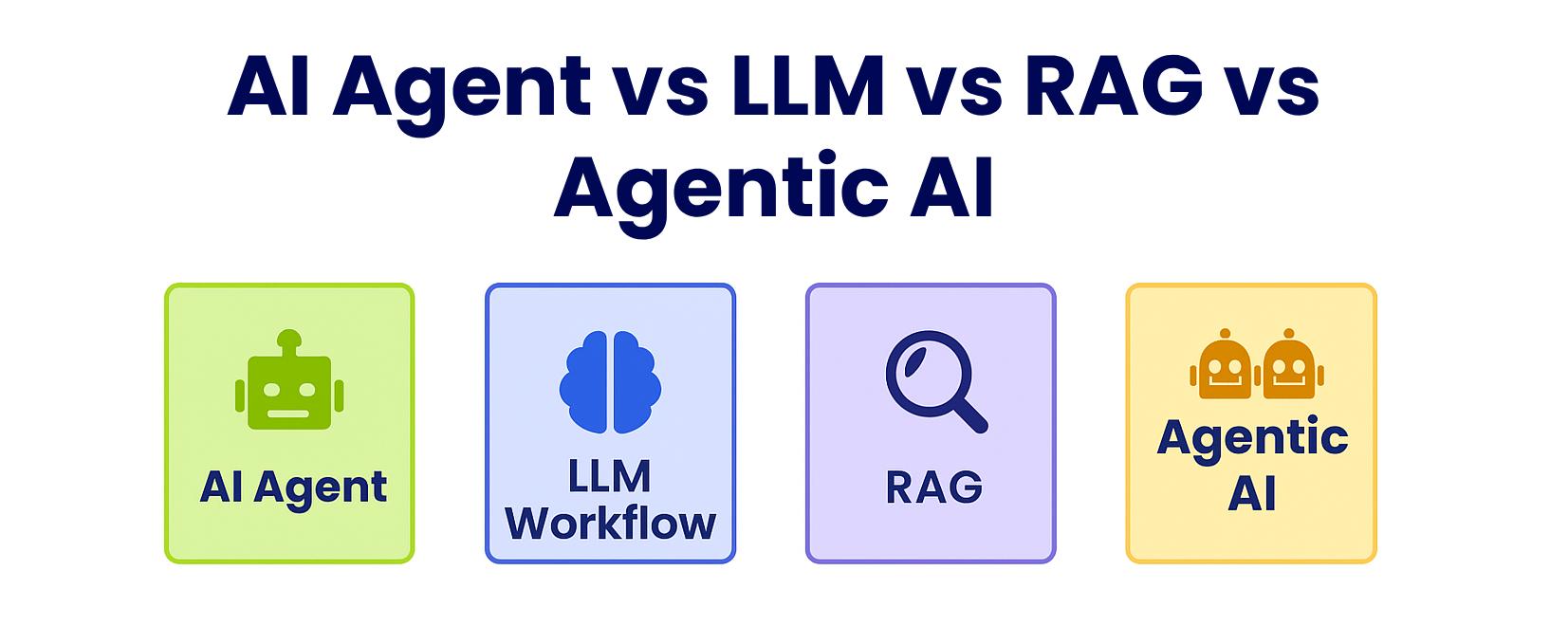
Understanding the modern ecosystem of artificial intelligence requires clarity on key concepts: AI Agent, LLM (Large Language Model), RAG (Retrieval-Augmented Generation), and Agentic AI. While these terms are related and often overlap, each occupies a distinct role within intelligent systems. In this guide, we’ll explore the definitions, architectures, capabilities, and real-world applications of each, helping you determine when and how to leverage them for your own projects.
What is an LLM (Large Language Model)?
An LLM (Large Language Model) is a neural network trained on vast amounts of text to generate, summarize, translate, or analyze language. Its core ability is to predict and generate human-like text based on context, making it an "AI brain" for applications like chatbots, virtual assistants, search, and content creation. LLMs are passive—they wait for prompts and respond with language without performing actions or interacting with the world directly.
Examples
- OpenAI’s GPT-4
- Google Gemini
- Anthropic Claude
- Meta Llama
What is an AI Agent?
An AI Agent is an autonomous or semi-autonomous system that can perceive its environment, make decisions, and take actions towards specific goals without constant human guidance. AI Agents employ LLMs for reasoning and language understanding but possess additional capabilities like tool use, workflow automation, environment interaction, and even learning from feedback. They are the connective tissue that moves from "thought" (LLM) to "action" and tangible results.
Examples
- AI code assistants (Cursor, Copilot)
- Virtual customer assistants
- Autonomous vehicles
What is RAG (Retrieval-Augmented Generation)?
RAG (Retrieval-Augmented Generation) is an AI framework where a language model is “augmented” with a retrieval system that fetches external data at query time—bridging the gap between static model knowledge and real-time, context-specific information. When the LLM receives a prompt, RAG enables it to query databases, search engines, or knowledge repositories, then blend retrieved context into its output for more factual, current, and transparent responses.
Benefits
- Updates knowledge on-the-fly
- Cites sources for transparency
- Reduces hallucination and outdated information
- Enables use of internal/private data
Examples
- AI-powered search copilots
- LLM systems with external document access
What is Agentic AI?
Agentic AI refers to systems that combine the autonomous, goal-driven, and adaptive behaviors of multiple AI agents—often orchestrated by LLMs, RAG, planning algorithms, and memory. These systems execute end-to-end workflows independently, solve multi-step problems, learn from feedback, adapt to new environments, and pursue objectives across ever-changing contexts.
Features
- Autonomy and adaptability
- Real-time action and planning
- Tool use, memory, environment perception
- Seamless integration of LLM, RAG, and agent behaviors
Examples
- Business process automation agents
- Robotics with integrated planning and information retrieval
- Complex multi-agent systems in customer support or logistics
Put these ideas to work.
From a specific fix to a complete website, we can help you define the scope and get it done.
Discuss my websiteCustom Web & Application DevelopmentShare your goals. We typically reply within 4 hours with questions and practical next steps.
Real-World Synergies – Why Definitions Matter
LLMs, AI Agents, RAG, and Agentic AI are not mutually exclusive—they’re layers of an intelligence stack:
- LLM
- Reasoning, language skills, pattern recognition
- Needs prompt to act
- RAG
- Adds timely, factual grounding for LLM answers
- Useful for enterprise knowledge, search, compliance
- AI Agent
- Wraps LLM and/or RAG in an action-oriented architecture
- Automates workflows, uses APIs, manipulates environments
- Agentic AI
- Orchestrates many agents, with memory/planning/learning
- Delivers business outcomes, autonomous adaptation, and multi-step reasoning
In modern systems, Agentic AI often combines LLM for communication/comprehension, RAG for up-to-date info, and AI Agent logic for action and memory.
When to Use Each Framework
- Use LLM when creativity, summarization, conversation, or simple text analysis is the goal.
- Use RAG for search, question answering, or anything requiring accuracy, citations, or enterprise context.
- Use AI Agent for task automation, tool chaining, or workflow execution, especially when direct API or system interaction is needed.
- Use Agentic AI for autonomous, real-world results—complex multi-agent orchestration, robotics, enterprise operations, and environments with changing data and requirements.
Practical Example
Scenario:
You’re building a customer support AI.
- LLM: Answers simple questions using its trained knowledge
- RAG: Pulls in the latest troubleshooting steps from your documentation, so the model is never out-of-date
- AI Agent: If a customer needs their password reset, the agent calls backend APIs, logs the request, and updates the customer record
- Agentic AI: Several agents collaborate—handling customer interactions, updating backend systems, escalating complex issues—without extra coding or human intervention.
The Evolution of Intelligence – The Future with Agentic AI
The trend is clear: AI systems are moving beyond passive text generation. Practical, scalable AI will be agentic—interacting with APIs, collecting feedback, planning over time, and retrieving relevant info when needed. This shift enables solutions with autonomy, memory, and awareness, dramatically increasing the useful impact of artificial intelligence in businesses, research, and society.
Frequently Asked Questions
1. What’s the main difference between an LLM and an AI Agent?
An LLM only generates or summarizes text; an AI Agent takes actions autonomously, uses LLMs for reasoning, and interacts with environments and tools.
2. Why is RAG important?
RAG improves LLM output with timely, real-world facts, reducing hallucinations and ensuring sources and citations for compliance and trust.
3. Is Agentic AI just a buzzword?
No—Agentic AI orchestrates LLMs, RAG, and agents for autonomy, adaptability, long-term memory, and real results in the world, such as robotics, business process automation, and autonomous customer service.
4. Can AI Agents work without an LLM or RAG?
They can, but usually have limited language understanding or dynamic reasoning. Most modern agents leverage LLMs for comprehension and RAG for up-to-date data.
5. Are these technologies converging?
Absolutely! The most advanced systems use LLMs for understanding, RAG for knowledge, agents for action, and Agentic AI for full autonomy and orchestration.
Summary
In the emerging world of AI system design, understanding AI Agent vs LLM vs RAG vs Agentic AI is vital. LLMs generate human-like text; RAG augments them with fresh, factual knowledge; AI Agents automate workflows and tasks; and Agentic AI delivers full autonomy, adaptability, and business value at scale. The synergy of these technologies is unlocking breakthroughs in creativity, automation, and real-world intelligence—ushering in the next era of AI-powered solutions.
Reference Links