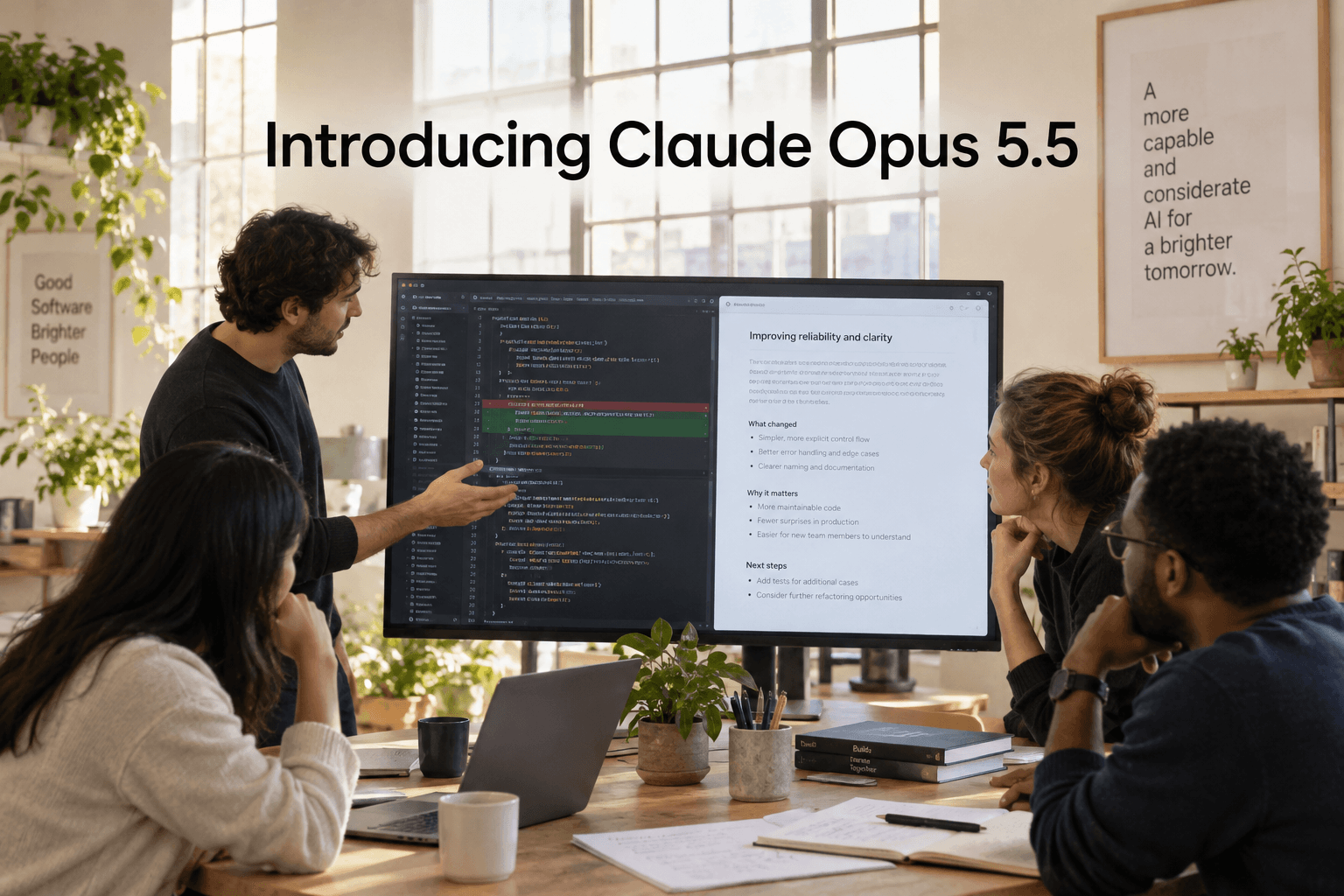
Claude Opus 5.5 arrived on September 22, 2026. For teams that use AI to build software or work through large documents, it raises a useful question: can a new model do the same job with less cost and review?
Anthropic presents this release as a step forward for coding and knowledge work. Its launch announcement reports stronger performance and lower task costs than Opus 5. Those are vendor-reported results. This introduction explains the verified product details and suggests how to test them on your own work.
Details were checked on September 23, 2026. We have not run an independent hands-on benchmark for this article.
What is Claude Opus 5.5?
Opus 5.5 is an Anthropic model built to work through tasks that may involve many steps. It accepts text and images and returns text. Its standard limits include a one-million-token context window and up to 128,000 output tokens, according to the official model page.
A token is a small unit of text used to measure input and output. A large context window lets a model consider more material at once. It does not mean that every detail in a long file will be handled correctly.
For a website team, the value is easier to picture as a workflow. Give the model a bug report, relevant files and a clear test. Ask it to propose a fix, check the result and explain what still needs review.
What does it cost?
Standard API pricing is $4 per million input tokens and $20 per million output tokens. Cache reads cost $0.20 per million tokens. These are API rates, not the price of a Claude chat subscription.
Here is a simple budget example. A request with 100,000 uncached input tokens and 10,000 billed output tokens costs $0.60 at the standard base rates. That is $0.40 for input plus $0.20 for output. Tool fees, extra requests and other pricing options can change the total.
Anthropic's claim of a 40% cost drop versus Opus 5 includes token-use efficiency. The base input and output rates themselves are 20% lower. Do not treat the larger claim as a guaranteed saving on every task.
Track the cost of work your team accepts. A cheap answer that needs a rewrite may cost more than a stronger answer with a higher token bill.
What changed for developers?
Opus 5.5 uses adaptive thinking that stays on. Its default effort is medium. Effort affects how much work the model puts into a task, so an old setting should be tested again.
There are also API changes to check. Forced tool selection can return an error. Earlier computer-use tool definitions need changes on some platforms. Apps that show progress between tool calls may need to handle a different response shape.
Read Anthropic's migration guide before switching a live integration. A successful plain-text request does not prove that a full tool workflow will still work.
Our earlier gives the prior release context. Use the current vendor docs for the exact new API behavior.
Three useful first tests
Start with a real task small enough to review in full. These are proposed pilot ideas, not results we measured.
For code, choose a contained bug with an existing failing test. Give the model the expected behavior and the files it may edit. Review the patch and run the tests yourself.
For documents, ask it to turn a messy project brief into a clear scope. Require a list of open questions. Compare the result with the source so a confident guess does not become a client promise.
For website content, give it a verified service brief and a few approved examples. Ask for a draft that preserves the facts and tone. Check claims, links and calls to action before it reaches the CMS.
Our can connect such a pilot to your existing tools. Our covers the application work around it.
Write a brief the model can act on
Include the goal, source files, constraints and finish line. For example: “Fix the mobile menu overlap in the test site. Keep the desktop layout. Show the patch and checks run.”
Ask for evidence that fits the task. Code needs test results. Research needs sources. A content draft needs a check against approved facts. Avoid asking for a long explanation when a small reviewable result would do.
The principles in our can help shape a brief, though model-specific settings should follow the new docs.
Keep the pilot easy to review
Set a budget and limit access to the files and tools the task needs. Use test data where possible. Have a person review code, client advice and live changes.
Then compare the result with your current workflow: Did the work pass? How long did review take? What was the full cost? What errors repeated?
If you are choosing across vendors, our is a useful starting point. The right next step is a small trial with your own work and a clear pass standard.
Frequently asked questions
When did Claude Opus 5.5 launch?
Anthropic announced Claude Opus 5.5 on September 22, 2026.
What is the standard Opus 5.5 API price?
As checked on September 23, 2026, base API rates are $4 per million input tokens and $20 per million output tokens. Caching, tools and other pricing modes can change the bill.
Does a larger context window guarantee a better answer?
No. It allows more input, but source quality, task design and review still matter. Test whether the model uses the right details.