The software development landscape is undergoing its most profound transformation in decades, driven by the maturation of large language models (LLMs) and the emergence of agentic systems. At the forefront of this evolution is Cursor 2.0, a monumental release from the AI-powered code editor that fundamentally redefines the integrated development environment (IDE) for the age of autonomous agents. Cursor 2.0 is not merely an incremental update; it’s a strategic pivot from an AI-assisted editor to a fully-fledged multi-agent orchestration platform, where the developer transitions from a hands-on coder to a project conductor.
The previous generation of AI coding assistants, while revolutionary, operated largely within a single-threaded paradigm. They excelled at single-step tasks like code completion, targeted refactoring, or providing context-aware chat responses. The limitations became apparent in complex, multi-step scenarios: poor context retention over long sessions, high latency, and an inability to autonomously manage and validate their own work. Cursor 2.0 was engineered to shatter these bottlenecks, delivering a coherent, high-velocity development experience centered on a powerful new model and a radically redesigned interface.
This comprehensive technical analysis will dissect the three pillars of the Cursor 2.0 release: the proprietary Composer model, the multi-agent architectural paradigm, and the suite of new end-to-end development tools that solidify Cursor 2.0 as a leader in the agentic coding space.
Composer: The Engine of Agentic Speed
The most significant technical feature of Cursor 2.0 is the introduction of Composer, Cursor's first in-house large coding model. This marks a strategic move by the company to control the entire AI stack, optimizing the model specifically for the unique demands of low-latency, multi-step agentic coding.
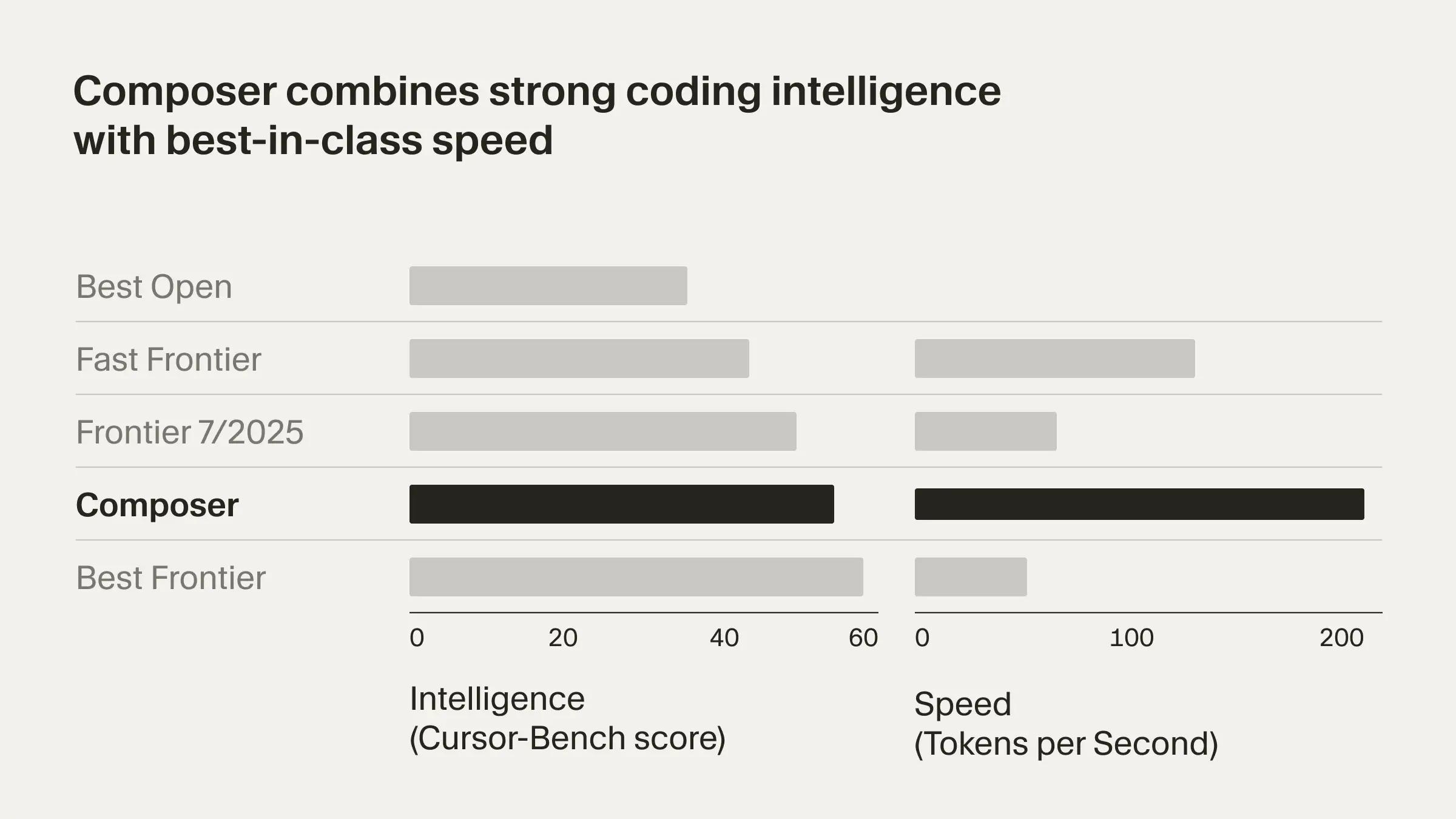
Engineered for Low-Latency Performance
Composer is not a general-purpose LLM shoehorned into an IDE; it's a frontier model purpose-built for the Cursor 2.0 environment. Cursor claims Composer is up to four times faster than other models of similar intelligence, a speed that is critical for maintaining developer flow. In an agentic workflow, a developer’s productivity is bottlenecked by the time it takes the agent to think, execute, and validate. By completing most conversational turns in under 30 seconds, Composer enables a fluid, rapid iteration cycle that was previously impossible. This speed is achieved, in part, through a sophisticated Mixture-of-Experts (MoE) architecture enhanced with Reinforcement Learning (RL) and trained using custom quantization kernels. This design allows Composer, the core component of Cursor 2.0, to selectively activate only the necessary parts of the model for a given coding task, dramatically improving throughput and reducing latency.
Deep Codebase Context and Semantic Search
One of the persistent Achilles’ heels of earlier AI coding assistants was "context loss" or "forgetfulness" within large, complex codebases. When asked to perform a refactor across dozens of files, these models often struggled to maintain a holistic view of the project, leading to inconsistent or broken changes.
Composer addresses this head-on. The model was trained with an integrated, codebase-wide semantic search engine. This is a crucial distinction: instead of bolting a search utility onto a finished LLM, Composer’s intelligence is fundamentally linked to its ability to understand and reference millions of lines of code. This deep integration allows the model within Cursor 2.0 to accurately interpret existing code architecture, reducing the likelihood of context mismatches and significantly improving its reliability for tasks like large-scale refactoring and debugging. Developers using Cursor 2.0 can, therefore, trust Composer to handle intricate, multi-file changes with a level of coherence previously unseen.
The Multi-Agent Paradigm: A Reimagined Interface
The shift in Cursor 2.0 goes beyond the model; it is fundamentally a transformation of the developer experience itself. The new user interface (UI) pivots away from the traditional, file-centric IDE view to an "Agent-centric" workflow. This redesign is critical because it mirrors the shift in the developer's role—from one who manually writes every line of code to one who delegates, manages, and reviews the work of multiple AI entities.
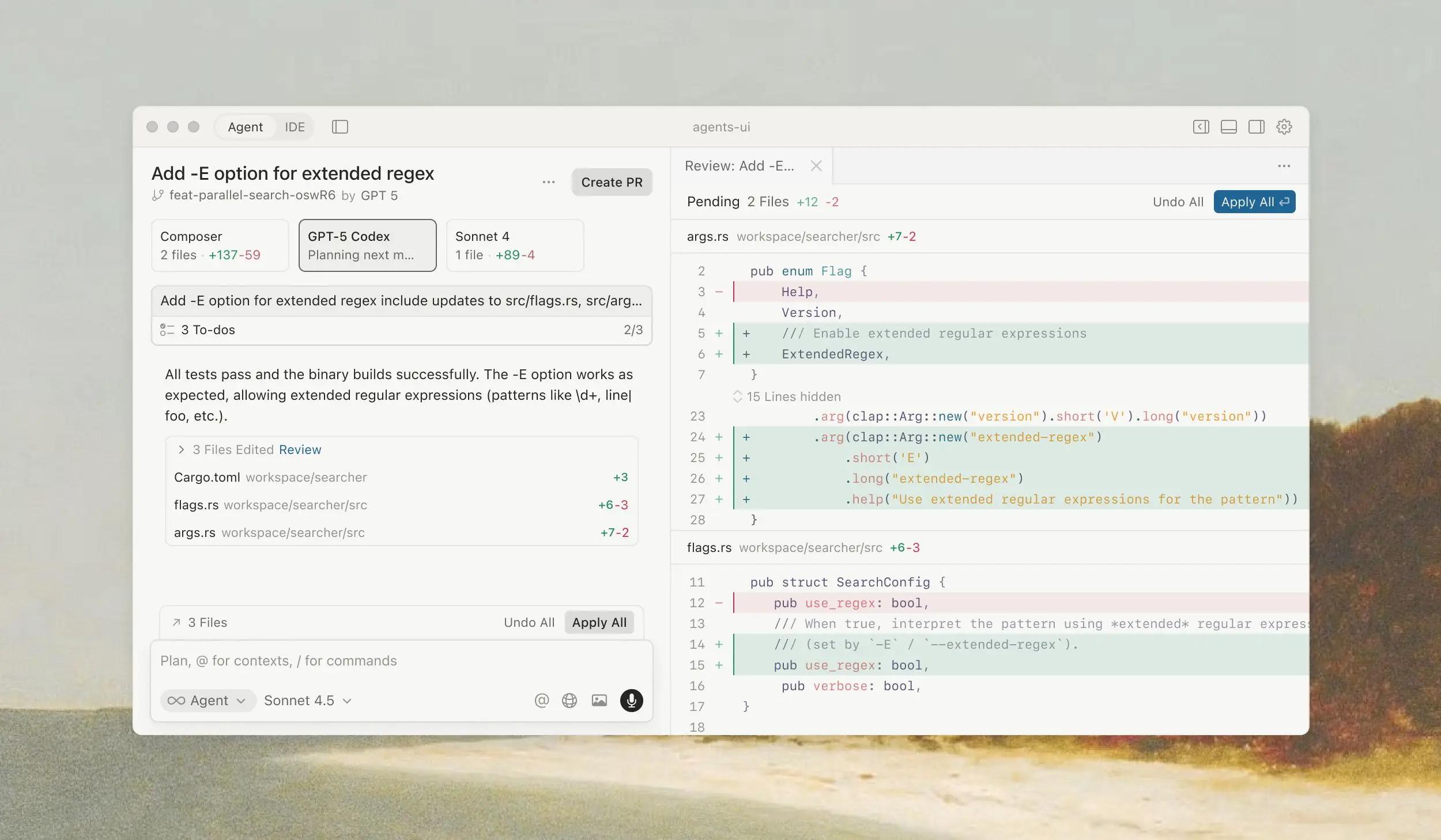
True Parallel Execution via Isolated Workspaces
The core innovation in the Cursor 2.0 multi-agent interface is the ability to run multiple independent AI agents in parallel without file conflicts. This functionality is technically enabled by leveraging Git worktrees or remote machines, creating isolated copies of the codebase for each agent.
Imagine a single developer trying to: 1) Implement a new feature, 2) Write comprehensive unit tests for an existing module, and 3) Refactor an outdated API endpoint, all simultaneously. In a traditional IDE, this is a context-switching nightmare. In Cursor 2.0, the developer can assign each task to a separate, dedicated agent.
- Agent 1 (using Composer): Focuses on implementing the new feature across multiple files.
- Agent 2 (perhaps using a third-party model like Claude 4.5 Sonnet): Writes the necessary tests.
- Agent 3: Handles the large-scale refactoring.
Each agent operates within its own isolated workspace, meaning their changes do not interfere until the developer, acting as the conductor, reviews and merges the desired outputs. This multi-model, multi-task approach in Cursor 2.0 not only accelerates feature development but also improves solution robustness by allowing developers to assign the same problem to multiple models and then select the best solution—a strategy that significantly improves output quality for complex tasks.
Plan Mode and Agent Orchestration
Cursor 2.0 formalizes the agentic workflow through its Plan Mode. When presented with a complex prompt, the agent no longer immediately begins coding; instead, it first generates a high-level plan, breaking the task into discrete, manageable sub-steps. This plan is displayed prominently in the agent interface, giving the developer a crucial point of review before any code is written. The developer can approve, modify, or steer the plan, ensuring the agent’s approach aligns with the project’s architectural goals. This separation of "thinking" (planning) and "workshop" (execution) spaces within Cursor 2.0 significantly increases transparency and trust in the AI-generated code.
Put these ideas to work.
From a specific fix to a complete website, we can help you define the scope and get it done.
Discuss my websiteCustom Web & Application DevelopmentShare your goals. We typically reply within 4 hours with questions and practical next steps.
End-to-End Development Workflow Automation
A major theme in the design of Cursor 2.0 is the recognition that as agents take on the coding burden, new bottlenecks emerge in the subsequent steps: reviewing the code and testing the changes. The new features in Cursor 2.0 aim to address these post-generation pain points, moving the platform closer to a fully autonomous development lifecycle.
Enhanced Code Review for Agent Changes
Reviewing code generated by an AI agent—especially one making multi-file, large-scale changes—can be time-consuming. Cursor 2.0 tackles this with a simplified review interface that makes it significantly easier to quickly review all changes made by an agent across multiple files without the need to jump between individual file diffs. The system provides natural language explanations of the agent’s modification intent, increasing transparency and allowing the developer to quickly focus on the why behind the change, not just the what. This feature is a direct response to the "review bottleneck" created by highly capable, autonomous agents in earlier versions of Cursor.
Native Browser and Sandboxed Terminal Tools
True agentic coding requires the AI to be able to test and validate its own work—it must move from theoretical code generation to real-world validation. Cursor 2.0 achieves this through two key general availability (GA) features:
- Native Browser Tool (GA): The agent can now directly read the Document Object Model (DOM) and run end-to-end frontend tests directly inside the editor. This capability means the agent can not only write the code for a new UI component but also render it, check for visual regressions, and iteratively adjust its solution until the final, correct result is produced. This is a leap forward for agent autonomy.
- Sandboxed Terminal (GA for macOS): To ensure security and prevent accidental or malicious operations on the developer's local machine, Cursor 2.0 runs all agent-initiated shell commands within a secure sandbox environment. This isolation provides read/write access to the workspace for the agent's work but no internet access for arbitrary commands, ensuring a safe environment for an increasingly powerful and autonomous agent.
Voice Mode and Team Commands
Further streamlining the developer experience, Cursor 2.0 introduces Voice Mode, allowing developers to control the agent using built-in speech-to-text conversion. This enables a hands-free workflow, particularly useful for initiating tasks or providing context while actively debugging or reviewing code.
For enterprise teams, Cursor 2.0 adds Team Commands. This feature allows administrators to define custom commands, rules, and contextual prompts (such as architectural guidelines or preferred testing frameworks) which are then automatically applied to all team members’ agents. This centrally managed context ensures consistency across a large engineering team without requiring manual setup or local file storage.
Conclusion: The New Development Archetype
Cursor 2.0 represents a paradigm shift from AI assistance to AI agency. By introducing its own highly optimized Composer model, the platform addresses the crucial issues of latency and contextual coherence in large codebases. The new multi-agent interface, powered by Git worktrees, fundamentally restructures the developer workflow, allowing for the parallel execution of complex, multi-step tasks under the developer's strategic guidance. The suite of end-to-end automation tools—including the native browser for self-testing and the simplified review process—re-focuses the developer's cognitive load away from boilerplate writing and toward high-level management, review, and creative problem-solving. Cursor 2.0 elevates the developer to the role of a strategic architect, commanding a fleet of specialized, autonomous AI agents. The future of coding is agentic, and Cursor 2.0 is setting the technical standard for this new era.
Frequently Asked Questions (FAQs)
Q1: What is the main difference between Cursor 2.0 and previous versions?
The main difference is the strategic shift from an AI-assisted IDE to a multi-agent orchestration platform. Previous versions relied heavily on third-party LLMs and a single-threaded workflow. Cursor 2.0 introduces its proprietary, low-latency Composer model and a revolutionary multi-agent interface that allows developers to run up to eight parallel agents in isolated workspaces, significantly accelerating complex, multi-step development tasks.
Q2: How does the new Composer model improve the developer workflow?
Composer is Cursor's first in-house model, engineered for low-latency agentic coding. Its primary benefit is speed (claimed to be 4x faster than similarly intelligent models) and deep codebase understanding, which comes from being trained with a codebase-wide semantic search engine. This allows the model within Cursor 2.0 to iterate quickly and reliably handle large-scale, multi-file changes without losing context.
Q3: What is "multi-agent parallel execution" and how is it secured in Cursor 2.0?
Multi-agent parallel execution is the ability of Cursor 2.0 to run multiple, independent AI agents simultaneously on different tasks (e.g., one agent implements a feature while another writes tests). This is technically achieved and secured by leveraging Git worktrees or remote machines to create isolated copies of the codebase for each agent. This prevents file conflicts between agents and allows the developer to review the best output from a competitive set of solutions.
Q4: What are the new tools in Cursor 2.0 for automating code review and testing?
Cursor 2.0 introduces a streamlined code review interface that provides natural language summaries of an agent's changes across multiple files, reducing the review bottleneck. For testing, it now includes a Native Browser Tool (GA) that allows the agent to read the Document Object Model (DOM) and run end-to-end frontend tests on its own output, enabling the agent to iteratively refine its code until it produces a correct final result.
Q5: How does Cursor 2.0 address large-scale team development?
Cursor 2.0 supports team development through Team Commands. This feature allows team administrators to define centralized rules, commands, and project-specific contextual prompts in the Cursor dashboard. This context is automatically applied to all team members' agents, ensuring that all agents adhere to the team's architectural guidelines and coding standards without the need for manual, local configuration.
Summary
Cursor 2.0 marks a watershed moment in the evolution of AI-driven software development. The release is anchored by the Composer model, a proprietary, low-latency, and contextually rich LLM optimized for agentic coding. This powerful new engine drives a radically redesigned, multi-agent interface that shifts the developer experience from file-centric editing to strategic agent orchestration. By allowing true parallel execution via isolated workspaces (Git worktrees) and introducing advanced end-to-end automation tools—such as the native browser for self-testing and streamlined code review—Cursor 2.0 empowers developers to offload complex, multi-step work to autonomous agents. The final product is a platform that transforms the developer into a high-level manager, focused on strategic direction and review, marking a definitive step into the age of autonomous, agentic software engineering.
Reference Links