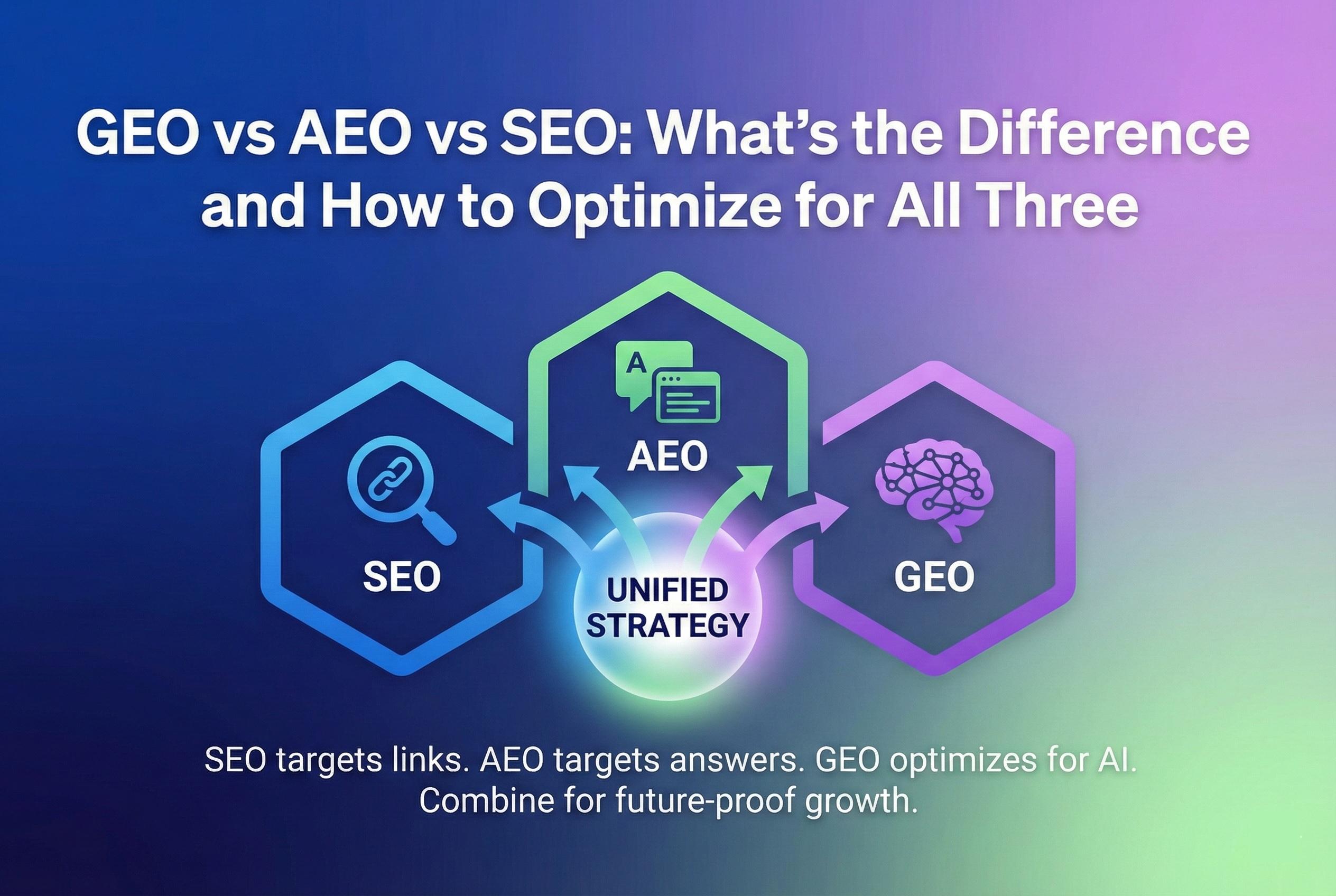
The digital marketing landscape is witnessing a tectonic shift. For two decades, we have worshipped at the altar of SEO (Search Engine Optimization). The goal was simple: get your website to the top of the "ten blue links" on Google. But as we move deeper into 2026, the game has changed. We are no longer just optimizing for search engines; we are optimizing for answer engines and generative AI engines.
This evolution has birthed two new acronyms that every content creator, marketer, and business owner must understand: AEO (Answer Engine Optimization) and GEO (Generative Engine Optimization).
The conversation is no longer just about keywords and backlinks. It is about GEO vs AEO vs SEO. Understanding the nuance between these three disciplines is the difference between being visible and being invisible in the modern search landscape. While they share DNA, they require distinct strategies. SEO targets the click; AEO targets the snippet; GEO targets the citation.
In this comprehensive guide, we will dissect the GEO vs AEO vs SEO debate, exploring what each term means, how they differ, and, most importantly, how you can build a unified content strategy to dominate all three.
1. The Incumbent: What is SEO (Search Engine Optimization)?
To understand where we are going, we must respect where we came from. SEO is the practice of optimizing web content to rank higher in traditional search engine results pages (SERPs).
- The Goal: To drive organic traffic by encouraging users to click a link to your website.
- The Mechanism: Search engines like Google crawl the web, index pages, and use complex algorithms (ranking factors) to determine which page best satisfies a user's query.
- Key Metrics: Organic traffic, Click-Through Rate (CTR), Bounce Rate, Backlinks.
SEO is the foundation. It is about discoverability. Even in a world of AI, if a crawler cannot find and index your site, you do not exist. Traditional SEO focuses heavily on technical health, keyword placement, and building authority through links. In the context of GEO vs AEO vs SEO, think of SEO as the bedrock infrastructure. Without solid SEO, you cannot hope to succeed in AEO or GEO.
2. The Specialist: What is AEO (Answer Engine Optimization)?
AEO emerged with the rise of voice search (Siri, Alexa) and Google's Featured Snippets ("Position Zero"). It is the art of optimizing content to provide immediate, concise answers to specific questions.
- The Goal: To be the single source of truth for a specific query, often without requiring a click.
- The Mechanism: Answer engines look for short, factual, and highly structured content that answers "Who," "What," "Where," "When," and "How."
- Key Metrics: Impressions, Voice Search Citations, "Position Zero" rankings.
When we compare GEO vs AEO vs SEO, AEO is the most "transactional" of the three. It serves users who want a quick fact, not a long research session. Optimizing for AEO involves structuring your content into Q&A formats, using bullet points, and ensuring your HTML schema is pristine so that engines can strip-mine your content for the answer.
3. The Newcomer: What is GEO (Generative Engine Optimization)?
GEO is the newest and most disruptive player. It refers to optimizing content for Generative AI engines like ChatGPT, Google Gemini (AI Overviews), Claude, and Perplexity.
- The Goal: To be cited and synthesized by an AI when it generates a comprehensive response to a complex user prompt.
- The Mechanism: Large Language Models (LLMs) ingest vast amounts of data to "learn" concepts. When queried, they generate a new, unique answer based on that training data and real-time retrieval (RAG).
- Key Metrics: Brand mentions, sentiment analysis, inclusion in AI snapshots, "Share of Model" (how often the AI recommends you).
In the battle of GEO vs AEO vs SEO, GEO is the most complex. It doesn't just look for keywords; it looks for context, authority, and consensus. AI engines favor content that is authoritative, easy to synthesize, and backed by reputable entities. They prioritize "Information Gain"—new, unique insights rather than recycled information.
The Core Differences: GEO vs AEO vs SEO
To optimize effectively, you must understand the friction points between these three methodologies. The GEO vs AEO vs SEO comparison reveals distinct priorities for each.
Content Structure
- SEO: Prioritizes comprehensive, long-form content that keeps users on the page (dwell time). It often uses "hooky" introductions to reduce bounce rates.
- AEO: Prioritizes the "BLUF" method (Bottom Line Up Front). It wants the answer in the first sentence. It hates fluff.
- GEO: Prioritizes logical flow and data density. It wants content that connects dots, offers statistics, and provides expert opinion that the AI can use to construct an argument.
User Intent
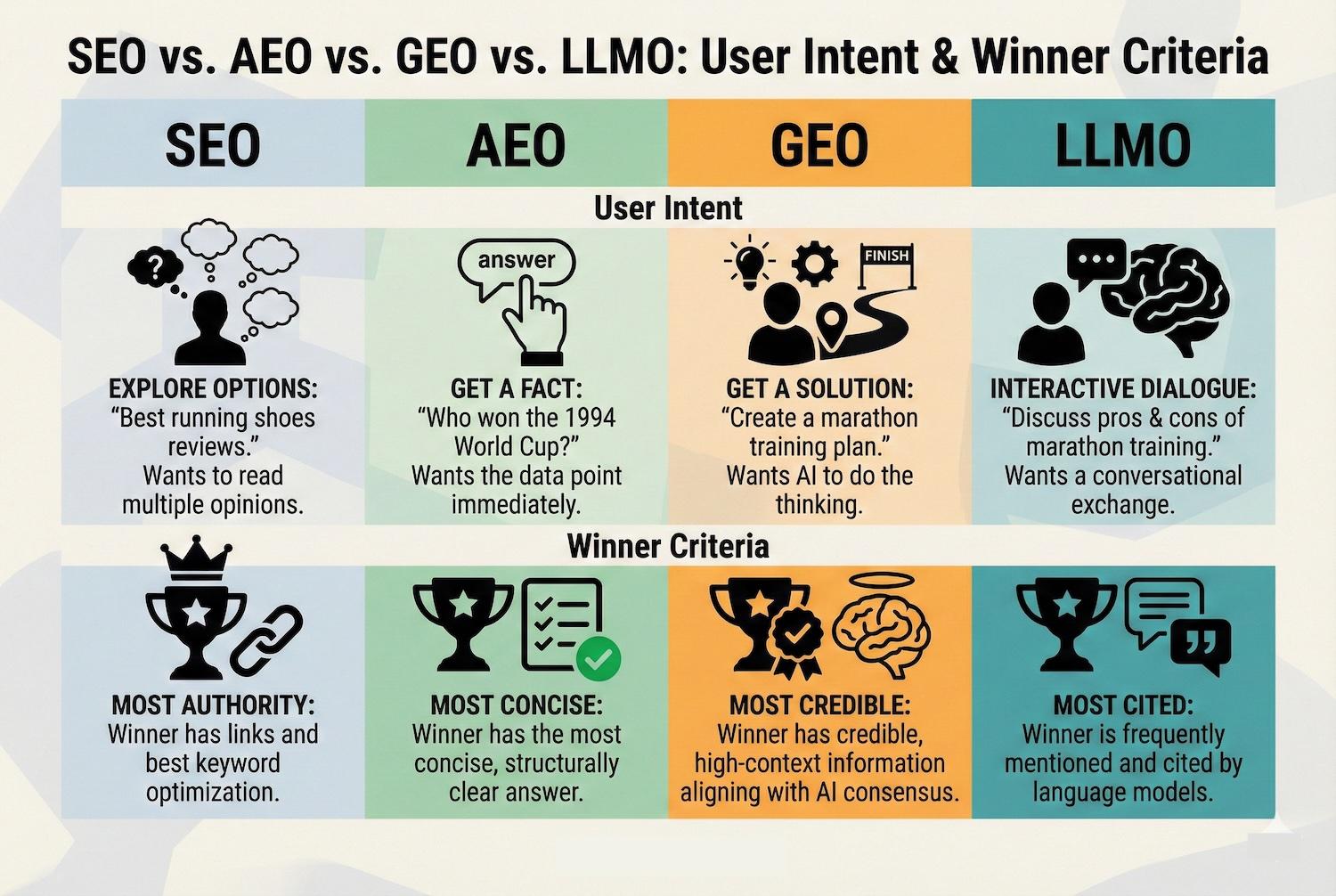
- SEO: "I want to explore options." (e.g., "Best running shoes reviews"). The user wants to read multiple opinions.
- AEO: "I want a fact." (e.g., "Who won the 1994 World Cup?"). The user wants the data point immediately.
- GEO: "I want a solution." (e.g., "Create a training plan for a marathon using these specific running shoes"). The user wants the AI to do the thinking for them.
The "Winner" Criteria
- SEO: The winner is the site with the most authority (links) and best keyword optimization.
- AEO: The winner is the site with the most concise, structurally clear answer.
- GEO: The winner is the site with the most credible, high-context information that aligns with the AI's training consensus.
Put these ideas to work.
From a specific fix to a complete website, we can help you define the scope and get it done.
Discuss my websiteProfessional SEO ServicesShare your goals. We typically reply within 4 hours with questions and practical next steps.
How to Optimize for All Three: A Unified Strategy
The good news is that you do not need three separate websites. A unified strategy can satisfy the requirements of GEO vs AEO vs SEO simultaneously. The secret lies in structuring your content layers.
1. Adopt the "Inverse Pyramid" Structure (For AEO & GEO)
To satisfy AEO and GEO, you must stop "burying the lead." Start every piece of content with the direct answer.
- Strategy: If your title is "How to Bake a Cake," the first paragraph should be a 50-word summary of the process. This feeds the AEO snippet.
- Follow Up: Immediately follow this with a detailed breakdown, data tables, and expert tips. This feeds the SEO need for depth and the GEO need for context.
2. Focus on "Information Gain" (For GEO)
AI models are trained on the "average" of the internet. To stand out in GEO, you must provide something above average.
- Strategy: Do not just rewrite top-ranking articles. Add unique data, original quotes, personal case studies, or contrarian viewpoints.
- Why it works: In the GEO vs AEO vs SEO landscape, AI engines are programmed to value unique insights. If your content adds new information to the knowledge graph, you are more likely to be cited.
3. Master Technical Schema (For SEO & AEO)
Structured data (Schema.org markup) is the universal language of all three engines.
- Strategy: Use
FAQPage,HowTo, andArticleschema. - Why it works: This code helps SEO crawlers index you, helps AEO engines pull snippets, and helps GEO models understand the relationship between entities (e.g., linking your Brand to a specific Product).
4. Build E-E-A-T (Experience, Expertise, Authority, Trust)
Google's E-E-A-T guidelines are critical for SEO, but they are arguably even more vital for GEO.
- Strategy: Ensure every article has a clear author with a bio linking to their credentials (LinkedIn, other publications). Cite authoritative sources (.gov, .edu).
- Why it works: AI models prioritize "high-confidence" sources to avoid hallucinations. In the GEO vs AEO vs SEO equation, trust is the currency that buys you visibility in AI responses.
5. Optimize for Natural Language (For AEO & GEO)
Keywords are still relevant for SEO, but AEO and GEO rely on Natural Language Processing (NLP).
- Strategy: Write like you speak. Use full questions as headings (e.g., "What is the difference between GEO and SEO?").
- Why it works: This aligns your content with the conversational queries users type into ChatGPT or speak into Siri.
The Future of Search: Convergence
As we look toward 2026 and beyond, the distinct lines in the GEO vs AEO vs SEO debate will blur. Google's Search Generative Experience (SGE) is already merging all three. A single search result now contains an AI snapshot (GEO), a featured snippet (AEO), and organic links (SEO).
The winners of tomorrow will be those who stop trying to "game" the system and start trying to be the ultimate resource. Whether a human clicks a link, a voice assistant reads a snippet, or an AI synthesizes a paragraph, your content must be the source of truth.
To dominate GEO vs AEO vs SEO, you must be:
- Technically Sound (Fast, Secure, Structured).
- Factually Direct (Clear answers, no fluff).
- Intellectually Unique (Original data, expert views).
Conclusion
The debate of GEO vs AEO vs SEO is not about choosing one over the others; it is about evolution. SEO is your foundation; it ensures you are found. AEO is your hook; it ensures you are useful immediately. GEO is your future; it ensures you remain relevant in the age of AI. By building a content strategy that serves all three—delivering quick answers, deep insights, and technical clarity—you future-proof your digital presence against the rapidly changing tides of technology.
Frequently Asked Questions (FAQs)
1. Is GEO going to replace SEO entirely?
No, GEO will not replace SEO. They serve different purposes. While AI engines (GEO) answer questions directly, users still need to visit websites for deep research, transactions, and community interaction (SEO). The two will coexist, with GEO handling top-of-funnel queries and SEO handling deep-dive investigation.
2. Which is the most important: GEO, AEO, or SEO?
For most businesses, SEO remains the most critical because it drives traffic you can control and monetize. However, AEO is vital for brand awareness (voice search), and GEO is becoming essential for maintaining authority. A balanced GEO vs AEO vs SEO strategy prioritizes SEO for traffic and GEO/AEO for visibility.
3. How do I track success in GEO?
Tracking GEO is difficult because AI engines don't always provide analytics like Google Search Console. Currently, success is measured by "Share of Model" (how often an AI mentions your brand in testing) and referral traffic from AI-powered search engines like Perplexity or Bing Chat.
4. Do I need to rewrite all my content for GEO?
You don't need to rewrite everything, but you should update your high-traffic pages. Focus on adding a "BLUF" (Bottom Line Up Front) summary to the top of articles to satisfy AEO, and add unique data or expert quotes to satisfy GEO's need for information gain.
5. Can small businesses compete in GEO vs AEO vs SEO?
Yes. In fact, GEO can level the playing field. Because AI models look for specific, high-quality answers rather than just domain authority, a small business with highly specialized, expert content can be cited over a large, generic competitor. Niche expertise is your superpower in the GEO vs AEO vs SEO landscape.
Summary
The digital marketing world is expanding from SEO (ranking links) to include AEO (ranking answers) and GEO (ranking in AI). SEO focuses on driving clicks through traditional search engines. AEO targets voice search and featured snippets by providing concise facts. GEO optimizes for generative AI models like ChatGPT by providing authoritative, structured, and unique data. To succeed in the GEO vs AEO vs SEO era, content must be structured with the answer first (Inverse Pyramid), marked up with technical schema, and bolstered by E-E-A-T signals to build trust with both human users and AI algorithms.