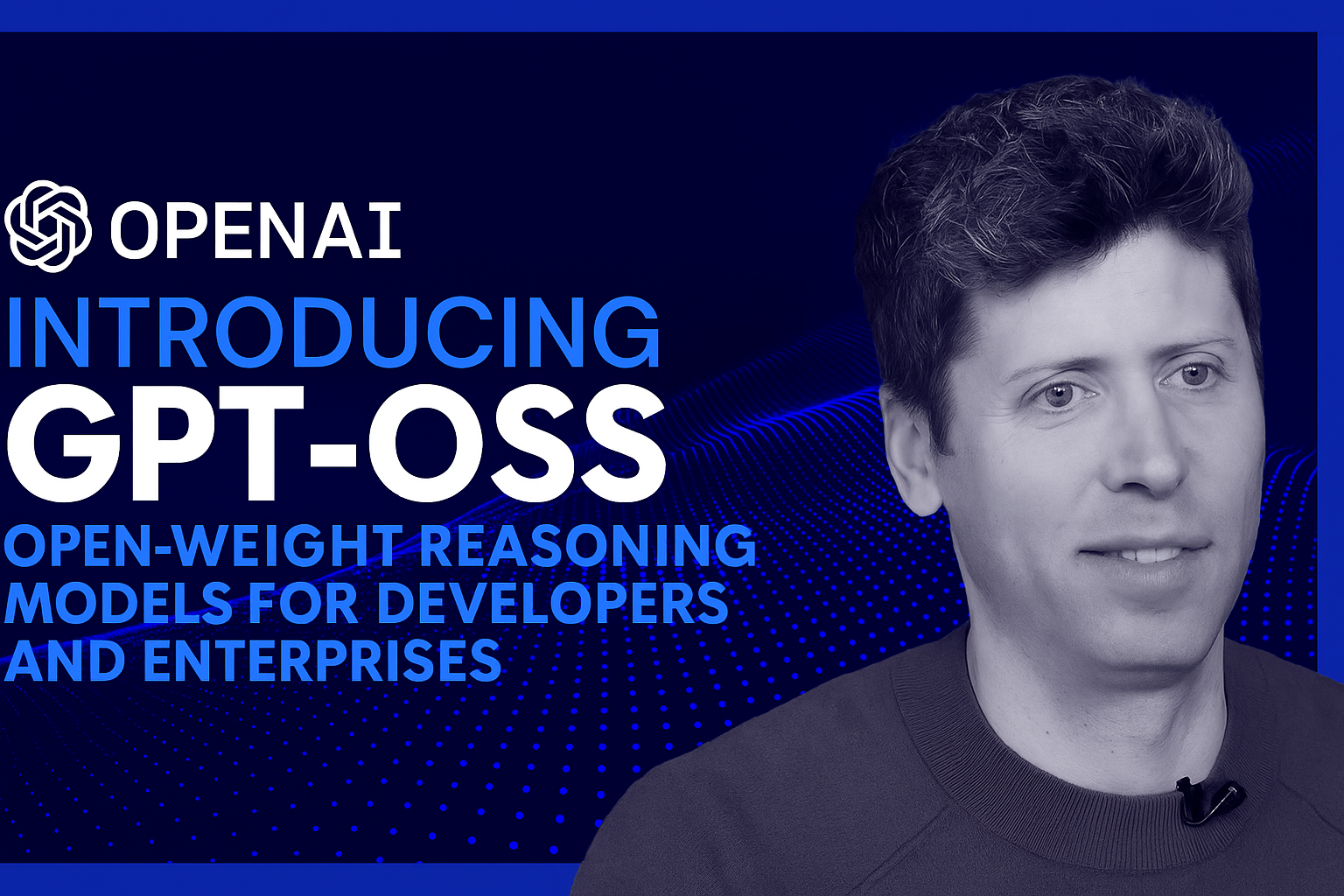
OpenAI has made a significant leap in democratizing AI technology with the launch of gpt-oss, a series of open-weight large language models that are designed for powerful reasoning, agentic tasks, and versatile developer use cases. gpt-oss models mark OpenAI's first open-weight release since GPT-2, offering unprecedented access, transparency, and customization potential—all under the permissive Apache 2.0 license. This breakthrough enables organizations and developers to deploy, fine-tune, and build next-generation AI systems locally or in their private cloud environments with full control over privacy, latency, and cost.
In this comprehensive article, we explore everything about gpt-oss: its architecture, capabilities, differentiation, applications, and how it empowers agentic AI workflows.
Overview of gpt-oss and Its Significance
gpt-oss comes in two primary variants:
- gpt-oss-120b: Featuring 117 billion parameters with 5.1 billion active parameters per token, it delivers top-tier reasoning capabilities, comparable to OpenAI's closed-source models such as o4-mini.
- gpt-oss-20b: A smaller, 21 billion parameter model activating 3.6 billion parameters per token, optimized for efficiency and running smoothly on a single 16GB GPU.
These models utilize a modern Transformer architecture with Mixture-of-Experts (MoE) layers, allowing selective activation of parameters for computation and memory efficiency. They incorporate technology such as Rotary Positional Embedding (RoPE) for context windows up to 128,000 tokens, supporting extended and complex reasoning tasks.
The open-weight nature of gpt-oss means all parameters and model internals are accessible without copyleft restrictions or patent risks, inspiring trust, rapid innovation, and broad commercial usage.
Key Features of GPT-OSS
- Open-Weight Models: Fully accessible weights to enable unprecedented inspection, modification, and customization.
- Powerful Reasoning: Excelling in chain-of-thought, multi-step problem solving, coding, math, and scientific reasoning.
- Agentic AI Support: Built-in native capabilities for function calling, Python execution, web browsing, and structured outputs supporting complex agentic workflows.
- Flexible Deployment: Run locally on consumer GPUs (16GB+), in enterprise data centers, or on cloud platforms with no API rate limits.
- Apache 2.0 License: Permissive license allowing use, modification, and commercial deployment freely with adherence to usage policy.
- Harmony Chat Format: A flexible message-based format for multi-turn interactive conversations optimized for gpt-oss.
Architecture and Technical Insights
The gpt-oss models leverage architectural innovations:
- Mixture-of-Experts (MoE): Enables efficient computation by activating subsets of the model’s parameters (experts) based on input.
- Grouped Multi-Query Attention: Improves memory and inference speed with a group size of eight.
- Rotary Positional Embedding (RoPE): Supports very long context windows up to 128k tokens for deep reasoning and long documents.
- Native 4-bit MXFP4 Quantization: Applied to MoE parameters for reduced memory footprint without sacrificing quality.
- Chain-of-Thought Reasoning: Models generate detailed intermediate reasoning steps to improve accuracy, especially in STEM and coding tasks.
Use Cases and Applications
gpt-oss unlocks a broad spectrum of real-world applications:
- Enterprise AI Agents: Build agents that autonomously interact with APIs, perform multi-step reasoning, and automate workflows with agentic capabilities.
- On-Premises AI Deployment: Maintain data sovereignty and privacy by self-hosting models on secure infrastructure, critical for healthcare, government, and telecom sectors.
- Domain-Specific Fine-Tuning: Customize models with proprietary datasets for specialized tasks in biotech, finance, legal, and scientific research.
- Research and Development: Accelerate innovation by running fully customizable AI models locally, enabling rapid experimentation without API limitations.
- Edge and Local Inference: The smaller 20B variant enables AI inference on consumer-grade GPUs or on-device, benefiting applications requiring low-latency responses.
Put these ideas to work.
From a specific fix to a complete website, we can help you define the scope and get it done.
Discuss my websiteCustom Web & Application DevelopmentShare your goals. We typically reply within 4 hours with questions and practical next steps.
Performance and Benchmarks
Comparative evaluations demonstrate that gpt-oss-120b matches or exceeds closed models on several benchmarks including:
- Coding competitions (Codeforces)
- Scientific and medical question answering (HealthBench)
- Mathematical problem solving (AIME 2024 & 2025)
- Agentic task performance (TauBench)
The 20B model delivers impressive efficiency and speed, often outperforming similarly sized competitors in mathematical and health-related tasks.
Developer Ecosystem and Open-Source Availability
OpenAI has released gpt-oss models and resources openly on GitHub and Hugging Face, including:
- Model weights and checkpoints
- Reference inference code and scripts
- Fine-tuning examples and recipes
- Guides for running models on popular runtimes such as Transformers, vLLM, llama.cpp, and Ollama
The open ecosystem fosters community-driven improvements, integration with existing AI pipelines, and freedom to tailor models for specific needs.
How gpt-oss Enables Agentic AI
Agentic AI systems require reasoning, action capabilities, and tool integration. GPT-OSS models support:
- Native function calling (e.g., invoking APIs or executing code)
- Tool use including web browsing and Python code execution within workflows
- Structured, interpretable outputs facilitating automated decision-making
- Multi-step, chain-of-thought problem solving for complex tasks
This native agentic support makes gpt-oss ideal for developers building autonomous AI assistants, intelligent copilots, and domain-specific AI applications requiring high levels of control.
Frequently Asked Questions (FAQs)
1. What is gpt-oss?
gpt-oss is OpenAI’s open-weight large language model family, featuring two sizes (120B and 20B parameters), designed for powerful reasoning, agentic tasks, and developer versatility with open licensing.
2. How can I deploy gpt-oss models?
You can self-host gpt-oss models locally on GPUs, use cloud platforms supporting them (AWS, Azure, GCP), or leverage community runtimes like vLLM and Ollama. The 20B model requires about 16GB VRAM, while 120B runs on 80GB GPUs like the NVIDIA H100.
3. Are gpt-oss models customizable?
Yes, gpt-oss models are fine-tunable on your own datasets using standard open-source tooling. This enables domain specialization and improved performance on niche tasks.
4. What capabilities does gpt-oss have for agentic AI?
gpt-oss natively supports function calling, tool integrations, web browsing, Python code execution, and chain-of-thought output—all essential for building autonomous, multi-step AI agents.
5. What licensing and usage restrictions apply?
gpt-oss models are licensed under Apache 2.0, allowing free commercial and personal use with compliance to OpenAI’s usage policy to promote ethical and legal use.
Summary
gpt-oss represents OpenAI’s landmark entry into open-weight AI models since GPT-2, combining cutting-edge architectural advances with open licensing to empower developers and organizations. With models designed for exceptional reasoning, extended context, efficient inference, and native agentic tasks, gpt-oss is a transformative platform for building customizable, autonomous AI applications. Whether running on local hardware, enterprise data centers, or cloud environments, gpt-oss offers unprecedented control, transparency, and flexibility—paving the way for a new era of accessible, responsible, and innovative AI.
Reference Links