The OpenAI Agent SDK is a powerful, open-source framework designed to simplify the development of intelligent, autonomous AI agents. As a successor to OpenAI’s experimental Swarm framework, it provides developers with a lightweight, Python-native toolkit to build agentic applications that leverage advanced reasoning, tool integration, and multi-agent collaboration. The SDK is optimized for OpenAI’s models like GPT-4o but supports external models such as Google’s Gemini, Anthropic’s Claude, and others through integrations like LiteLLM, making it highly versatile for enterprise and individual developers.
Key Features of OpenAI Agent SDK
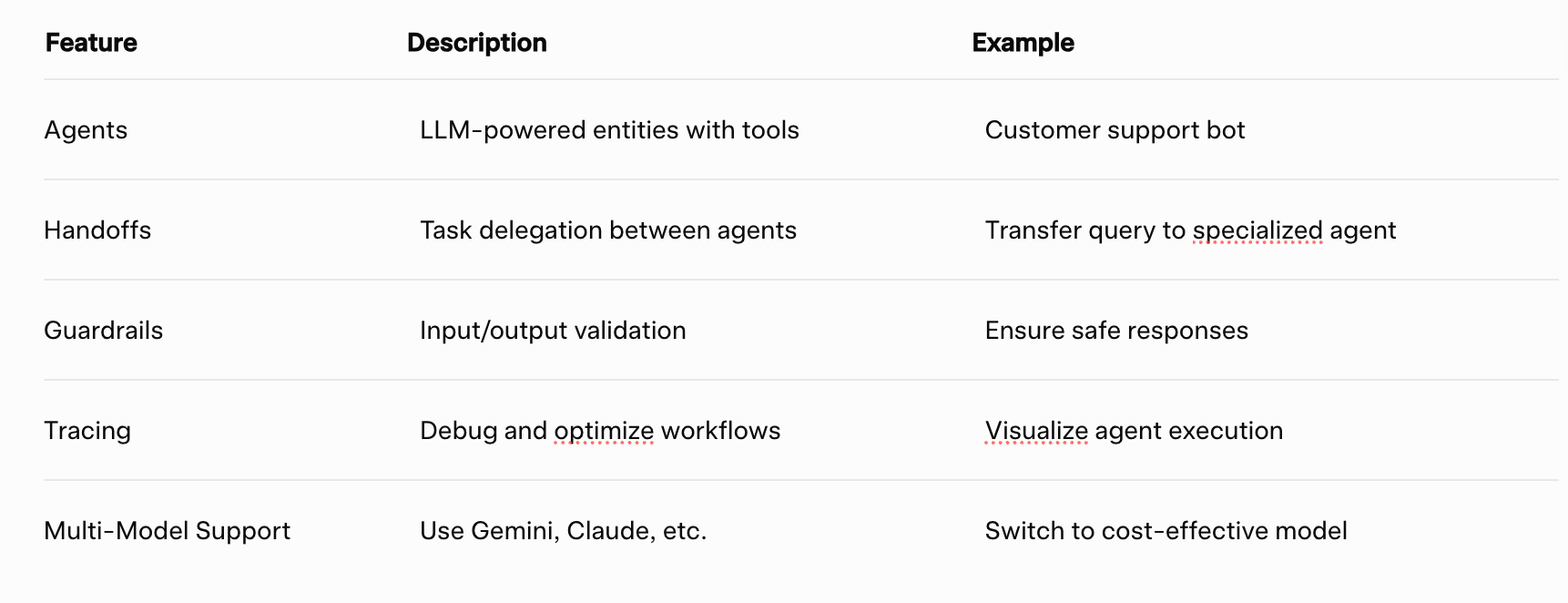
The OpenAI Agent SDK offers a streamlined approach to building AI agents with the following features:
- Agents: Configurable LLMs with instructions and tools, enabling task-specific functionality. For example, an agent can be set up to handle customer queries or automate code reviews.
- Handoffs: Seamless task delegation between agents, ensuring specialized tasks are handled by the most suitable agent.
- Guardrails: Built-in safety checks to validate inputs and outputs, enhancing reliability and security.
- Tracing and Observability: Visualize and debug agent workflows, with tools to evaluate performance and fine-tune models.
- Multi-Model Support: Integrates with non-OpenAI models (e.g., Gemini, Claude) via OpenAI-compatible APIs, offering flexibility to choose cost-effective or specialized models.
- Tool Integration: Automatically generates schemas for Python functions using Pydantic, allowing seamless integration with APIs, databases, and custom tools.
- Responses API Compatibility: Works with OpenAI’s Responses API for advanced tool use, such as web search and file search, simplifying complex workflows.
Getting Started with OpenAI Agent SDK
To use the OpenAI Agent SDK, install it via pip:
pip install openai-agents
Set up an API key (e.g., OPENAI_API_KEY for OpenAI models or provider-specific keys for others). A basic example of creating an agent:
from agents import Agent, Runner
agent = Agent(name="Assistant", instructions="You are a helpful assistant")
result = Runner.run_sync(agent, "Write a Python function to calculate factorial.")
print(result.final_output)
This code demonstrates how the SDK enables quick setup for tasks like code generation. For non-OpenAI models, configure a custom client:
from openai import AsyncOpenAI
from agents import Agent
client = AsyncOpenAI(base_url="https://generativelanguage.googleapis.com/v1beta/openai/", api_key="GOOGLE_API_KEY")
agent = Agent(name="GeminiAgent", model="gemini/gemini-2.5-pro", client=client)
This flexibility makes the SDK suitable for diverse use cases.
Put these ideas to work.
From a specific fix to a complete website, we can help you define the scope and get it done.
Discuss my websiteCustom Web & Application DevelopmentShare your goals. We typically reply within 4 hours with questions and practical next steps.
Real-World Applications
The OpenAI Agent SDK powers a variety of applications:
- Customer Support Automation: AI agents handle inquiries and escalate complex issues to specialized agents.
- Code Review and Generation: Automate code analysis and generate applications from natural language prompts.
- Content Creation: Generate documentation, articles, or structured outputs like JSON schemas.
- Research and Data Analysis: Combine web search and internal data to extract insights securely.
- Enterprise Workflows: Integrate with APIs and databases for tasks like sales prospecting or logistics optimization.
Difference Between OpenAI Agent SDK and Google Gemini SDK
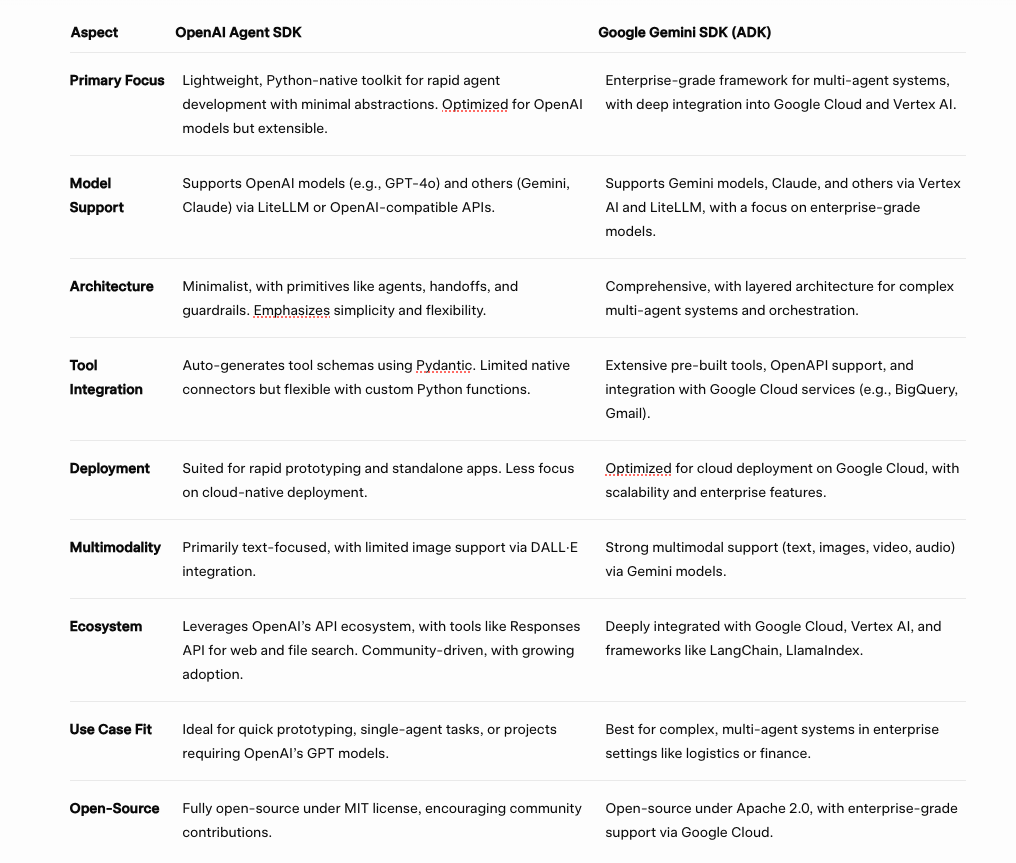
While both the OpenAI Agent SDK and Google Gemini SDK (part of Google’s Agent Development Kit, or ADK) enable developers to build AI agents, they differ in architecture, focus, and ecosystem. Below is a detailed comparison:
Key Differences
- Philosophy and Simplicity: The OpenAI Agent SDK prioritizes a minimalistic, developer-friendly approach, making it easier to learn and use for rapid prototyping. In contrast, the Google Gemini SDK (via ADK) is designed for enterprise-grade, complex systems, offering more robust tooling and cloud integration but with a steeper learning curve.
- Ecosystem Integration: OpenAI’s SDK aligns tightly with its own ecosystem (e.g., Responses API), while Google’s ADK leverages Google Cloud services and pre-built connectors, making it more suitable for organizations already using Google’s infrastructure.
- Multimodality: Google’s Gemini models excel in multimodal tasks (text, images, video), giving the Google Gemini SDK an edge for applications requiring diverse data processing. OpenAI’s SDK is more text-centric, with limited multimodal support.
- Scalability: Google’s ADK is built for scalable, cloud-native deployment, ideal for large-scale enterprise applications. OpenAI’s SDK is better suited for smaller, agile projects or standalone applications.
- Community and Support: OpenAI’s SDK benefits from strong community buzz and simplicity, while Google’s ADK offers enterprise-grade support and integration with frameworks like LangGraph and CrewAI.
Choosing the Right SDK
- Choose OpenAI Agent SDK if you need a lightweight, flexible framework for rapid prototyping or are heavily invested in OpenAI’s models. It’s ideal for developers seeking simplicity and quick integration with Python-based workflows.
- Choose Google Gemini SDK if your project requires complex multi-agent systems, enterprise-grade scalability, or deep integration with Google Cloud services. It’s best for organizations building sophisticated applications in domains like logistics or finance.
Future Prospects
The OpenAI Agent SDK is poised to grow with community contributions, given its MIT license and active developer engagement. Its compatibility with external models ensures long-term flexibility. Meanwhile, the Google Gemini SDK will likely expand with Google’s advancements in multimodal AI and cloud infrastructure, making it a strong contender for enterprise applications.
Conclusion
The OpenAI Agent SDK empowers developers to create intelligent AI agents with minimal complexity, offering flexibility, multi-model support, and robust features like handoffs and guardrails. Its lightweight design makes it ideal for rapid development, while its compatibility with external models broadens its appeal. Compared to the Google Gemini SDK, it offers simplicity over enterprise-grade scalability, making the choice dependent on your project’s needs. Whether you prioritize ease of use or cloud-native robustness, understanding these frameworks’ strengths ensures you select the right tool for building next-generation AI agents.