
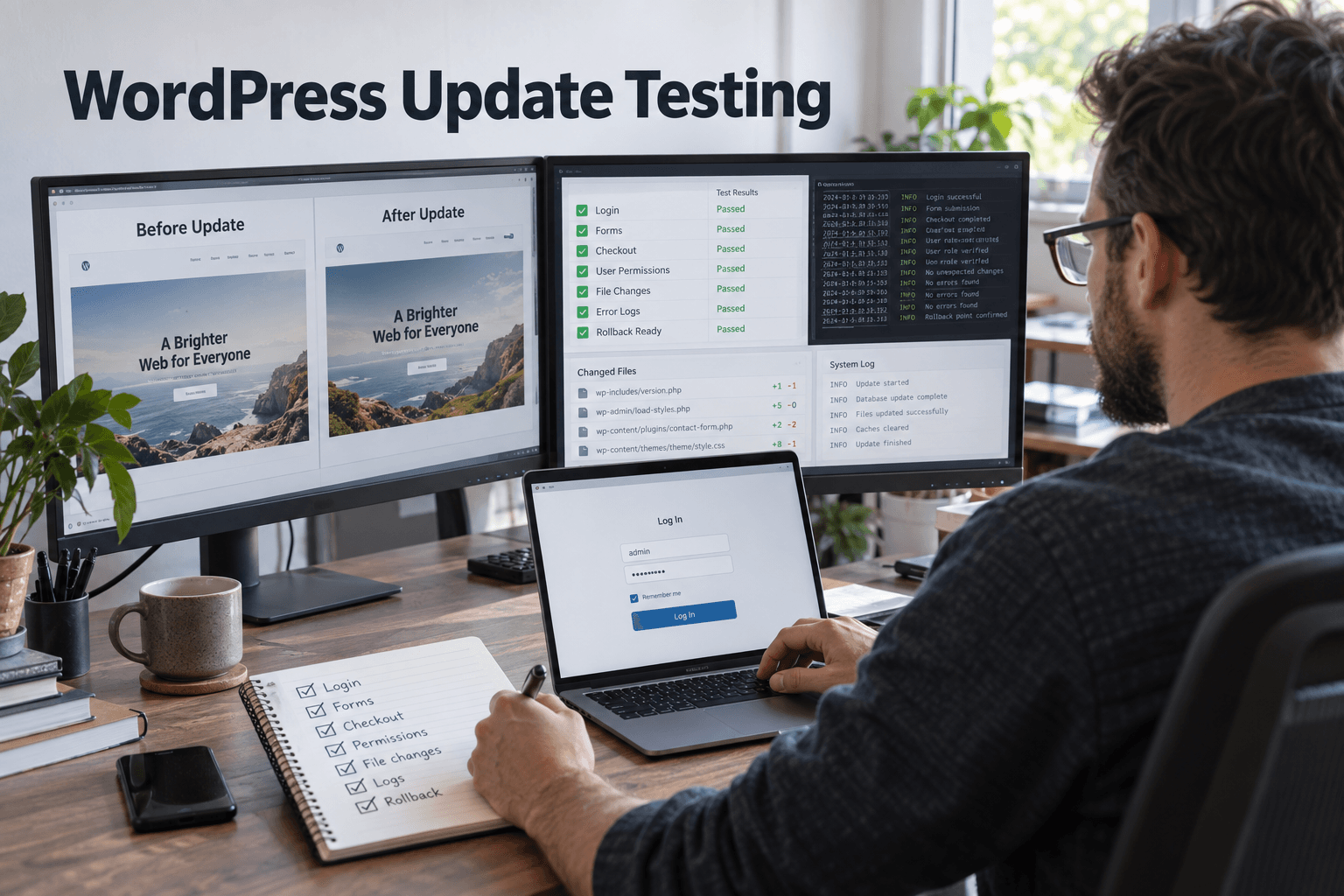
Installing a WordPress update is not the end of maintenance; it is the beginning of verification. Core, plugin, theme, PHP, and database changes can alter permissions, templates, APIs, scheduled tasks, checkout behavior, caching, and security controls. A repeatable test process catches regressions before customers—or attackers—find them.
Classify the update before testing
Record the component, current and target versions, change source, security relevance, affected workflows, dependencies, database migrations, known compatibility notes, and rollback method. An actively exploited security fix deserves rapid handling, while a major feature release may justify a longer staging cycle.
Book a free, no-obligation strategy call and we'll map out your next move.
A complete WordPress security audit helps identify the high-value workflows and controls that every update must preserve.
Create a reliable pre-update baseline
Before changing anything, capture page response times, error logs, active components, administrator users, scheduled tasks, file integrity, security headers, forms, payment settings, and the status of backups. Without a baseline, teams often mistake an old problem for a new regression or overlook a subtle change.
Use a protected staging environment
Test on a representative copy with the same PHP version, server configuration, plugin set, theme, caching, and important integrations. Sanitize personal data, disable real customer emails and payments, protect the environment from public access, and prevent search indexing.
Apply the update through the same controlled method used for production. A staging test is less useful if production uses a different package, manual upload, or deployment path.
Verify backup and rollback readiness
Confirm the pre-update backup completed, is stored outside the production account, and contains the database, uploads, code, and configuration needed for recovery. Know the recovery point and expected restore time. For database migrations, confirm whether a code rollback also requires a database restore.
Use our WordPress backup and recovery guide to define reliable restore points, off-site storage, retention, and recovery tests.
Run functional smoke tests
Test the homepage, navigation, search, login, password reset, editor, media uploads, contact and lead forms, transactional email, scheduled jobs, sitemaps, and critical APIs. For stores, include product pages, cart, coupons, tax, shipping, checkout, payment callbacks, order emails, accounts, refunds, and subscriptions.
Use accounts with different roles. An administrator may bypass a failure that affects editors, customers, subscribers, or anonymous visitors. Test mobile and desktop layouts and at least one clean browser session without an existing administrator cookie.
Run security regression tests
Confirm multi-factor authentication, rate limits, firewall rules, security headers, file protections, audit logging, backup jobs, malware monitoring, and privileged-user restrictions still work. Review any new endpoints, permissions, scheduled tasks, database tables, files, and outbound connections introduced by the update.
Follow our WordPress file permissions guide to detect updates that leave sensitive paths unnecessarily writable.
Recheck browser protections against our because caching, CDN, or server changes can alter delivered headers.