The landscape of software development is undergoing a seismic shift, propelled by the maturation of Artificial Intelligence (AI) and Large Language Models (LLMs). We are moving beyond simple chatbot interfaces to a world populated by sophisticated, autonomous agents capable of performing complex, multi-step tasks. To manage this complexity and bridge the gap between powerful backend logic and intuitive user experiences, a new set of architectural tools and protocols is emerging. Chief among these is the powerful combination of the Agent Development Kit (ADK), the AG-UI Protocol, and the comprehensive development suite, CopilotKit.
This architectural trinity represents a paradigm shift in how developers conceive, build, and deploy AI-driven applications. It focuses on modularity, seamless front-end integration, and superior user interaction. By understanding how these components interoperate, developers can unlock a new generation of truly intelligent and highly effective software agents.
The Foundation: Understanding the Agent Development Kit (ADK)
The Agent Development Kit (ADK) is the essential scaffolding for any serious agent development effort. It is not merely a library of functions; it is a structured framework designed to abstract the complexities of state management, tool invocation, and conversational flow that are inherent to sophisticated AI agents.
Core Functionality of the ADK
At its heart, the ADK provides a robust environment where an agent's logic can thrive. It is responsible for several critical functions:
- Tool Orchestration: Agents often need to use external tools—like databases, APIs, or proprietary services—to fulfill user requests. The ADK manages the discovery, selection, and invocation of these tools, ensuring the agent uses the right resource at the right time.
- Memory Management: Maintaining context across multiple turns in a conversation is vital. The ADK includes mechanisms for both short-term (context window) and long-term memory, allowing agents to remember past interactions and user preferences.
- State Management: Complex agents move through various states (e.g., gathering input, executing tool, generating output). The ADK provides a clear structure for tracking and transitioning between these states, which is fundamental for reliable execution.
- Error Handling and Resilience: Building an agent that fails gracefully is crucial. The ADK offers standardized patterns for handling API timeouts, tool failures, and other execution errors, ensuring a more resilient user experience.
In essence, the Agent Development Kit (ADK) transforms a simple LLM prompt into a reliable, enterprise-grade software agent. It provides the necessary structure for building scalable and maintainable AI applications.
The Bridge: The Role of the AG-UI Protocol
While the ADK handles the backend intelligence, a common challenge in agent development is creating a corresponding, dynamic, and integrated front-end experience. Traditional approaches often rely on brittle, static user interfaces that cannot adapt to the agent’s execution path. This is where the AG-UI Protocol comes in as a revolutionary solution.
Defining the AG-UI Protocol
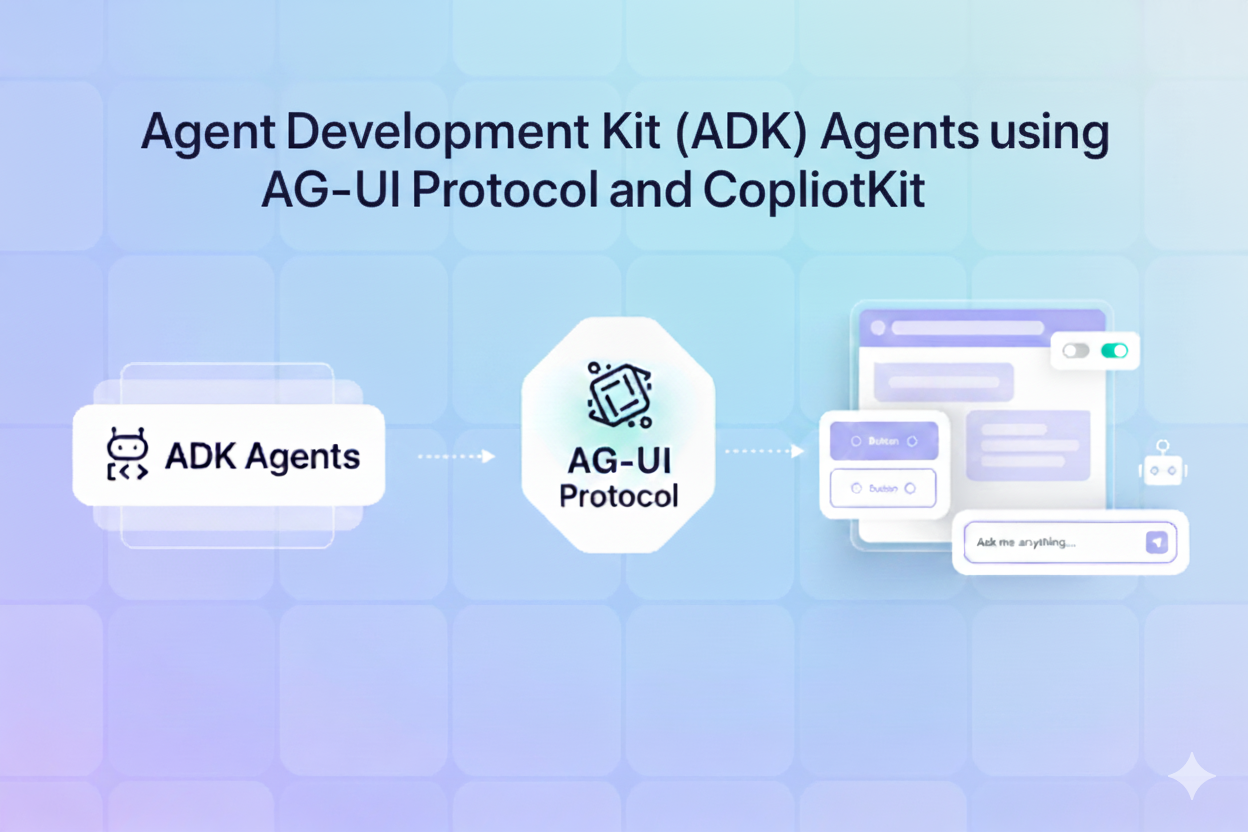
The AG-UI Protocol is a communication standard designed to facilitate a dynamic, bidirectional exchange between an AI agent (built with the ADK) and a client-side user interface. Its core innovation lies in enabling the agent to not just return text, but also to define and control the UI components displayed to the user.
Instead of the backend simply returning a final text string, it returns a structured message, dictated by the AG-UI Protocol, which can include instructions for rendering:
- Interactive Forms: The agent might need specific data (e.g., "What date should I book the flight for?"). The AG-UI Protocol allows the ADK agent to instruct the front-end to render a date picker or a structured form, collecting the required information directly.
- Progress Indicators: For long-running tasks, the agent can signal the front-end to display a progress bar or status updates, keeping the user informed.
- Visualizations and Data Tables: If the agent performs a data query, the protocol can instruct the front-end to render the results as a clean table or a chart, rather than a wall of text.
The Protocol's Mechanism
The flow works as follows:
- A user interacts with the front-end (e.g., "Book a flight to Paris.").
- The front-end sends the request to the Agent Development Kit (ADK) agent.
- The agent determines it needs more information (e.g., the return date).
- The agent generates a structured JSON payload conforming to the AG-UI Protocol, instructing the front-end to display a specific input form.
- The front-end receives the payload and renders the dynamic UI.
- The user fills out the form.
- The front-end sends the new data back to the ADK agent, and the execution continues.
This dynamic interaction, enabled by the AG-UI Protocol, fundamentally transforms the user experience from a turn-based chat to an interactive, collaborative workflow. It allows the agent to guide the user through complex processes seamlessly, making the Agent Development Kit (ADK) Agents using AG-UI Protocol and CopilotKit a powerful development stack.
The Unifying Layer: Integrating with CopilotKit
Building an agent with the Agent Development Kit (ADK) and implementing the AG-UI Protocol from scratch can still be a significant engineering challenge. This is where CopilotKit enters the equation, providing a comprehensive, full-stack framework that simplifies the entire development lifecycle. CopilotKit acts as the glue and the accelerator, bundling necessary tools and conventions to make the integration of ADK Agents using AG-UI Protocol and CopilotKit seamless.
CopilotKit's Full-Stack Advantage
CopilotKit is designed to facilitate the rapid creation of "copilots" or embedded AI agents within existing applications. It provides pre-built components that natively understand and implement both the ADK and the AG-UI Protocol.
- Backend Utilities (ADK Integration): CopilotKit provides server-side utilities and SDKs that dramatically simplify the process of defining tools and endpoints for the Agent Development Kit (ADK). Developers can quickly define functions that the agent can call, abstracting away the boilerplate code for API registration and schema definition.
- Frontend Components (AG-UI Native): Perhaps the most transformative feature of CopilotKit is its suite of ready-to-use frontend components. These components are inherently AG-UI Protocol-aware. When an ADK agent sends an AG-UI Protocol message, the CopilotKit components automatically interpret the instruction (e.g., render a form, show a table) and display the corresponding UI without requiring extensive custom development. This makes building a frontend for your ADK Agents using AG-UI Protocol and CopilotKit remarkably efficient.
- Tool Integration Layer: CopilotKit offers a streamlined way to integrate external APIs as tools for the ADK agent. This allows the Agent Development Kit (ADK) agent to seamlessly interact with a vast ecosystem of services, from project management tools to e-commerce platforms.
By leveraging CopilotKit, developers don't just get a framework; they get a complete ecosystem where building Agent Development Kit (ADK) Agents using AG-UI Protocol and CopilotKit is the path of least resistance. The framework handles the complexities of real-time communication, token management, and security, allowing the developer to focus purely on the agent's unique business logic.
Put these ideas to work.
From a specific fix to a complete website, we can help you define the scope and get it done.
Discuss my websiteCustom Web & Application DevelopmentShare your goals. We typically reply within 4 hours with questions and practical next steps.
Synergy in Action: How the Three Components Interoperate
The true power of this stack lies in the tightly coupled synergy between the Agent Development Kit (ADK), the AG-UI Protocol, and CopilotKit.
Consider the use case of a "Travel Planner Agent."
- Request: User types: "I need to plan a 5-day trip to Rome in December."
- ADK Processing: The Agent Development Kit (ADK) agent processes the request. It determines it needs specific dates and budget information before calling its
flight_booking_tool. - Protocol Generation: The ADK agent generates a message that conforms to the AG-UI Protocol. This message tells the frontend: Request two date inputs (start/end) and one slider input (budget).
- CopilotKit Rendering: The CopilotKit frontend component receives the AG-UI Protocol message and instantly renders the requested dynamic form fields.
- User Input & Loop: The user fills the fields. This data is sent back to the Agent Development Kit (ADK) agent via CopilotKit's communication layer.
- Tool Execution: The ADK agent now has all necessary data and proceeds to call the
flight_booking_toolandhotel_search_toolsequentially. - Final Output & UI: The agent compiles the results and uses the AG-UI Protocol to instruct the CopilotKit frontend to display the output not just as text, but as an interactive table of flight options and a gallery of hotel images.
This example illustrates the power of ADK Agents using AG-UI Protocol and CopilotKit. The user never leaves the conversational context, yet they benefit from the structured, guided input and rich, interactive output that a traditional chat interface could never provide. The seamless integration of the Agent Development Kit (ADK) logic and the dynamic UI enabled by the AG-UI Protocol is the key differentiator.
Deep Dive: Designing Tools for ADK Agents
The effectiveness of any Agent Development Kit (ADK) agent hinges on the quality and accessibility of its tools. In the context of ADK Agents using AG-UI Protocol and CopilotKit, tools must be designed with an awareness of their potential impact on both the backend execution and the frontend experience.
Principles of Tool Design
- Clarity of Schema: Each tool must be defined with a precise JSON schema that clearly articulates the required inputs and expected outputs. The ADK uses this schema to reason about when and how to call the tool. CopilotKit helps enforce this best practice by providing structured methods for tool declaration.
- Granularity: Tools should be atomic and focused. Instead of one large
plan_triptool, it’s better to havesearch_flights,Google Hotels, andcalculate_budget. This allows the Agent Development Kit (ADK) agent to stitch together a more complex, adaptive workflow. - UI Awareness: A tool's definition can implicitly suggest a front-end need. If
search_flightsrequires adateinput, the ADK agent, when using this tool, knows to check if the date is available and, if not, to use the AG-UI Protocol to request it from the user via the CopilotKit frontend. This is the hallmark of modern ADK Agents using AG-UI Protocol and CopilotKit.
The Technical Advantage: Efficiency and Developer Experience
Beyond the functionality, the stack offers significant technical advantages for the development team.
1. Reduced Latency and Improved User Perception
By offloading complex data gathering and presentation to the dynamic front-end (via the AG-UI Protocol), the Agent Development Kit (ADK) agent reduces the need for multiple backend round trips. The agent can ask for three pieces of input in a single UI instruction, rather than three separate text prompts. This use of the AG-UI Protocol significantly improves the perceived responsiveness of the ADK agent, leading to a much better user experience.
2. Enhanced Modularity and Maintenance
The strict separation of concerns provided by the Agent Development Kit (ADK) ensures that the core logic and tool orchestration are decoupled from the UI implementation. A developer can update a tool's underlying API (the ADK layer) without changing the CopilotKit frontend, as long as the AG-UI Protocol contract remains consistent. This modularity makes building and maintaining complex ADK Agents using AG-UI Protocol and CopilotKit a much more manageable task.
3. Simplified Context Management
CopilotKit abstracts the complex task of managing the conversation history, token limits, and prompt engineering required for the ADK. It handles the data flow, ensuring that relevant context is correctly formatted and fed back into the Agent Development Kit (ADK) for the next turn. This eliminates a major source of bugs and development overhead in AI applications.
The Future of Software: ADK Agents using AG-UI Protocol and CopilotKit
The evolution from simple websites to dynamic applications, and now to autonomous ADK Agents using AG-UI Protocol and CopilotKit, marks a fundamental transformation in how humans interact with technology.
The ability of the Agent Development Kit (ADK) to manage sophisticated logic, combined with the power of the AG-UI Protocol to create truly intelligent interfaces, and the ease of development provided by CopilotKit, is setting the standard for enterprise-grade AI applications. These are not merely digital assistants; they are highly integrated, autonomous workers that seamlessly bridge the gap between human language and complex system execution.
Developers who master the principles of the Agent Development Kit (ADK) Agents using AG-UI Protocol and CopilotKit stack will be uniquely positioned to build the next generation of software—applications that are not only responsive but genuinely adaptive, proactive, and deeply integrated into the user's workflow. The future of software is not just AI-powered; it is agent-driven, protocol-defined, and fully integrated. The journey to highly functional ADK Agents using AG-UI Protocol and CopilotKit is already underway.
FAQs ( Frequently Asked Questions )
1. What is the fundamental difference between a traditional chatbot and an ADK Agent?
A traditional chatbot is primarily a conversational interface focused on dialogue, often following a fixed script or decision tree. An Agent Development Kit (ADK) Agent, on the other hand, is designed for autonomous execution of multi-step tasks. The ADK provides the structured environment for the agent to manage its state, orchestrate complex tool calls (to external APIs, databases, etc.), and maintain context across non-linear workflows, moving beyond simple Q&A to true action-taking.
2. How does the AG-UI Protocol enhance the user experience of an ADK Agent?
The AG-UI Protocol enhances the user experience by allowing the Agent Development Kit (ADK) Agent to dynamically control the frontend UI. Instead of relying solely on text-based prompts and responses, the agent can instruct the client (via the protocol) to render structured inputs (like forms, date pickers) for data collection or rich outputs (like charts, tables, image galleries) for data presentation. This transforms the interaction from a purely conversational one into a guided, interactive, and visually informative workflow.
3. Is CopilotKit mandatory for building ADK Agents that use the AG-UI Protocol?
No, CopilotKit is not strictly mandatory, as the Agent Development Kit (ADK) and the AG-UI Protocol define the architectural pattern and communication standard, respectively. However, CopilotKit is a highly recommended full-stack framework because it provides ready-made libraries and components that natively implement both the ADK backend integration and the AG-UI Protocol on the frontend. It significantly reduces development time and complexity, making the creation of ADK Agents using AG-UI Protocol and CopilotKit much more streamlined.
4. What are the key technical components a developer needs to understand when using this stack?
Developers should focus on three key technical areas: 1) Tool Definition within the Agent Development Kit (ADK) (defining clear schemas for functions the agent can call); 2) State Management (understanding how the ADK tracks the agent's progress through a task); and 3) AG-UI Protocol structure (knowing the JSON format the agent must return to trigger specific UI components on the CopilotKit frontend). Mastering these ensures effective logic and dynamic UI.
5. What kind of applications are best suited for development using ADK Agents using AG-UI Protocol and CopilotKit?
This powerful stack is ideal for building complex, task-oriented applications that require user input and rich data output. Examples include: e-commerce configurators (guiding product selection), financial analysts (collecting data and displaying complex reports), project management assistants (creating tasks, scheduling meetings), or internal business process agents (automating form submissions and data lookups). Any scenario requiring both intelligent backend logic and sophisticated, adaptive frontend interaction is a perfect fit for ADK Agents using AG-UI Protocol and CopilotKit.
Summary
The development of sophisticated AI applications is being revolutionized by a powerful, synergistic architecture centered on the Agent Development Kit (ADK), the AG-UI Protocol, and CopilotKit. The Agent Development Kit (ADK) provides the foundational logic for building resilient, multi-step agents, handling critical functions like tool orchestration and state management. The AG-UI Protocol acts as a crucial bridge, a dynamic communication standard that allows the ADK agent to directly control and generate rich, structured user interface components (like forms and charts) on the front end, moving beyond simple text-in/text-out conversations. Finally, CopilotKit serves as the full-stack integration layer, offering pre-built SDKs and frontend components that natively interpret the AG-UI Protocol and simplify the definition and execution of tools for the ADK. Together, these three components form a robust, efficient, and highly adaptive stack for building the next generation of intelligent, action-oriented, and highly user-friendly software agents, making the creation of complex ADK Agents using AG-UI Protocol and CopilotKit significantly more manageable and scalable.