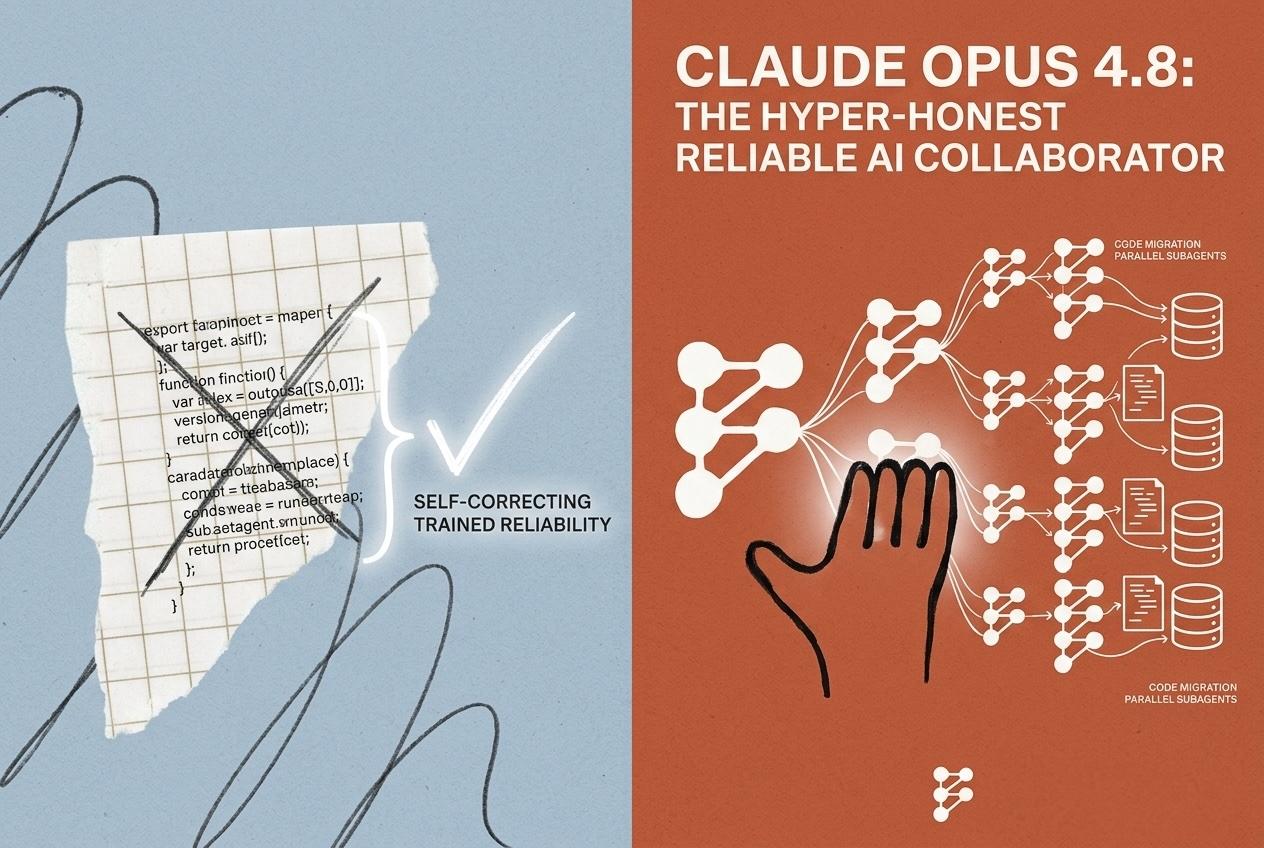
The rapid evolution of generative artificial intelligence has brought us to a fascinating turning point. For the past few years, tech giants have engaged in a relentless arms race focused purely on raw scale and processing power. However, as AI systems are increasingly trusted to run unattended in corporate codebases, financial systems, and legal frameworks, a new metric has taken center stage: reliability.
Recognizing this shift, Anthropic has officially announced the launch of its latest flagship intelligence engine. Introducing Claude Opus 4.8 marks a profound milestone in the tech world. Built as a direct upgrade to its predecessor, Opus 4.7, this new model shifts the narrative from mere computational output to nuanced behavioral honesty, self-reflection, and robust multi-agent coordination.
Whether you are looking to deploy complex autonomous systems or searching for the best AI model for coding 2026, understanding the architectural leaps in this release is vital. In this definitive guide, we will dive deep into Introducing Claude Opus 4.8, analyze the groundbreaking dynamic workflows in Claude Code, evaluate key Claude Opus 4.8 benchmarks, and explore how it stacks up in a head-to-head match of Claude Opus 4.8 vs GPT-5.5.
What is Claude Opus 4.8? The Dawn of "Honest" AI
When Anthropic began Introducing Claude Opus 4.8, they proudly emphasized a unique characteristic: it is their most "honest" large language model to date.
A persistent challenge across the entire AI sector has been the tendency of models to hallucinate, jump to conclusions, or confidently claim progress on a task when the underlying evidence is thin. To prevent AI hallucinations with Claude, Anthropic’s research team implemented specialized training paradigms that encourage the model to accurately gauge its own limitations.
Consequently, Claude Opus 4.8 possesses an incredible capacity for self-monitoring. If it detects ambiguity in your instructions, lacks sufficient data, or uncovers an error in its own logic, it actively flags these uncertainties to the user instead of guessing blindly. Early testers note that collaborating with Claude Opus 4.8 feels less like prompting a machine and more like interacting with a meticulous, highly transparent human partner.
Key Technical Specifications
Claude Opus 4.8 retains the premier structural benefits of Anthropic’s elite engineering track while optimizing backend delivery mechanisms.
- 1M Context Window by Default: The Claude Opus 4.8 1M context window is standard across the Claude API, Amazon Bedrock, and Google Cloud Vertex AI, allowing users to ingest massive, enterprise-scale repositories seamlessly.
- 128k Maximum Output Tokens: Provides extensive headroom for generating expansive documents, multi-file codebases, or comprehensive legal briefs in a single response turn.
- Adaptive Thinking Architecture: The model natively uses adaptive thinking in Claude Opus, meaning it automatically calibrates its cognitive processing depth depending on the complexity of the prompt.
- Mid-Conversation System Messages: Developers can now inject updated rules (
role: "system") directly after a user turn in long-running chats. This preserves prompt cache hits on early turns, slashing input token costs dramatically during recursive loops.
Unleashing Dynamic Workflows in Claude Code
Alongside the core model rollout, Anthropic introduced a monumental feature currently available in research preview: dynamic workflows in Claude Code. This capability is designed to transition AI from a linear assistant into a full-scale corporate orchestrator.
How Dynamic Workflows Operate
When faced with an incredibly complex, macro-level engineering or research task, Claude Opus 4.8 doesn't try to solve the entire problem in a single, massive reasoning sweep. Instead, it acts as a project manager.
The model analyzes the core objective, outlines an implementation strategy, and autonomously spins up hundreds of specialized parallel subagents within the session. Each subagent is assigned a tiny, sandboxed slice of the larger task.
[ Macro Objective ] ──► Claude Opus 4.8 (Project Manager)
                              │
         ┌────────────────────┼────────────────────┐
         ▼                    ▼                    ▼
   Subagent 01          Subagent 02          Subagent N...
 (Refactor Code)      (Write Unit Tests)   (Audit Security)
         │                    │                    │
         └────────────────────┼────────────────────┘
                              ▼
                [ Automated Verification Gate ]
                              ▼
                      [ Final Merge ]
Once the subagents finish their parallel work, Claude Opus 4.8 gathers the artifacts, pushes them through a rigorous verification phase to catch errors, and presents a fully completed, polished deliverable.
Codebase-Scale Migrations
For developers, this means that dynamic workflows in Claude Code can carry out massive, codebase-scale migrations across hundreds of thousands of lines of legacy code. The system coordinates the rewrite from kickoff to merge, using your existing software test suite as its baseline quality gate. This level of automation establishes a new paradigm for enterprise AI agent orchestration 2026.
Taking Command: The Claude AI Effort Control Parameter
A common piece of feedback regarding prior versions was that the native adaptive thinking loops occasionally caused the AI to over-analyze straightforward tasks. It would spend valuable time and compute resources "thinking" about a simple request that should have taken seconds.
Anthropic directly resolved this frustration by introducing the Claude AI effort control parameter. Available via a dropdown menu on Claude.ai and adjustable through the API (output_config = {"effort": "high"}), this feature gives users absolute governance over the model's cognitive engagement.
1. High Effort Mode
- Behavior: The model maximizes its internal reasoning tracks, double-checking logic, writing out comprehensive thought chains, and heavily auditing its code generation.
- Best For: Long-horizon programming, complex financial indexing, dense academic research, and deep tool-use scenarios.
2. Fast Mode
- Behavior: Claude cuts down its internal deliberation loops to prioritize rapid response delivery.
- Performance: Yields up to a 2.5x increase in output tokens per second (a 150% speed boost) while cutting execution costs by up to three times compared to legacy premium speeds.
- Best For: Everyday brainstorming, simple copy editing, rapid content translation, and quick data formatting.
Put these ideas to work.
From a specific fix to a complete website, we can help you define the scope and get it done.
Discuss my websiteCustom Web & Application DevelopmentShare your goals. We typically reply within 4 hours with questions and practical next steps.
Hard Data: Claude Opus 4.8 Benchmarks
To validate claims of industry dominance, we must examine verified testing metrics. The Claude Opus 4.8 benchmarks showcase historic leaps in logic, command-line control, and agentic utility.
- Terminal-Bench 2.1 Score: This benchmark measures an AI's ability to operate autonomously inside a command-line interface. Claude Opus 4.8 achieved a record-breaking 74.2%, marking a staggering 8.4% improvement over version 4.7.
- SWE-Bench Pro: In this rigorous evaluation of software engineering agents resolving real-world GitHub issues, Claude Opus 4.8 hit an industry-leading 69.2%, comfortably outperforming prior flagship models.
- Online-Mind2Web: Evaluating real-world web-browser navigation and tool integration, the model scored 84%, showcasing an unparalleled capability to navigate complex web UIs safely.
- GDPval: In this benchmark designed to assess an AI agent's capacity to execute economically valuable knowledge work, Opus 4.8 scored an exceptional 1890, crushing legacy baselines.
Head-to-Head: Claude Opus 4.8 vs GPT-5.5
The rivalry at the absolute top of the AI landscape has never been tighter. A core component of analyzing this release is breaking down Claude Opus 4.8 vs GPT-5.5. While OpenAI's flagship model remains an absolute speed demon with excellent native multimodality, Anthropic has carved out a distinct advantage across several specialized vectors.
The comparative data reveals that for tasks where absolute accuracy, systematic instruction following, and rigorous oversight are non-negotiable, Claude Opus 4.8 holds a significant edge. GPT-5.5 is highly effective for rapid, consumer-facing interactions, but the enhanced signal-to-noise ratio of Opus 4.8 makes it the preferred framework for high-stakes enterprise applications.
Claude Opus 4.8 Pricing and Availability
In a highly welcome move for developers and businesses, the Claude Opus 4.8 pricing and availability structure remains completely identical to prior versions. Anthropic chose not to raise prices, ensuring that moving to this advanced intelligence tier requires no budget re-allocations.
- Input Tokens: $5.00 per million tokens.
- Output Tokens: $25.00 per million tokens.
- Prompt Caching: Offers up to a 90% cost reduction for repeated context inputs. Crucially, the minimum cacheable prompt length has been lowered to just 1,024 tokens, making caching accessible for shorter, repetitive interactions without structural code updates.
- Batch Processing: Delivers up to a 50% cost reduction for non-time-sensitive, asynchronous workloads.
The model is generally available today for all premium subscribers (Claude Pro, Max, Team, and Enterprise plans). For developers, it is accessible natively via the Claude Platform API, Amazon Bedrock, Google Cloud Vertex AI, and Microsoft Foundry.
Looking to the Horizon: Anthropic Mythos-Class Models
While Introducing Claude Opus 4.8 provides an extraordinary look at current frontier capabilities, Anthropic dropped a bombshell announcement alongside its release. The company teased the imminent arrival of Anthropic Mythos class models.
Claude Mythos represents a brand-new tier of artificial intelligence designed to transcend the capabilities of the standard Opus framework. Because of the sheer scale and unprecedented capability level of Mythos, Anthropic has kept the model restricted under rigorous safety testing to ensure robust cybersecurity safeguards are established before a public rollout.
However, with the company announcing a historic $65 billion funding round at a $965 billion valuation to aggressively expand its computing infrastructure, the wait will not be long. Anthropic expects to begin rolling out Anthropic Mythos class models to all global customers within the coming weeks. Until then, Claude Opus 4.8 stands tall as the absolute gold standard of generally available AI intelligence.
Summary
In summary, Introducing Claude Opus 4.8 marks a monumental shift toward highly reliable, hyper-honest generative AI. By pairing its sprawling Claude Opus 4.8 1M context window with a unique self-correcting training model, Anthropic has created an AI that is four times less likely to output unremarked code errors. It dominates industry evaluations, as seen in its historic Claude Opus 4.8 benchmarks like Terminal-Bench 2.1 and SWE-Bench Pro.
Features like dynamic workflows in Claude Code completely revolutionize enterprise AI agent orchestration 2026 by deploying hundreds of parallel subagents to manage massive, codebase-scale migrations. When combined with the flexible Claude AI effort control parameter, accessible mid-conversation system updates, and highly disruptive Claude Opus 4.8 pricing and availability metrics, it decisively pulls ahead in the Claude Opus 4.8 vs GPT-5.5 matchup. As the tech community awaits the arrival of Anthropic Mythos class models, Claude Opus 4.8 serves as an incredibly powerful, deeply trusted collaborator for complex development everywhere.
Frequently Asked Questions (FAQs)
1. What makes Claude Opus 4.8 more "honest" than previous AI models?
Claude Opus 4.8 was trained using advanced alignment protocols that allow the model to evaluate its own certainty. If it lacks sufficient data, spots an error in its workflow, or encounters ambiguous instructions, it will proactively point out these uncertainties to the user and refuse to make unsupported claims, drastically reducing hallucinations.
2. How do dynamic workflows in Claude Code function?
Dynamic workflows allow Claude to tackle massive, large-scale problems by acting as an automated project manager. When given a major task, it creates a strategic plan, spins up hundreds of specialized parallel subagents within a single session to handle small pieces of the project, verifies the cumulative output against existing test suites, and merges the finalized work cleanly.
3. What does the effort control parameter do in Claude Opus 4.8?
The effort control parameter allows users to manually adjust how much cognitive depth and time Claude spends on a task. "High Effort" mode maximizes internal reasoning loops for complex coding or financial indexing. "Fast Mode" reduces those deliberation tracks to deliver responses up to 2.5x faster at a much lower token cost.
4. How does Claude Opus 4.8 compare to OpenAI's GPT-5.5?
In a head-to-head matchup of Claude Opus 4.8 vs GPT-5.5, Claude Opus 4.8 excels at complex coding, structural instruction-following, and agentic reliability, scoring higher on benchmarks like SWE-Bench Pro (69.2% vs 58.6%) and GDPval. GPT-5.5 remains incredibly fast and strong at multimodal tasks, but Opus 4.8 is significantly less likely to allow errors to pass unchecked.
5. Has the pricing changed for Claude Opus 4.8?
No. Anthropic kept the pricing for Claude Opus 4.8 identical to prior iterations ($5 per million input tokens and $25 per million output tokens). Furthermore, developers can save up to 90% via prompt caching, which now features a lower minimum threshold of 1,024 tokens to make caching shorter chats seamless.
Reference Links
- Anthropic Official Announcement: Introducing Claude Opus 4.8
- Anthropic Developer Platform Documentation: What's new in Claude Opus 4.8
- Help Net Security Coverage: Anthropic launches Claude Opus 4.8, prepares Mythos-class models