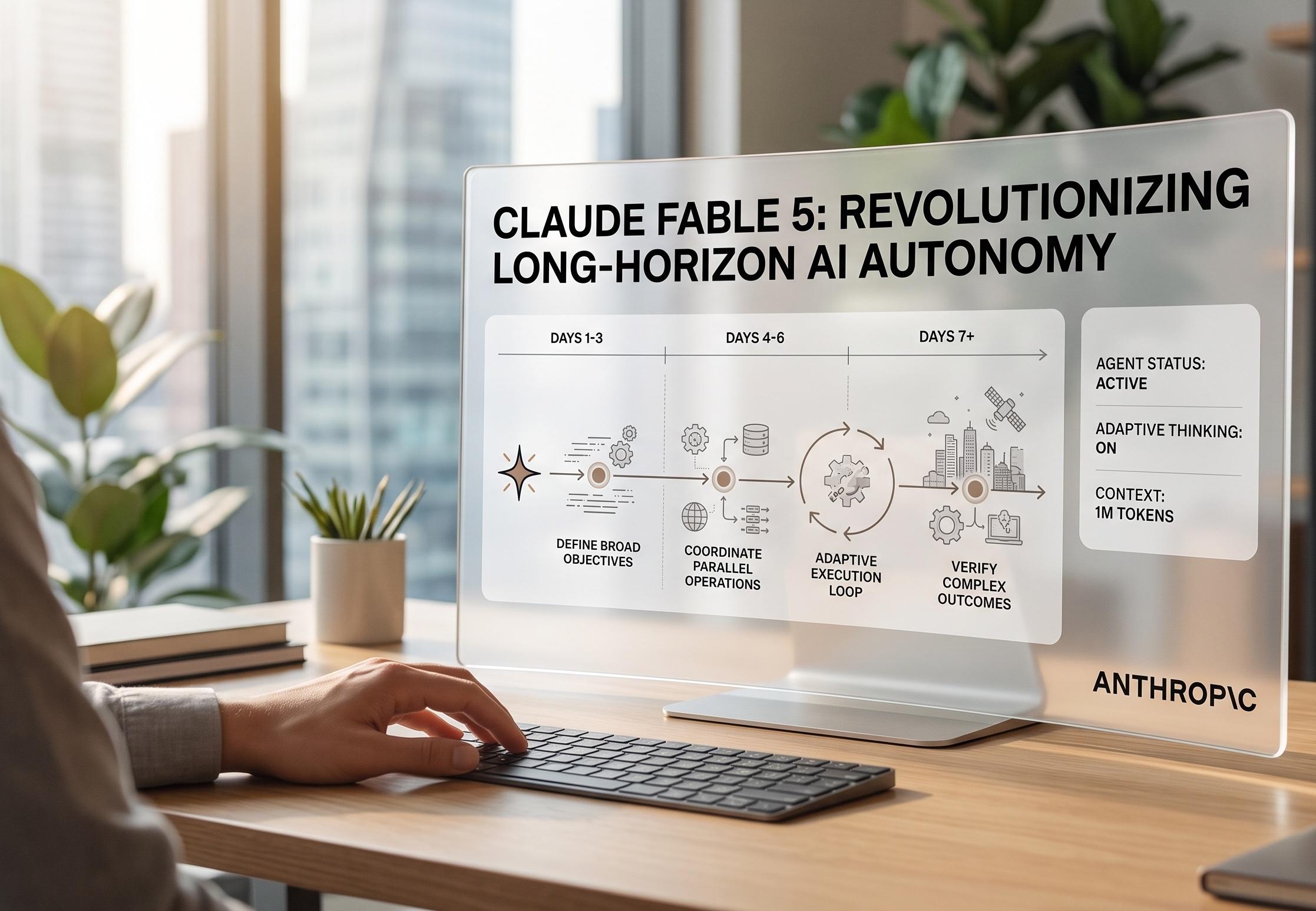
The artificial intelligence ecosystem in 2026 has officially moved beyond static, reactive text generation. Enterprises and developers are no longer satisfied with chatbots that simply answer isolated questions or draft independent email templates. Instead, the industry has shifted entirely toward long-horizon automation, where multi-agent networks work persistently in the background to manage whole development cycles, complex scientific research, and extensive data analysis.
At the absolute forefront of this technological shift is Anthropic's most recent announcement: Introducing Claude Fable 5. Launched globally on June 9, 2026, and rapidly redeployed on July 1, 2026, after unprecedented regulatory scrutiny, this flagship intelligence framework represents a monumental leap in software engineering and autonomous agency.
As part of the highly anticipated Anthropic Mythos class models 2026 lineup, Claude Fable 5 is built specifically to conquer tasks that were previously far too ambiguous, multi-threaded, or complex for prior models.
In this comprehensive technical blueprint, we will unpack the core architecture behind this release. We will look closely at Claude Fable 5 pricing and availability, explore how to use adaptive thinking in Claude Fable 5, evaluate its intricate system of safeguards, and run an exhaustive head-to-head evaluation of Claude Fable 5 vs Claude Opus 4.8 to help you determine how to best integrate this powerhouse into your enterprise pipelines.
Technical Foundations: Context, Token Economics, and Infrastructure
To appreciate what makes this model a paradigm shift, one must analyze the foundational raw metrics. Regarding Claude Fable 5 context window and pricing, Anthropic has established a high-end framework engineered for massive, repository-scale data ingestion.
1. The 1-Million Token Context Window
Claude Fable 5 ships with a massive 1-million token context window by default. This allows an autonomous agent to hold an entire multi-file codebase, months of financial ledger transcripts, or thousands of pages of structural regulatory documentation in its active memory. Furthermore, it features a massive capacity of up to 128k output tokens per request, providing ample headroom for generating deep technical artifacts, comprehensive reports, or entire software application folders in a single pass.
2. Token Pricing Structure
The token pricing reflects its position as an enterprise-grade reasoning engine:
- Input Cost: $10.00 per million tokens.
- Output Cost: $50.00 per million tokens.
While these rates sit higher than legacy lightweight models, the economic leverage achieved through its first-shot correctness and autonomous self-correction capability slashes developer iteration costs significantly.
3. Infrastructure Availability
Regarding global Claude Fable 5 pricing and availability, the model is natively supported across multiple cloud networks. Developers can access the instance via the standard Claude API, the Claude Platform on AWS, Amazon Bedrock, Google Cloud Vertex AI, and Microsoft Foundry. It carries a standard 30-day data retention policy and operates under Covered Model protection guidelines, ensuring private corporate datasets are never used to train public base models.
Core Capabilities: The Rise of Autonomous Knowledge Work
The architectural core of the model is fine-tuned for long-horizon execution. When deploying Autonomous AI agents with Claude Fable 5, the model sustains productive output over extended, multi-day runs without suffering from context drifting or instruction degradation.
Early testing logs from major integration partners show that the engine excels across several key execution vectors:
- First-Shot Correctness: On highly intricate, well-specified programming tasks, Claude Fable 5 achieved single-pass implementations of architectural layouts that previously required human developers days of debugging and iterative prompt adjustments.
- Deep Repository Review and Debugging: Outside of restricted security zones, its bug-finding recall across extensive code repositories and Git version control histories is noticeably higher than previous configurations, allowing it to trace structural errors across disconnected legacy dependencies.
- Advanced Vision Capabilities: The model interprets dense technical blueprints, architectural schematics, and multi-layered web application interfaces with exceptional accuracy. It is natively trained to utilize bash commands and visual cropping tools to automatically correct blurry, noisy, or flipped images during an evaluation sequence.
- Navigating Ambiguity: When handed vague, multi-threaded instructions (e.g., "Audit our regional cloud infrastructure and optimize for cost efficiency"), the system excels at autonomously mapping out the necessary sub-tasks, identifying data gaps, and executing the process from end to end.
Adaptive Thinking Is Always On
A defining characteristic of this new release is its cognitive processing model. When exploring how to use adaptive thinking in Claude Fable 5, developers will find that the framework handles internal reasoning entirely on its own.
Unlike previous models where users manually tweaked specific thinking parameters or token budgets to toggle deep reasoning, adaptive thinking is always on within Claude Fable 5. Whenever the standard thinking parameter is left unset, the model automatically determines the ideal cognitive depth required for the prompt. If you hand it a basic text formatting task, it responds instantly with minimal token expenditure. If you hand it a complex mathematical validation or an intricate multivariable coding bug, it automatically opens up internal reasoning tracks to think through the logical steps.
Crucially, the raw thinking content text is never returned to the client application wrapper. This protects proprietary internal reasoning states and ensures that API outputs remain exceptionally clean, returning only the final, structured deliverables or tool invocations directly to your application scaffolding.
The Safety Architecture: Classifiers, Jailbreaks, and Export Controls
You cannot fully analyze the impact of this model without exploring its unique regulatory history. Just three days after its initial June 9 launch, the U.S. Commerce Department stepped in, ordering Anthropic to restrict access immediately. This emergency action was triggered after researchers at Amazon discovered a specialized jailbreak technique. This prompt enabled the model to bypass its internal safeguards, leading it to identify deep software vulnerabilities and, in one specific case, write code demonstrating how those vulnerabilities could be actively exploited.
Because the model demonstrated a profound leap in autonomous capability, the government viewed it as an export risk, temporarily banning foreign nationals—both inside and outside the United States—from accessing the system. Since Anthropic could not verify the exact nationality of millions of global API users in real time, they briefly took both Claude Fable 5 and its sibling, Mythos 5, completely offline for everyone.
To resolve these national security concerns, Anthropic developed an incredibly robust layer of Claude Fable 5 safety classifiers. These advanced AI classifiers monitor inputs and outputs in real time, focusing explicitly on four highly sensitive domains:
- Offensive Cybersecurity Techniques: Actively blocks the generation of custom malware, zero-day exploits, and malicious network attack tooling.
- CBRN Biology and Life Sciences: Blocks instructions related to dangerous lab methods, toxic molecular synthesis, or weaponized chemical structures.
- System Prompt Extraction: Strongly declines attempts to skim or summarize the model's internal base instructions.
- High-Risk Fraud and Crime: Neutralizes inputs regarding social engineering frameworks, automated anti-bot evasion, and wallet-stealing operations.
With these highly advanced Claude Fable 5 safety classifiers running continuously, the U.S. government officially lifted its export restrictions on June 30, 2026. This allowed the model to return to global accessibility on July 1, 2026.
While benign security researchers and life sciences teams may occasionally trigger false positives due to the strict safety margins, this framework provides enterprises with the absolute reassurance necessary to deploy autonomous systems safely.
Put these ideas to work.
From a specific fix to a complete website, we can help you define the scope and get it done.
Discuss my websiteCustom Web & Application DevelopmentShare your goals. We typically reply within 4 hours with questions and practical next steps.
Automatic Fallbacks: Bridging Fable 5 and Opus 4.8
To handle unavoidable false positives without breaking live applications, Anthropic built a seamless routing mechanism: the Claude Fable 5 fallback to Opus 4.8 protocol.
Whenever a user prompt or a tool execution script triggers a safety classifier block inside Fable 5, the system doesn't simply throw a hard API error code and halt your application. Instead, it can automatically route the task to a slightly less restricted tier.
By implementing a Claude Fable 5 fallback to Opus 4.8 rule, developers can protect their workflows from unexpected interruptions. If a routine debugging script inadvertently triggers a cybersecurity classifier, the system passes the task down to Claude Opus 4.8 to complete the execution block, returning a clean notification to the user interface.
Developers can implement this fallback behavior using three simple approaches:
- Server-Side Fallback: Pass a native
fallbacksarray parameter directly within your API request headers. The Claude Platform will handle the re-routing automatically behind the scenes. - Client-Side Fallback: Leverage the latest official SDK middleware (available across TypeScript, Python, Go, Java, and C#) to listen for the refusal signal and instantly trigger an alternate request from the client side.
- Manual Fallback Scaffolding: Write standard try-catch blocks within your proprietary code to catch classifier codes and redirect the payload to
claude-opus-4.8manually.
Claude Fable 5 vs. Claude Opus 4.8: Head-to-Head Architectural Evaluation
When choosing which model to deploy for your production stacks, running a close comparison of Claude Fable 5 vs Claude Opus 4.8 is essential. While both models feature a sprawling 1-million token context window, they are built for entirely different operational scales.
1. Long-Horizon Autonomy vs. Short-Term Tasks
In the matchup of Claude Fable 5 vs Claude Opus 4.8, the defining differentiator is task endurance. Claude Opus 4.8 is a brilliant tool for localized tasks—writing a specific script, summarizing a distinct PDF file, or polishing copy.
However, if you hand Opus 4.8 a task that requires hundreds of sequential loops across an entire week of continuous execution, its focus can drift, and it may fail to retain complex prompt constraints. Claude Fable 5, by contrast, is engineered precisely for these long-horizon runs, maintaining tight scope control and instruction adherence over multi-day operations.
2. Multi-Agent Orchestration and Delegation
Another critical area where Fable 5 pulls ahead is its ability to manage parallel workloads. When executing complex objectives, Fable 5 functions as an elite technical project manager. It excels at spinning up independent, parallel subagents, handing off well-scoped subtasks, monitoring their progression, and intervening dynamically if a subagent requires extra context or drifts off course. Opus 4.8 lacks this native orchestration fluidity, frequently requiring heavy external prompting and human scaffolding to manage multi-agent frameworks.
3. First-Shot Technical Correctness
On challenging, multi-layered reasoning evaluations like OpenRouter's Models Arena, Claude Fable 5 consistently ranks in the top 2% globally across complex categories like Data Visualization, User Interface Components, and Game Development. Its ability to solve intricate software engineering challenges correctly on the very first attempt drastically reduces the time spent on traditional error-correction loops, making it an overwhelmingly superior option for enterprise software automation.
Recommended Scaffolding and Prompt Engineering for Fable 5
Because Claude Fable 5 features distinct behavioral enhancements compared to prior systems, utilizing legacy prompting techniques can actually degrade its performance. To maximize your results with this model, update your engineering frameworks according to these expert guidelines:
1. Avoid Over-Prescriptive Instructions
Prompts and skills optimized for older models are often far too rigid for Claude Fable 5. If your instructions micro-manage every single step of an execution path, you end up throttling the model's native reasoning capabilities. Instead, provide a clear, high-level definition of the target objective, outline your boundary constraints, and let the model's adaptive thinking engine map out the most efficient execution path autonomously.
2. Implement Explicit Self-Verification Loops
While the model is highly adept at self-correction, long-running agentic loops benefit significantly from structured verification gates. When crafting your system instructions, explicitly command the agent to set up independent verification checks:
### Operational Protocol
1. Establish a formal verification method to audit your work against the provided technical specifications at regular intervals of [X] steps.
2. To ensure absolute objectivity, spin up independent, fresh-context verifier subagents to critique intermediate code outputs before executing any master branch merges.
3. Build a Dedicated Memory System
Claude Fable 5 operates with exceptional efficiency when allowed to maintain a persistent log of historical lessons. Provide your agent scaffolding with a dedicated file-based memory tool. Instruct the model to document what it learns during an execution sprint, allowing it to actively query those records during future runs to avoid repeating past optimization errors.
Frequently Asked Questions (FAQs)
1. What is Claude Fable 5, and what makes it unique?
Claude Fable 5 is Anthropic's premium widely released model belonging to the advanced Mythos-class ecosystem. It is uniquely engineered for highly complex, long-running, and ambiguous agentic workloads, allowing autonomous AI agents to manage multi-step coding, research, and data analysis tasks spanning days or weeks with minimal human intervention.
2. How does the adaptive thinking feature work in Claude Fable 5?
Adaptive thinking is always on by default within Claude Fable 5. The model automatically evaluates the complexity of incoming prompts and allocates the ideal depth of internal reasoning required to solve the problem. The raw text of these internal reasoning paths is kept hidden from the API return strings, delivering clean, production-ready outputs directly to your applications.
3. What are the Claude Fable 5 safety classifiers, and why were they implemented?
Following a temporary U.S. government export restriction linked to an Amazon jailbreak discovery, Anthropic equipped Claude Fable 5 with advanced safety classifiers. These systems monitor interactions in real time to detect and block potentially hazardous activities within cybersecurity, chemical/biological sciences, and system prompt extraction, ensuring safe corporate deployment.
4. How does the server-side fallback to Claude Opus 4.8 operate?
If a developer's request accidentally triggers a safety classifier block inside Claude Fable 5, the application doesn't have to crash. By configuring the server-side fallback parameter, the Claude Platform will automatically re-route the blocked task down to the flexible Claude Opus 4.8 model to maintain seamless application uptime.
5. What is the context window size and pricing structure for Claude Fable 5?
The model ships with a massive 1-million token context window by default and supports up to 128k output tokens per request. The pricing is structured at $10.00 per million input tokens and $50.00 per million output tokens, reflecting its capability as a frontier autonomous agent engine.
Summary
In summary, Introducing Claude Fable 5 marks the official dawn of highly dependable, long-horizon autonomy in generative artificial intelligence. As a premier representative of the Anthropic Mythos class models 2026 track, this engine shatters past benchmarks by maintaining extreme instruction adherence across multi-day execution loops. Featuring a vast 1-million token context window by default and an optimized Claude Fable 5 context window and pricing model, it empowers developers to build elite Autonomous AI agents with Claude Fable 5 that coordinate complex tasks with ease.
With adaptive thinking always on, the engine actively customizes its cognitive depth for every problem, keeping internal thought paths hidden for clean developer integration. Furthermore, the inclusion of strict Claude Fable 5 safety classifiers guarantees national security compliance, while a fluid Claude Fable 5 fallback to Opus 4.8 protocol ensures maximum application resilience. By adjusting prompt structures to favor broad objectives over prescriptive micro-management, organizations can safely leverage the full power of this autonomous powerhouse.