
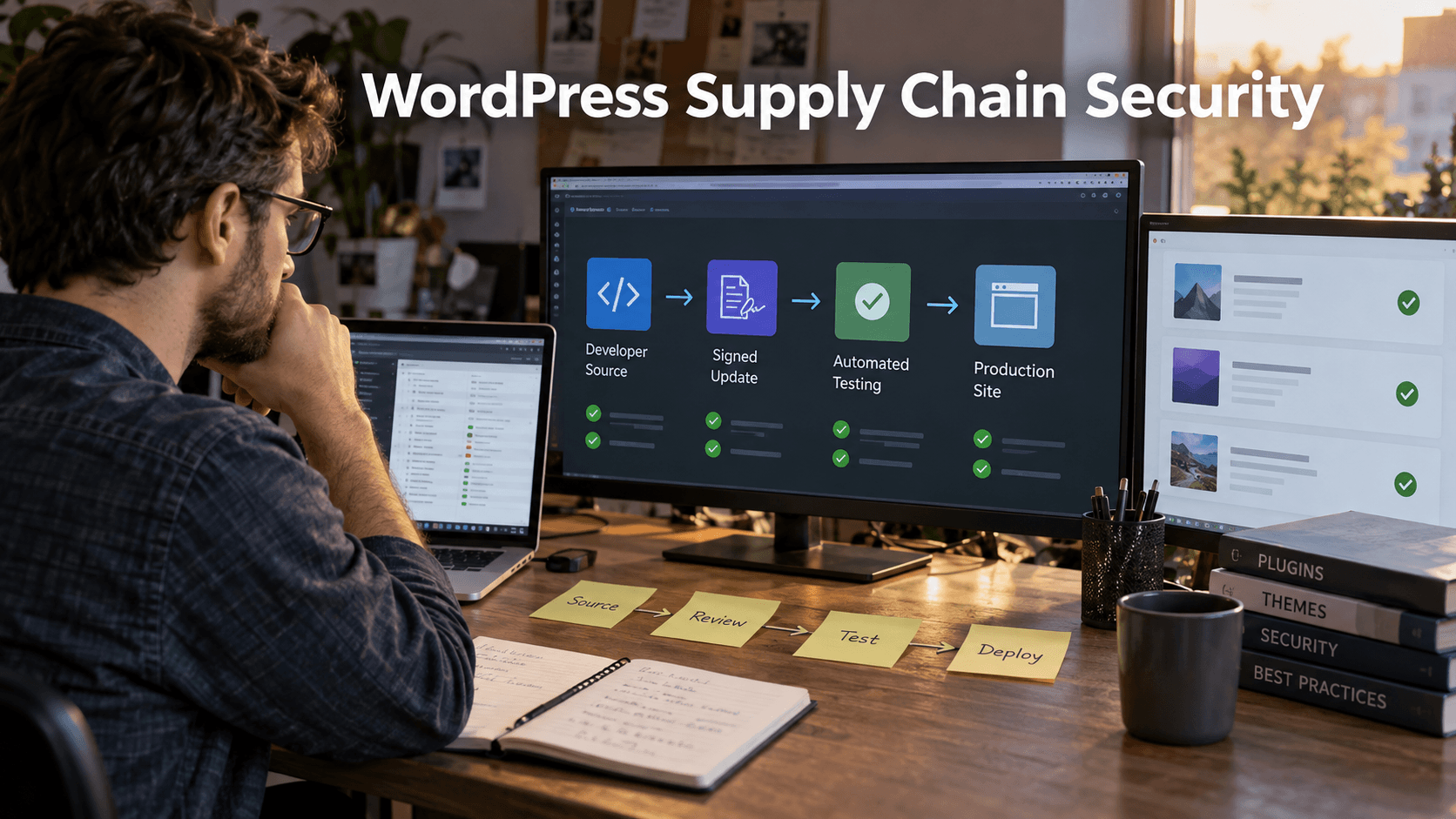
Most WordPress sites depend on dozens of external components: plugins, themes, libraries, build tools, CDNs, and vendor accounts. Even secure custom code can be undermined when a trusted update channel is compromised. Supply-chain security means evaluating where software comes from, who can change it, how updates are tested, and how suspicious releases are detected.
Understand the trust chain
Map each component from publisher and maintainer accounts through distribution, download, testing, deployment, and production. Include premium marketplaces, private repositories, license portals, composer packages, JavaScript dependencies, must-use plugins, snippets, and hosting-provided code.
Book a free, no-obligation strategy call and we'll map out your next move.
Begin with a WordPress security audit to create a defensible inventory and remove unknown or abandoned components.
Reduce unnecessary dependencies
Every plugin or theme adds code, update channels, maintainers, and configuration. Remove components without a current business purpose. Deactivation is not enough when files remain accessible. Prefer a smaller set of well-supported tools over several overlapping products.
Vet publishers and ownership
Review release frequency, changelogs, vulnerability response, support quality, active installations, recent ownership transfers, requested permissions, and development transparency. Be cautious when a dormant component suddenly changes ownership or introduces unrelated behavior.
Our article on common WordPress security mistakes explains why abandoned plugins and excessive access create recurring risk.
Protect purchasing and developer accounts
Premium download portals, source repositories, package registries, deployment systems, and hosting dashboards deserve unique credentials and multi-factor authentication. Use individual accounts, remove former collaborators, and protect recovery email accounts and domain registration.
Follow our WordPress two-factor authentication guide across every account capable of changing production code.
Test updates before production
Use a protected staging environment with representative configuration and automated smoke tests. Review file changes, database migrations, new permissions, outbound connections, scheduled tasks, checkout or lead flows, and performance. Maintain a tested rollback rather than assuming an older package will remain available.
Our WordPress backup and recovery guide helps define restore points and rollback evidence before high-risk releases.
Control how code reaches production
Limit production write access, disable unnecessary in-dashboard editing, and use an accountable deployment path. Keep secrets out of repositories and validate downloaded packages when publishers provide signatures or checksums. Record who approved and deployed each change.
Apply our WordPress file permissions guide so a compromised process cannot rewrite more of the site than necessary.