The artificial intelligence arms race has reached a fever pitch in the spring of 2026. Just when the tech industry thought the dust had settled between OpenAI and Google, Anthropic disrupted the ecosystem by introducing Claude Opus 4.7. This latest release has redefined the boundaries of autonomous agentic workflows, complex reasoning, and software engineering benchmarks. However, it does not exist in a vacuum. To truly understand its impact, we must analyze it against its fiercest competitors.
If you are a developer, an enterprise decision-maker, or a tech enthusiast, navigating the nuances of these frontier models is critical. The decision between Anthropic's latest offering and the incumbent giants is no longer just about generating text; it is about choosing the brain that will power your company's automation.
In this comprehensive, deep-dive guide, we are formally introducing Claude Opus 4.7 and breaking down the critical difference between GPT-5.4 and Gemini 3.1 Pro. We will explore their architectural philosophies, context window capabilities, coding proficiency, and native multimodality to help you determine which AI titan deserves your API budget in 2026.
1. Introducing Claude Opus 4.7: Anthropic’s New Heavyweight
Before we draw comparisons, we must understand the new challenger. Introducing Claude Opus 4.7 is not merely an iterative update; it represents a fundamental leap in Anthropic’s "Constitutional AI" framework.
Released in April 2026, Opus 4.7 is the heaviest, most capable model in the Claude family. While its predecessors were known for their human-like writing tone and safety guardrails, Opus 4.7 was engineered specifically to dominate the "deep work" category.
Agentic Computer Use Perfected
The defining feature of Claude Opus 4.7 is its flawless execution of "computer use." While earlier models experimented with taking control of a cursor or terminal, Opus 4.7 acts as a fully autonomous senior developer. If you give it access to your local environment, it can open an IDE, read your PostgreSQL database schema, debug a Node.js backend, and deploy a fix without human intervention. Its ability to self-correct during multi-step planning loops is currently unmatched in the industry.
Extended Context and Perfect Recall
Introducing Claude Opus 4.7 also brings an expansion to its already massive context window. Operating smoothly at 500,000 tokens, it can ingest hundreds of dense technical manuals, financial reports, or complete software repositories. More importantly, it maintains a near 100% "needle-in-a-haystack" retrieval accuracy, ensuring that no detail is lost or hallucinated when synthesizing massive datasets.
2. The Reigning Champion: Understanding GPT-5.4
To understand the difference between GPT-5.4 and Gemini 3.1 Pro versus Claude, we must look at OpenAI's current flagship. GPT-5.4 is the evolution of the much-lauded System 2 thinking models. It is built for raw, universal problem-solving.
Dynamic Compute and Deep Reasoning
GPT-5.4 utilizes dynamic compute allocation. When faced with a complex logic puzzle, algorithmic challenge, or advanced physics equation, GPT-5.4 does not just stream an immediate answer. It pauses to "think." It runs invisible internal simulations, testing different mathematical pathways and logical routing before outputting the final token. This makes it exceptionally powerful for academic reasoning and structured enterprise workflows.
The Microsoft Ecosystem Advantage
One cannot discuss GPT-5.4 without mentioning its ubiquitous presence. It is the engine driving GitHub Copilot, Microsoft 365 Copilot, and Azure AI. For businesses already entrenched in the Microsoft ecosystem, GPT-5.4 offers frictionless integration, robust enterprise security compliance, and an incredibly stable API infrastructure.
3. The Multimodal Behemoth: Gemini 3.1 Pro
Google’s approach with DeepMind is fundamentally different from both OpenAI and Anthropic. The core difference between GPT-5.4 and Gemini 3.1 Pro lies in how the models perceive the world.
Native Multimodality
Gemini 3.1 Pro was not trained on text first and vision later. It is natively multimodal. It understands text, images, raw audio, and video streams simultaneously. You can upload an hour-long MP4 video and ask Gemini 3.1 Pro to identify the exact timestamp where a specific topic is discussed, or to analyze the emotional tone of the speaker's voice. This eliminates the need for separate transcription (Speech-to-Text) or optical character recognition (OCR) models.
The Infinite Context Window
Google has continued to push the boundaries of memory. Gemini 3.1 Pro operates with a staggering 2-million to 10-million token context window (depending on the enterprise tier). It can hold entire libraries of information in its active memory. When paired with Google Workspace (Docs, Sheets, Drive) and Google Cloud, it becomes the ultimate research assistant for parsing astronomically large datasets.
4. Claude Opus 4.7 vs GPT-5.4 vs Gemini 3.1 Pro: Head-to-Head
Now that we have established the baseline for each model, let's explore the granular difference between GPT-5.4 and Gemini 3.1 Pro, and see how they stack up against the newly released Claude Opus 4.7 across key performance categories.
A. Coding and Software Engineering
For developers, the AI must act as a reliable pair-programmer.
- Claude Opus 4.7: Anthropic takes the crown here. On the industry-standard SWE-bench, introducing Claude Opus 4.7 shifted the paradigm. Its ability to understand complex code architectures, navigate multi-file repositories, and execute autonomous terminal commands makes it the best AI for coding in 2026. It rarely falls into infinite loops and is exceptional at modern frameworks (like React, Next.js, and Tailwind CSS).
- GPT-5.4: A very close second. Its algorithmic problem-solving is practically flawless. It writes incredibly optimized code and excels at backend logic and database query generation. Its primary advantage is its seamless integration into IDEs via GitHub Copilot.
- Gemini 3.1 Pro: Highly proficient, particularly in Python, web development, and Android ecosystems. While it might slightly trail Opus 4.7 in zero-shot complex architectural debugging, its ability to ingest an entire massive codebase into its context window makes it exceptional for legacy code refactoring.
B. Reasoning and Logic
- GPT-5.4: Wins in purely abstract, mathematical, and highly structured logical routing. Its "thinking" tokens allow it to process scenarios that confuse other models.
- Claude Opus 4.7: Excels in nuanced, verbal reasoning. It is unparalleled at analyzing legal documents, synthesizing contradictory medical research, and maintaining a high level of intellectual honesty (i.e., it will admit when it does not know something rather than confidently hallucinating).
- Gemini 3.1 Pro: Its reasoning is heavily tied to its context. It shines when it needs to logically connect dots across a massive variety of inputs—such as correlating a spike in a financial chart image with a specific paragraph in a 200-page earnings report.
C. Vision and Multimodal Capabilities
- Gemini 3.1 Pro: The undisputed leader. Native multimodality means it processes video and audio with a level of fluidity and precision that competitors cannot match. It is the ultimate tool for visual data extraction and real-time audio conversation.
- GPT-5.4: Offers exceptional vision and Advanced Voice capabilities. It is highly adept at reading messy handwritten notes, parsing complex data charts, and engaging in emotionally resonant audio conversations.
- Claude Opus 4.7: Introducing Claude Opus 4.7 brought significant upgrades to its vision capabilities, specifically optimized for reading UI/UX screenshots, technical diagrams, and dense PDF layouts. However, it still relies primarily on text and images, lacking the native raw audio/video ingestion of Gemini.
Put these ideas to work.
From a specific fix to a complete website, we can help you define the scope and get it done.
Discuss my websiteCustom Web & Application DevelopmentShare your goals. We typically reply within 4 hours with questions and practical next steps.
5. Writing Tone and Content Generation
For digital marketers, copywriters, and content creators, the "vibe" of the model is just as important as its benchmark scores.
When introducing Claude Opus 4.7, Anthropic maintained its legendary human-sounding tone. Claude does not sound like a robot. It avoids the repetitive, overly enthusiastic corporate jargon ("In today's fast-paced digital world...") that plagues AI-generated content. It requires the least amount of prompt engineering to produce a nuanced, highly readable blog post or essay.
The difference between GPT-5.4 and Gemini 3.1 Pro in writing is subtle. GPT-5.4 is highly steerable and excellent at following strict formatting instructions (like producing exact JSON outputs or adhering to strict word counts), but its default tone can feel sterile. Gemini 3.1 Pro is incredibly fast at drafting and excels at matching the tone of the documents you provide it in its massive context window.
6. Security, Privacy, and Enterprise Adoption
Enterprise decision-makers do not just buy intelligence; they buy security.
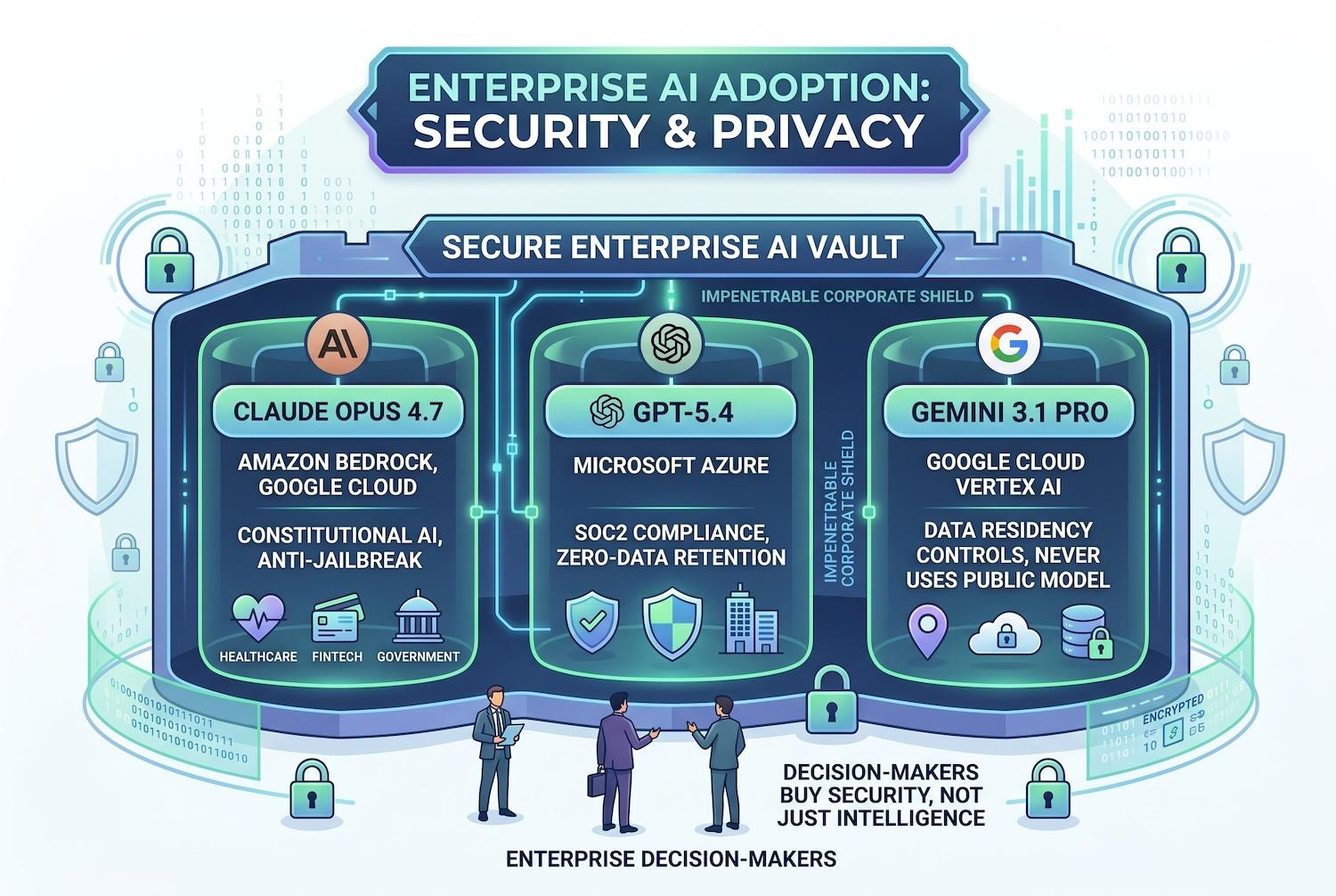
Anthropic's entire brand is built on "Constitutional AI." Introducing Claude Opus 4.7 reinforced this commitment. The model is highly resistant to jailbreaks and prompt injection attacks, making it a favorite for fintech, healthcare, and government institutions where data security is paramount. It is available securely via Amazon Bedrock and Google Cloud.
OpenAI's GPT-5.4 offers enterprise-grade security through Microsoft Azure. For companies that require strict SOC2 compliance and zero-data-retention policies, routing GPT-5.4 through Azure provides an impenetrable corporate shield.
Google’s Gemini 3.1 Pro is similarly locked down within the Google Cloud Vertex AI platform. It offers robust data residency controls, ensuring that enterprise queries are never used to train public models.
7. Pricing and Cost-Efficiency
Power comes at a price. All three of these are "frontier" models, meaning they are the most expensive options in their respective ecosystems.
- Claude Opus 4.7: As the most capable model from Anthropic, API costs are premium. For automated background tasks, developers often downgrade to Claude Sonnet, reserving Opus strictly for the most complex reasoning tasks.
- GPT-5.4: Pricing remains standard for OpenAI’s flagship tier. It is expensive for bulk processing, but the ROI on complex logical tasks makes it worthwhile for enterprise applications.
- Gemini 3.1 Pro: Google often uses its massive server infrastructure to offer highly competitive pricing, especially for multimodal inputs. If you are processing thousands of images or hours of video, Gemini is often the most cost-effective frontier model.
8. Conclusion: Which Model Should You Choose in 2026?
The tech landscape of 2026 is blessed with an abundance of intelligence. There is no longer a single "best" AI; there is only the best AI for your specific workflow.
If you are a software engineer building complex web applications, managing massive databases, or seeking an autonomous agent to navigate your terminal, the arrival of Claude Opus 4.7 is the answer you have been waiting for. Its coding proficiency and agentic capabilities are currently unrivaled.
If your daily workflow involves solving complex mathematical equations, structured enterprise reporting, or you are deeply integrated into the Microsoft ecosystem, GPT-5.4 remains the undisputed king of deep, logical reasoning.
However, if you are a researcher analyzing gigabytes of raw data, a video editor parsing hours of footage, or a data scientist needing to cross-reference thousands of documents, the Gemini 3.1 Pro with its native multimodality and multi-million token context window is the ultimate tool.
By understanding the strengths of Claude Opus 4.7 and the fundamental difference between GPT-5.4 and Gemini 3.1 Pro, you can strategically deploy the right AI to skyrocket your productivity and safeguard your digital future.
Frequently Asked Questions (FAQs)
1. What makes Claude Opus 4.7 different from previous Claude models?
Introducing Claude Opus 4.7 brought a paradigm shift in agentic automation. Unlike previous models, Opus 4.7 was perfected for "computer use," meaning it can autonomously interact with development environments, run terminal commands, and execute multi-step software engineering tasks flawlessly. It also features an expanded context window and enhanced logical reasoning.
2. What is the main difference between GPT-5.4 and Gemini 3.1 Pro?
The core difference between GPT-5.4 and Gemini 3.1 Pro is their architectural foundation. GPT-5.4 is heavily focused on deep, "System 2" logical reasoning and dynamic compute allocation, making it ideal for math and abstract problem-solving. Gemini 3.1 Pro is natively multimodal with a massive context window (up to 10 million tokens), making it superior for processing raw video, audio, and gigantic datasets simultaneously.
3. Is Claude Opus 4.7 better than GPT-5.4 for coding?
Yes, in 2026, Claude Opus 4.7 is widely considered superior for complex software engineering and autonomous coding workflows. Its ability to navigate multi-file repositories, understand modern frameworks, and debug its own code places it at the top of the SWE-bench leaderboards, though GPT-5.4 remains an exceptional pair-programmer.
4. Can Gemini 3.1 Pro process video files directly?
Yes. Because Gemini 3.1 Pro is natively multimodal, you can upload an MP4 or other video files directly into the prompt. The model processes the visual frames and the audio track concurrently, allowing you to ask highly specific, timestamp-related questions about the video content without needing a text transcript.
5. Are these AI models safe for enterprise use?
Yes, all three models are designed with enterprise security in mind. Claude Opus 4.7, GPT-5.4, and Gemini 3.1 Pro can be accessed through secure cloud providers (Amazon Bedrock, Microsoft Azure, and Google Cloud Vertex AI, respectively) that offer zero-data-retention policies, ensuring your proprietary company data is never used to train public models.
Summary
The spring of 2026 brought a monumental shift in the AI landscape by introducing Claude Opus 4.7, Anthropic's most advanced model designed for autonomous agentic workflows and elite software engineering. To choose the right tool, developers must understand the difference between GPT-5.4 and Gemini 3.1 Pro. While Claude dominates coding and human-like writing, OpenAI’s GPT-5.4 remains the gold standard for deep mathematical reasoning and Microsoft enterprise integration. Conversely, Google's Gemini 3.1 Pro leads the industry in native multimodality (video/audio processing) and boasts a staggering multi-million token context window. By assessing your specific needs—whether coding, logic, or big data analysis—you can select the ultimate AI to power your 2026 tech stack.
Reference Links