The landscape of artificial intelligence has shifted once again with the monumental release of Claude Opus 4.5. On November 24, 2025, Anthropic unveiled its most advanced model to date, reclaiming the throne in the fiercely competitive world of Large Language Models (LLMs). As we navigate a year saturated with releases like OpenAI's GPT-5.1 and Google's Gemini 3, the arrival of Claude Opus 4.5 marks a definitive turning point for software engineers, enterprise architects, and AI researchers. This isn't just an incremental update; Claude Opus 4.5 represents a paradigm shift in agentic capabilities, coding proficiency, and cost-efficiency.
In this extensive technical deep dive, we will explore every facet of Claude Opus 4.5, from its shattering of the 80% barrier on the SWE-bench Verified benchmark to its revolutionary "computer use" features. We will analyze the Claude Opus 4.5 pricing structure, its integration with tools like Cursor and GitHub Copilot, and why Claude Opus 4.5 is being hailed as the first AI to truly outperform human software engineers in complex technical assessments.
The Dawn of Claude Opus 4.5
The release of Claude Opus 4.5 comes at a critical juncture. The AI community has been eagerly awaiting a model that doesn't just chat but does. Claude Opus 4.5 is built to be that doer. Anthropic has engineered Claude Opus 4.5 to excel in long-horizon tasks, meaning it can maintain a train of thought, execute complex multi-step plans, and manage sprawling projects without losing context.
Unlike its predecessors, Claude Opus 4.5 is not merely a text generator; it is an intelligent agent designed to operate within your digital environment. With Claude Opus 4.5, the boundaries between an AI assistant and a digital coworker have blurred significantly. The model's ability to navigate user interfaces, perform deep research, and write production-ready code positions Claude Opus 4.5 as the premier tool for the next generation of software development.
Unmatched Coding Capabilities: The SWE-bench Breakthrough
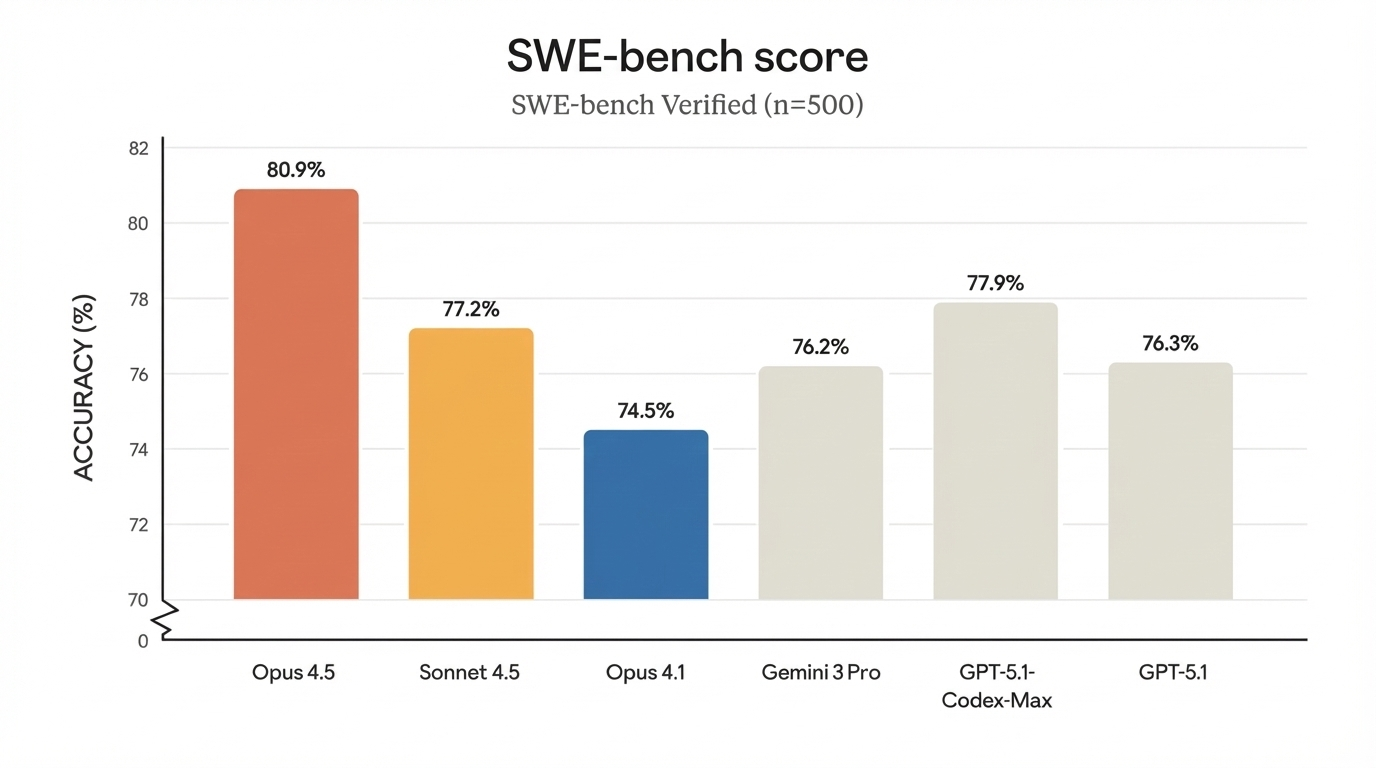
The headline feature of Claude Opus 4.5 is undoubtedly its coding prowess. For months, the industry has looked to the SWE-bench Verified benchmark as the gold standard for evaluating an AI's ability to solve real-world GitHub issues. Claude Opus 4.5 has achieved what was previously thought to be years away: a score of 80.9%.
This Claude Opus 4.5 SWE-bench score is historic. To put it in perspective, Claude Opus 4.5 is the first model to break the 80% threshold, surpassing formidable competitors like GPT-5.1-Codex-Max (77.9%) and Google’s Gemini 3 Pro (76.2%). This isn't just about passing unit tests; it's about understanding complex codebases, identifying the root cause of obscure bugs, and generating patches that respect the existing architecture.
When developers use Claude Opus 4.5, they are noticing a distinct difference in "vibe coding"—the model's ability to intuitively grasp the stylistic preferences and architectural patterns of a project. Claude Opus 4.5 doesn't just write code; it architects solutions. In Anthropic's own internal coding interviews—the same ones given to human candidates—Claude Opus 4.5 outperformed 100% of human applicants on technical proficiency. While it lacks the soft skills of a human, the sheer technical leverage Claude Opus 4.5 provides is undeniable.
Claude Opus 4.5 Pricing: Democratizing Frontier Intelligence
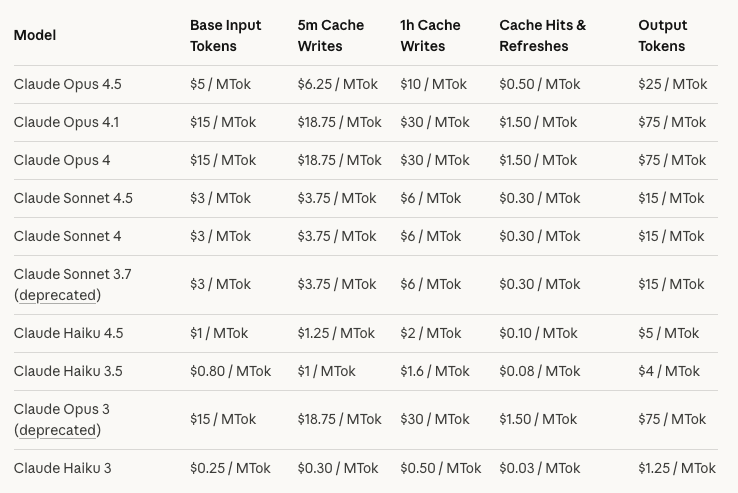
One of the most shocking aspects of the Claude Opus 4.5 release is its aggressive pricing strategy. Historically, the "Opus" tier meant "expensive." The previous Claude 3 Opus was priced at a premium that made it difficult to scale. However, Claude Opus 4.5 pricing has been slashed to $5 per million input tokens and $25 per million output tokens.
This represents a nearly 67% reduction compared to previous generations. By positioning Claude Opus 4.5 at this price point, Anthropic has made it a viable "daily driver" for developers. You no longer have to hoard your Claude Opus 4.5 credits for special occasions. The cost-efficiency of Claude Opus 4.5 combined with its high accuracy means fewer retries, further driving down the total cost of ownership for API users.
When compared to the competition, Claude Opus 4.5 offers exceptional value. While GPT-5.1 and Gemini 3 Pro hover around similar or slightly higher price points, the token efficiency of Claude Opus 4.5—its ability to solve problems in fewer steps—makes it arguably the most economical choice for complex tasks. For enterprise teams running thousands of automated coding agents, the Claude Opus 4.5 API cost reduction is a game-changer.
Computer Use and Agentic Workflows
Claude Opus 4.5 doubles down on the "Computer Use" capabilities introduced in earlier Sonnet models. However, Claude Opus 4.5 brings a level of precision and reliability that transforms this from a gimmick into a productivity staple.
A key innovation in Claude Opus 4.5 is the new Screen Zoom Tool. Previously, AI agents struggled with high-density interfaces or small buttons. Claude Opus 4.5 can now request to zoom in on specific regions of the screen, allowing it to interact with pixel-perfect precision. This makes Claude Opus 4.5 incredibly effective at automating tasks in legacy enterprise software or complex web applications that lack an API.
Furthermore, Claude Opus 4.5 introduces a "Thinking Blocks" preservation feature. In agentic workflows, it is crucial for an AI to remember how it arrived at a conclusion. Claude Opus 4.5 retains its chain-of-thought across multi-turn conversations by default. This allows Claude Opus 4.5 to self-correct and refine its plans without needing the user to restate context. This makes Claude Opus 4.5 agentic capabilities far superior to models that simply react to the latest prompt.
Claude Opus 4.5 vs. GPT-5.1 and Gemini 3
The inevitable comparison: Claude Opus 4.5 vs GPT-5.1. Both models launched in late 2025, and both claim supremacy. However, benchmarks paint a clear picture. While GPT-5.1 excels in general knowledge and multimodal creative tasks, Claude Opus 4.5 dominates in technical reasoning and coding.
In head-to-head comparisons, Claude Opus 4.5 consistently solves complex logic puzzles and architectural design problems that stump GPT-5.1. Users have reported that Claude Opus 4.5 hallucinates less often when dealing with technical documentation. Against Google's Gemini 3, Claude Opus 4.5 holds a significant lead in coding efficiency. While Gemini 3 boasts a massive context window, Claude Opus 4.5 utilizes its 200k token context window (expandable in enterprise plans) more effectively, demonstrating better recall and instruction adherence.
For developers choosing between Claude Opus 4.5 and its rivals, the choice often comes down to the use case. If you need a creative writing partner, competitors are strong. But if you need a software engineer, Claude Opus 4.5 is the undisputed champion.
Integrations: Where You Can Use Claude Opus 4.5
Anthropic has ensured that Claude Opus 4.5 is available wherever developers work. The Claude Opus 4.5 integrations ecosystem is robust from day one.
- Cursor & VS Code: Claude Opus 4.5 is natively integrated into modern AI code editors like Cursor. The model's speed and low latency make it feel instant, providing real-time suggestions that are contextually aware of your entire repository.
- Claude Code CLI: Anthropic’s own command-line tool, Claude Code, is powered by Claude Opus 4.5. This tool allows developers to refactor code, run tests, and manage git commits directly from the terminal using natural language, all orchestrated by the intelligence of Claude Opus 4.5.
- Microsoft Foundry & GitHub Copilot: In a strategic move, Claude Opus 4.5 is available on Microsoft Azure and integrates with GitHub Copilot. This puts Claude Opus 4.5 in the hands of millions of enterprise developers who are already embedded in the Microsoft ecosystem.
- Google Cloud Vertex AI & Amazon Bedrock: Continuing its multi-cloud strategy, Claude Opus 4.5 is available on all major cloud providers, ensuring that enterprises can deploy Claude Opus 4.5 within their existing security perimeters.
Put these ideas to work.
From a specific fix to a complete website, we can help you define the scope and get it done.
Discuss my websiteCustom Web & Application DevelopmentShare your goals. We typically reply within 4 hours with questions and practical next steps.
The "Effort" Parameter: Control Your Costs
A unique feature introduced with Claude Opus 4.5 is the "Effort" parameter. Recognizing that not every query requires the full, expensive brainpower of the model, Anthropic allows Claude Opus 4.5 users to toggle between Low, Medium, and High effort.
- Low Effort: Perfect for quick summaries or simple code snippets. Claude Opus 4.5 responds instantly with minimal token usage.
- Medium Effort: The default setting. Claude Opus 4.5 balances reasoning depth with speed, ideal for most daily tasks.
- High Effort: Claude Opus 4.5 engages its full "System 2" deep thinking capabilities. It will explore multiple branches of possibilities, verify its own work, and produce the highest quality output possible. This is where Claude Opus 4.5 achieves its state-of-the-art benchmark scores.
This granularity gives developers control over the Claude Opus 4.5 API cost like never before, allowing them to optimize for performance or budget dynamically.
Safety and Alignment: The Trusted Choice
In an era of deepfakes and automated cyberattacks, safety is paramount. Claude Opus 4.5 is classified as an ASL-3 (AI Safety Level 3) model. Anthropic has invested heavily in making Claude Opus 4.5 robust against prompt injection attacks. Internal tests show that Claude Opus 4.5 is significantly harder to "jailbreak" than competing frontier models.
This focus on safety makes Claude Opus 4.5 particularly attractive to enterprise clients in regulated industries like finance and healthcare. They can deploy Claude Opus 4.5 with the confidence that it will adhere to strict compliance guidelines and avoid generating harmful output. The "Constitutional AI" framework that underpins Claude Opus 4.5 ensures it remains helpful, harmless, and honest, even as its capabilities grow.
Real-World Use Cases for Claude Opus 4.5
The versatility of Claude Opus 4.5 unlocks new possibilities across various sectors:
- Legacy Code Migration: Companies stuck with archaic COBOL or Fortran codebases can use Claude Opus 4.5 to autonomously refactor and migrate systems to modern languages like Python or Go. Claude Opus 4.5 understands the nuances of legacy logic better than most junior engineers.
- Automated QA Testing: Claude Opus 4.5 can autonomously browse a web application, identify UI glitches, write reproduction steps, and even generate the fix. The Claude Opus 4.5 computer use capability makes it the ultimate QA tester.
- Scientific Research: Researchers are using Claude Opus 4.5 to synthesize massive datasets and generate hypotheses. Its deep reasoning allows Claude Opus 4.5 to find correlations in complex data that humans might miss.
- Legal & Financial Analysis: With its large context window, Claude Opus 4.5 can ingest thousands of pages of contracts or financial reports, summarizing risks and opportunities with executive-level precision.
Conclusion: The Future is Built with Claude Opus 4.5
The launch of Claude Opus 4.5 is more than just a spec bump; it is a declaration of intent. Anthropic has proven that it can compete with—and beat—the giants of the industry. Claude Opus 4.5 sets a new standard for what we expect from artificial intelligence. It is no longer enough to be a smart chatbot; the future belongs to agents that can act, code, and reason.
With its record-breaking Claude Opus 4.5 benchmarks, accessible Claude Opus 4.5 pricing, and robust Claude Opus 4.5 integrations, this model is poised to become the engine of the digital economy in 2026 and beyond. For anyone serious about leveraging AI for technical work, upgrading to Claude Opus 4.5 is not just an option; it is a necessity.
Frequently Asked Questions (FAQs)
1. What is the release date of Claude Opus 4.5?
Claude Opus 4.5 was officially released on November 24, 2025. It became immediately available to users on the Claude.ai platform, as well as via API for developers and through major cloud partners like Amazon Bedrock and Google Vertex AI.
2. How much does the Claude Opus 4.5 API cost?
The Claude Opus 4.5 pricing is highly competitive, set at $5.00 per million input tokens and $25.00 per million output tokens. This is a significant price reduction compared to the previous Claude 3 Opus model, making Claude Opus 4.5 much more accessible for high-volume enterprise applications and individual developers alike.
3. What is the Claude Opus 4.5 context window size?
Claude Opus 4.5 comes with a standard context window of 200,000 tokens. However, for Enterprise plan users and specific API use cases, this can be expanded up to 500,000 tokens, allowing Claude Opus 4.5 to process vast amounts of information, such as entire codebases or long technical documents, in a single prompt.
4. How does Claude Opus 4.5 compare to GPT-5.1?
In technical benchmarks, particularly coding and reasoning, Claude Opus 4.5 outperforms GPT-5.1. Claude Opus 4.5 achieved a score of 80.9% on the SWE-bench Verified test, compared to GPT-5.1-Codex-Max's 77.9%. While GPT-5.1 remains a strong generalist model, Claude Opus 4.5 is widely considered the superior model for software engineering and complex agentic tasks.
5. Can Claude Opus 4.5 use my computer?
Yes, Claude Opus 4.5 features advanced "Computer Use" capabilities. It can navigate web browsers, interact with desktop applications like Excel, and perform clicks and keystrokes to automate workflows. Claude Opus 4.5 also introduces a new "Screen Zoom Tool" to handle precise interactions on high-density screens, making it a powerful agent for automating repetitive digital tasks.
Summary
Claude Opus 4.5 represents a monumental leap in AI capability, solidifying Anthropic's position as a leader in the field. Launched in late 2025, Claude Opus 4.5 distinguishes itself with a historic SWE-bench score of 80.9%, making it the most capable coding AI ever released. With a drastically reduced price point of $5/$25 per million tokens, Claude Opus 4.5 democratizes access to frontier intelligence. Its robust agentic features, including advanced "Computer Use" and deep integration with tools like GitHub Copilot and Cursor, empower developers to build faster and more reliably. Whether compared to GPT-5.1 or Gemini 3, Claude Opus 4.5 stands out as the superior choice for technical reasoning and complex automation.
Reference Links