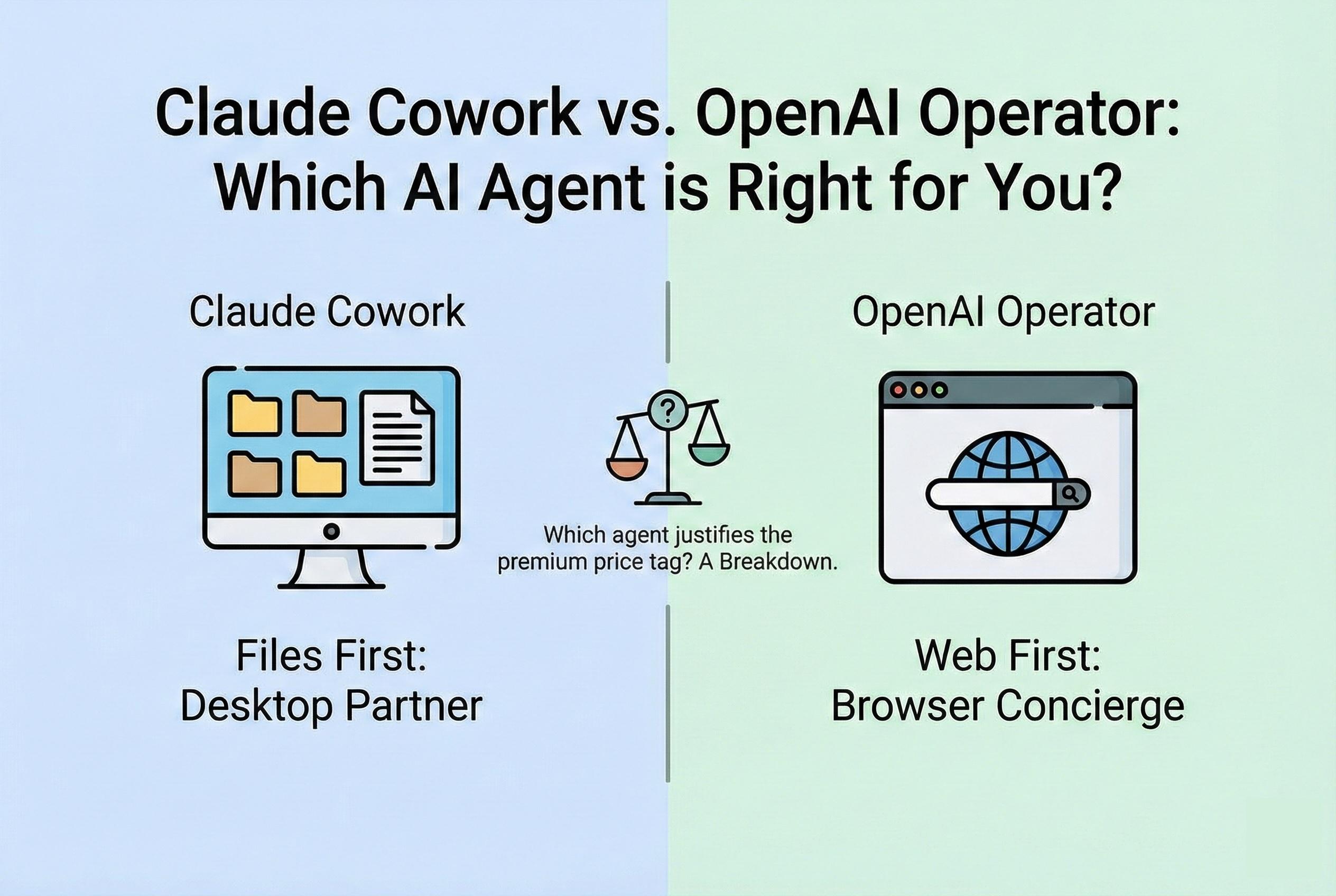
Update notice: OpenAI Operator is no longer a standalone product. OpenAI first integrated Operator’s browser capabilities into ChatGPT agent and now directs users to ChatGPT Work for longer, multi-step tasks and to Cloud browser for supported browser workflows. This guide preserves the original Operator comparison while answering the current question: Claude Cowork or ChatGPT Work?
The short answer: Claude Cowork is a strong fit when the job revolves around a selected workspace, local files and connected business tools. ChatGPT Work is broader when you want a finished deliverable assembled from files, plugins, connected services, scheduled work and browser-based actions. The safest choice depends on where your information lives and which permissions the task requires.
What happened to OpenAI Operator?
OpenAI introduced Operator in January 2025 as a research preview that could use a remote browser to click, type and scroll. In July 2025, OpenAI integrated that functionality into ChatGPT agent and deprecated the standalone Operator experience. OpenAI’s current help documentation says ChatGPT agent is no longer available and directs users to ChatGPT Work and Cloud browser.
OpenAI: Introducing Operator, including the July 2025 integration update
OpenAI Help: current ChatGPT agent status
Because the product changed, a 2026 comparison that presents Operator as a separate $200 browser agent is no longer accurate.
Claude Cowork vs ChatGPT Work: quick comparison
The product boundaries and availability can change quickly. Verify plan access and workspace permissions before buying a subscription or designing an operational workflow.
What Claude Cowork is designed to do
Claude Cowork is Anthropic’s environment for delegating multi-step knowledge work across files and connected applications. Anthropic’s own examples include reviewing collections of contracts, organizing information from multiple documents and producing a finished report.
The key idea is not simply “Claude can edit files.” Cowork is intended for a project that spans multiple files, tools or steps, where the user reviews the outcome rather than directing every individual action.
Where Claude Cowork is strongest
- Projects centered on documents and folders selected by the user.
- Longer assignments that require reading, comparing and producing multiple files.
- Organizations already using Claude and supported connectors.
- Workflows where a clearly scoped workspace is more important than unrestricted access.
How Anthropic contains Cowork
Anthropic explains that Claude Cowork uses a user-selected workspace folder. Its security architecture has used a local virtual machine to isolate code execution, while the selected workspace is mounted into that environment. Credentials remain in the host keychain rather than being placed inside the guest machine.
That architecture reduces exposure, but it does not make every task risk-free. A user can still grant access to sensitive files, connect an untrusted service or approve an incorrect action.
Anthropic engineering: how Claude is contained across products
What ChatGPT Work is designed to do
OpenAI describes ChatGPT Work as an agent for longer, multi-step assignments and finished deliverables. It can gather context from files and connected tools, create documents, spreadsheets, presentations and reports, and keep work moving through scheduled or recurring tasks.
On supported desktop workflows, Work can use local files and desktop applications with permission. Cloud Work is available across eligible web, mobile and desktop accounts, while access can depend on the user’s plan, rollout status and workspace controls.
OpenAI Help: ChatGPT Work and Codex
Cloud browser: the current successor to Operator-style tasks
For supported web tasks, ChatGPT Work can use a separate computer in the cloud. It can read pages, click buttons, enter form information and work with signed-in sessions. It pauses for sign-in, additional information or confirmation when required.
The remote environment is separate from the browser on your device. It does not automatically inherit personal tabs, history, passwords, cookies or existing sign-ins. Users sign in through a secure flow, and OpenAI says credentials entered there are not visible to the model.
OpenAI Help: using Cloud browser in ChatGPT
Claude Cowork vs ChatGPT Work by use case
Choose Claude Cowork when:
- The work is primarily contained in a known folder or document collection.
- Your team already relies on Claude and its supported integrations.
- You want a workspace-oriented model for research, document review and content production.
- You prefer to scope access around selected files before the task begins.
Choose ChatGPT Work when:
- The outcome may require documents, spreadsheets, presentations or an interactive deliverable.
- You need supported browser actions on public or signed-in websites.
- You want cloud tasks that can continue after you close your computer.
- Your workflow relies on plugins, connected tools or recurring scheduled work.
Use neither without additional controls when:
- The task can transfer money, accept legal terms or create an irreversible commitment without review.
- The source material includes secrets that the selected environment does not need.
- A mistake could affect customers, production infrastructure or regulated data.
- You cannot audit the inputs, permissions and final result.
Put these ideas to work.
From a specific fix to a complete website, we can help you define the scope and get it done.
Discuss my websiteCustom Web & Application DevelopmentShare your goals. We typically reply within 4 hours with questions and practical next steps.
Security and privacy questions to ask
A product comparison should not reduce security to “local is safe” and “cloud is risky.” The actual risk depends on the task, data, connectors, browser sessions, organizational controls and user approvals.
- What files, folders, websites and connected services can the agent access?
- Can access be limited to the minimum required scope?
- Where does code or browser activity execute?
- How are credentials entered and stored?
- Which actions require confirmation?
- Can administrators block websites, connectors or local access?
- How will the final output be reviewed and retained?
Prompt injection remains an important risk
Both file-based and browser-based agents can encounter instructions embedded in documents, emails or websites. Those instructions may attempt to redirect the agent, disclose information or trigger an unintended action. Treat external content as untrusted, restrict permissions and review consequential steps.
Pricing and plan access
Avoid choosing between the products using an old “$200 versus $200” comparison. Anthropic currently lists Free, Pro, Max 5x and Max 20x plans, but specific Cowork availability and usage can vary. ChatGPT Work availability also varies by plan, platform, region, rollout and workspace policy.
Before subscribing, verify:
- Whether the required feature is available on your exact plan and device.
- Usage or credit limits for the expected workload.
- Whether local files, cloud work and browser capabilities are separately controlled.
- Enterprise data, retention and administrator requirements.
Anthropic Help: choosing a Claude plan
A practical evaluation method
- Select five real workflows, including at least one sensitive or failure-prone task.
- Give each product the same source material, outcome and review criteria.
- Restrict access to only the files and services needed for each task.
- Measure completion time, corrections, failed actions and output quality.
- Review security prompts, auditability and the effort required to verify the result.
- Choose the product that completes your actual work reliably—not the one with the longest feature list.
Related Claude and AI agent guides
- Start with the product workflow in our beginner’s guide to Claude Cowork.
- For a deeper permission and sandbox review, read our Claude Cowork safety guide.
- If your work includes software repositories, compare Claude Code and Claude Cowork.
- Explore practical adoption ideas in our Claude Cowork use-case guide.
- Clarify the underlying terminology with our AI agent vs LLM vs RAG comparison.
- Non-technical teams can also review why Claude Code is useful beyond developers.
- Developers building custom agent workflows can also read our OpenAI Agent SDK guide.
Frequently asked questions
Is OpenAI Operator still available?
No. Operator’s functionality was first incorporated into ChatGPT agent. OpenAI’s current documentation directs users to ChatGPT Work and Cloud browser instead of a standalone Operator product.
Is Claude Cowork only for local files?
No. Local or selected workspace files are an important part of Cowork, but Anthropic also describes workflows spanning connected applications and services. Availability depends on the current product and plan.
Can ChatGPT Work use websites where I am signed in?
Yes, for supported workflows through Cloud browser. It uses a separate remote browser session and may pause for secure sign-in, two-factor authentication or confirmation.
Which one is safer?
Neither product is automatically safer for every task. Claude Cowork emphasizes scoped workspace access and isolated execution, while ChatGPT Work documents separate cloud-browser sessions, website permissions and confirmation for consequential actions. Safety depends on how narrowly you grant access and how carefully you review results.
Final verdict
Choose Claude Cowork for file-centered projects where a clearly selected workspace and Claude’s connected environment match the job. Choose ChatGPT Work when you need broader deliverable creation, supported browser actions, connected tools or recurring cloud work. If you originally searched for Claude Cowork vs OpenAI Operator, ChatGPT Work and Cloud browser are now the relevant OpenAI products to evaluate.